
The United States caught an enormous break on Sunday.
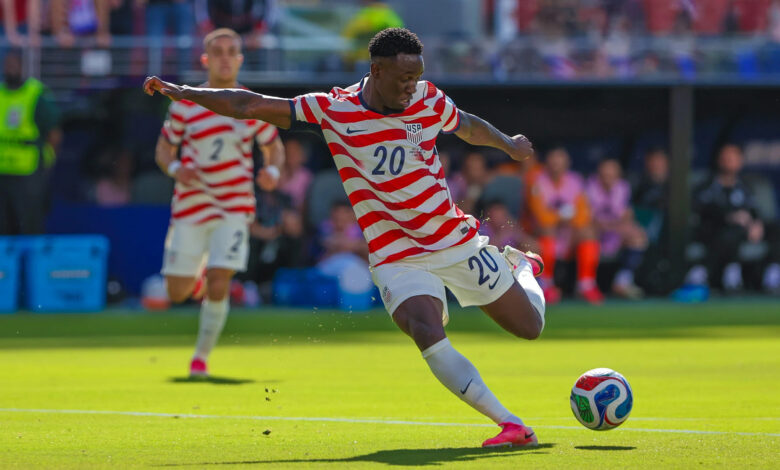
FIFA gave USMNT striker Folarin Balogun, the team’s leading goal scorer at this World Cup, a rare reprieve for the controversial red card he received on July 1 in the team’s 2-0 Round of 32 victory over Bosnia and Herzegovina. By rule, Balogun was to sit out the next match, a Monday night showdown against Belgium in Seattle in the Round of 16.
But on Sunday, FIFA announced it has essentially suspended that suspension, invoking Article 27 of its disciplinary code, which says FIFA’s “judicial body may decide to fully or partially suspend the implementation of a disciplinary measure.”
So Balogun is good to go—a huge boost for the U.S. attack.
“We accept the decision of the Disciplinary Committeeand are pleased that Folarin Balogun is eligible to compete tomorrow,” U.S. Soccer said in a statement. “Our full attention is on the Round of 16 match against Belgium in Seattle, and we look forward to the continued support of our amazing fans.”
“Thank you to FIFA for doing what was right, and reversing a great injustice!” U.S. President Donald Trump wrote in a social media post.
“HOME COOKING IS THE BEST,” Men In Blazers, the popular U.S. soccer podcasting network, wrote in a cheeky Instagram post.
The thing is, Belgium really shouldn’t have a beef here. What Balogun did on the field against Bosnia did not at all scream “eject this guy from this game and make him sit the next.” Red cards, as opposed to yellow cards, are given for the worst on-field behaviors, including spitting, biting, receiving a second yellow card in the same match (Balogun did not have a prior yellow against Bosnia), denying an opposing player an obvious goal-scoring opportunity by committing a handball offense, violent conduct, and what’s known in the laws of the game as “serious foul play,” which is defined as “a tackle or challenge that endangers the safety of an opponent or uses excessive force or brutality” or lunging at an opponent “in challenging for the ball from the front, from the side or from behind using one or both legs, with excessive force or endangers the safety of an opponent.”
Balogun was red-carded, after a video review, for stepping on the ankle of Bosnia’s Tarik Muharemovic while going for a ball. Officials felt the replay showed Balogun was “dangerous in his play,” which makes sense when you look at these sort of high-speed contact plays, frame by frame, in super slow motion. Anything can look bad. But Balogun clearly did not have serious foul play on his mind.
Yellow cards, as opposed to red cards, are issued for, among other things, players who commit any offense “which interferes with or stops a promising attack.”
Maybe stepping on Muharemovic’s ankle rose to a yellow. Maybe not.
Soccer laws leave room for interpretation.
Still, the red made little sense. But FIFA realized it got it wrong and corrected the error. Balogun is under a year-long probationary period: If he commits another similar infraction, the suspension is back and he may receive even further harsh penalties. Article 27 does have precedent. It was used to defer the final two games of Cristiano Ronaldo’s three-match ban following a World Cup-qualifier red card, to make him fully eligible at the start of the World Cup. Nicolás Otamendi, of Argentina, and Ecuadoran midfielder Moisés Caicedo had one-game bans deferred for red cards in qualifiers, which also permitted them to play in World Cup opening matches.
Now Balogun, the offensive juggernaut whose backstory has received its fair share of attention—he plays for the U.S. via birthright citizenship, which the Supreme Court upheld last week—is back in the lineup. That gives the Americans full force against a Belgium side that hasn’t overly impressed at this World Cup.
It’s no exaggeration to call Monday night’s game the most important in U.S. men’s soccer history. Bowing out in the Round of 16, like the American men have done in their past three World Cup appearances, feels like a disappointment given the U.S. has been so dominant in its home World Cup wins, outscoring opponents 8-1. Balogun’s absence gave them a “what-if” in the event of a loss. But that asterisk is no more.
Sleep well in Seattle, Team USA. It’s all on the line Monday night.