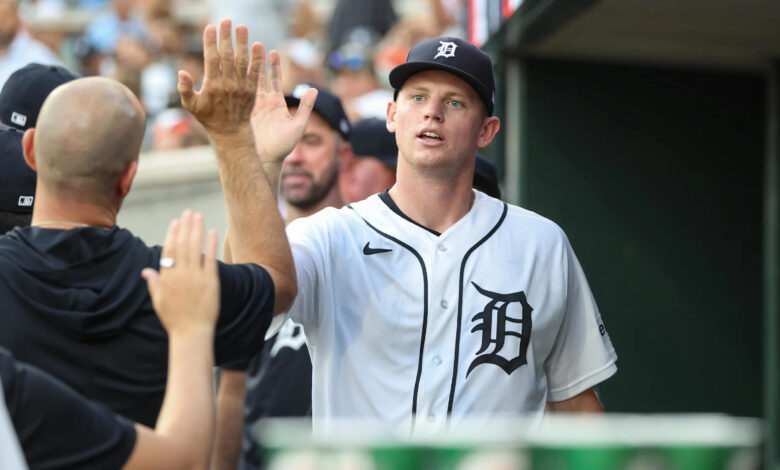

Following the developmental path of Detroit Tigers’ starting pitcher Troy Melton has been a pretty fascinating ride. Watching him improve in 2024, it was pretty clear that he would become a factor in 2025 if he could avoid the plague of pitcher injuries in the Tigers’ system, and so it went. However, during his mixed work as a starter and reliever down the stretch and in the postseason, his ability to handle left-handed hitters was the question determining his long-term future as a starting pitcher. This year, the 25-year-old Melton has found the answer, but it’s not the pitch we were expecting.
Last fall, I wrote about Melton’s splitter being the defining factor in locking down left-handed hitters, and argued that the cutter either had to get a lot better or be ditched entirely. Melton has chosen the first of those paths. He was good overall in his rookie season, and pitched pretty impressively in the postseason as well. Left-handers weren’t a huge problem for him, but they hit him quite a bit better than right-handers, and more specifically, Melton struggled to strike out left-handed hitters.
He managed a meager 14.2 percent K-rate against lefties in 2025. He struck out 26.2 percent of right-handed hitters. That was all fine in a relief role, but to really become a dominant starting pitcher, he was going to have to get a lot more whiffs against left-handed batters in particular. The .191 BABIP he ran against lefties just wasn’t going to hold up, especially as a full-time starter.
The answer, I assumed, lie in his split-finger fastball. Typically the development of a changeup or splitter is the key to limiting damage and getting whiffs against opposite handed hitters. Melton’s fourseam-slider combo wasn’t really going to get it done. Melton has gone another direction, turning his cutter into a monster weapon against hitters on either side of the plate.
In 2025, Melton threw the cutter just 10.8 percent of the time, regardless of which batter’s box the hitter was in. In 2026, that rate is up to 20.1 percent.
Against lefties, he uses the cutter 19.5 percent of the time. He’ll mix in the splitter (12.1%)and curveball (8.1%) sparingly against them, accounting for about 20 percent of his pitches to lefties combined. The slider is used 18.3 percent of the time against lefties, while the majority of the work is still handled by his fourseam fastball, which he throws 40.8 percent of the time.
So he’s still using a pretty deep mix against left-handed hitters, but the cutter is certainly playing a lot bigger role than it did in 2025. It’s also suddenly become a much better pitch in recent weeks. In 2025 he averaged 90.9 mph with it. He’s added a full tick of velo this season, but lately he’s really found the feel with it and is throwing it even harder, even topping 95 mph repeatedly in late June and July. Since June 15, the cutter is averaging 92.5 mph. There are only about 30 pitchers in the major leagues who average 92.5 mph with a cutter, and many of them are relievers.
Melton is getting a 23.9 percent whiff rate, which is nothing special, but hitters have posted a meager .158 wOBA against the pitch. The expected wOBA is just .196, so he isn’t just getting lucky here either.
The effect here is to give him a pitch between his relatively straight fourseamer that has average ride but a good angle to the top of the zone, and the slider he breaks off to back foot left-handers. Hitters have had a really hard time distinguishing between the slider and the cutter, and the result is that his slider went from a 23.1 percent whiff rate in 2025, with a big chunk of that coming as a reliever, to a 31.3 percent whiff rate in 2026.
I mean, deal with this thing after seeing the heater and knowing the wipeout slider is lurking.
Melton now has three pitches that he can work with to his gloveside, tying up left-handed hitters. They are doing nothing against him, hitting just .157. The one fly in the ointment is that when lefties do connect on his fourseam fastball, they’re crushing it, but the rise of the cutter-slider combo means they’re getting less fastballs, and a lot less obvious fastballs, no matter the count. Overall they’re striking out a lot more, and putting the ball in play weakly for the most part.
Right-handed hitters are doing even worse, and the cutter is a big part of that too as hitters have to look for two different hard breaking balls. The cutter looks like the fourseamer and breaks away late. Once they’ve seen that, there is less certainty for hitters when they see the slider come out of his hand. It could be the cutter, or it could be the slider, and they have to swing just as the latter disappears down and away for whiffs. The slider’s performance continues to improve as the cutter becomes more effective. Melton really has them on the horns of a dilemma trying to discern between the two breaking balls while knowing they could get 97-98 mph at the top of the zone with big-time extension helping it play up.
This is rapidly becoming a really deep mix of pitches for Troy Melton, and while his ERA looked unsustainable early on after his return to the rotation in late May, the stuff and underlying performance is rapidly catching up to the results, making the whole package look far more sustainable. We can still hope Melton gets more comfortable and consistent with the splitter, because it gives him another pitch beyond the fourseamer, curveball, and the occasional curveball that he can use armside, generating even more whiffs from lefties.
Overall, Melton still needed to punch out more hitters to turn himself into a top shelf, frontline starter that can lead a rotation. But with the amped up cutter, he’s now well on his way. He barely struck anyone out as he returned to the rotation in May, but he managed contact, didn’t walk hitters, and was somewhat fortunate. In June, his overall strikeout rate was just 22.1 percent but he was still limiting the traffic on the bases and occasionally giving up homers, but never a rally. In July, since he added more velo to the cutter? His strikeout rate through two starts in July in now 36.4 percent. You have to love the trendline there.