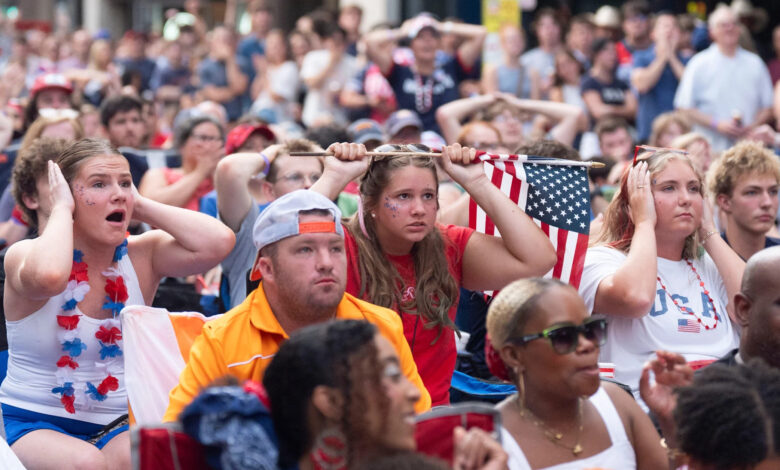

The United States men’s national team is out of its own World Cup, and the manner of the exit — a 4-1 blowout to a Belgium side that started Jérémy Doku and Kevin De Bruyne on the bench — has reopened the same question that follows every American World Cup cycle. Is any of this going to stick?
Charles De Ketelaere scored twice in the first half in Seattle on Monday and set up a third. Romelu Lukaku added a fourth late. It was the USMNT’s fourth Round of 16 exit in the last five World Cups it has actually qualified for, and it happened on home soil, with the suspended red card of striker Folarin Balogun barely making it back in time to matter.
“It feels exactly the same,” Tyler Adams said, adding that the tournament had its positives but that ultimately “it just doesn’t feel like it matters.”
Christian Pulisic became the face of that frustration by Monday night. He was pulled midway through the second half with an ankle injury, closing out a tournament in which he’d already missed one match and left two others early. FS1’s Nick Wright wasn’t interested in the injury excuse, calling it “unacceptable” for the team’s most talented player to disappear in the biggest game of his career, whatever else went wrong around him. Pulisic himself brushed the exit off as a sprained ankle in his post-match interview with Fox’s Jenny Taft, saying only that he now had time to rest before adding, more broadly, that the U.S. still has “that next step to climb” against the best teams in the world.
That’s the soccer conversation. The more interesting one, at least for anyone who covers sports media, is what happens to the audience now that the team everyone was watching is gone.
By the numbers, there’s plenty to suggest this cycle was different. Monday’s game itself drew a preliminary 30 million viewers on Fox, topping the 26.4 million the team pulled against Bosnia and Herzegovina five days earlier and peaking near 37 million late in the match, the most-watched soccer telecast in U.S. history in any language. Telemundo added another 12 million on the Spanish-language side.
That growth is real, and it isn’t going anywhere just because the U.S. lost a knockout-round game. The harder question is what it’s actually growing in. CNBC’s Alex Sherman named the distinction on social media Monday night, describing a “bifurcation” between the USMNT’s results, where the U.S. remains well behind the world’s best, and the country’s underlying soccer fandom, which he said is clearly rising regardless of what the national team does.
There’s a bifurcation at play here. US clearly still well behind as a soccer country in terms of generating talent. But soccer fandom clearly on the rise here. That’s a good sign for the future. https://t.co/LVcc5bsZFU
— Alex Sherman (@sherman4949) July 7, 2026
Nielsen’s most recent fandom research puts the U.S. soccer fanbase at 62.5 million people, the fourth-largest in the world, up nearly 11% over five years. YouGov has tracked the share of Americans who call themselves regular soccer followers climbing from 8% in late 2022 to 12% now, with the growth almost entirely driven by 18-to-34-year-olds, whose engagement roughly doubled over the same stretch.
But the problem is that “underlying appetite for the sport” and “underlying appetite for this team” aren’t the same audience, and the gap between them is exactly where the domestic product lives.
The host country effect on domestic soccer has a well-documented shelf life, and the United States is not starting from the same place as France, Brazil, or Germany. Research from Statathlon tracking domestic league attendance before and after host years found that countries with an established footballing identity tend to hold onto the gains. Countries without one usually don’t. South Africa’s top flight was drawing about 40% fewer fans six years after 2010 than it was the year before. South Korea’s K-League fell from an average of 14,651 fans in 2009 to 10,214 by 2016, a decline researchers attributed to the national team’s fading results and, just as much, to the country’s best players signing with clubs in Japan and Europe rather than staying home.
That second part is the uncomfortable comparison for the U.S. Of the 11 players in the USMNT’s starting lineup against Belgium, eight play their club soccer in Europe: Pulisic at Milan, Adams at Bournemouth, Weston McKennie at Juventus, Antonee Robinson at Fulham, Chris Richards at Crystal Palace, Malik Tillman at Bayer Leverkusen, Folarin Balogun at Monaco, and Sergiño Dest at PSV Eindhoven. Only three players, goalkeeper Matt Freese, right back Alex Freeman, and captain Tim Ream, currently play in MLS.
The generation of American players good enough to justify all this new attention has mostly opted into the same European leagues that L.E.K. Consulting already finds avid U.S. fans prefer, by better than two to one, over the domestic product.
If the problem is that America’s best players leave and many of its most engaged fans follow them, MLS’s solution has been to make itself look more like the leagues it competes against. Back in November, the league announced it’s moving to a summer-to-spring calendar starting in 2027, kicking off in July, taking a break in December and January, and crowning a champion in May instead of December. The MLS Cup currently has to compete with the NFL and college football for attention every fall, and a May title game would place the league’s biggest game ahead of the NBA and NHL playoffs rather than buried under them.
But the calendar change isn’t just about when the trophy gets handed out. MLS’s current calendar runs straight through FIFA’s international windows, pulling players away from their clubs mid-season and putting the league out of step with the transfer windows used by the rest of the world to buy and sell talent. Aligning the calendar is supposed to fix both, giving MLS a legitimate avenue to retain the players who have long viewed Europe as the only viable path to competing at the highest level.
None of that changes what happened Monday, and none of it can be judged until 2027 at the earliest. The U.S. didn’t lose millions of soccer fans against Belgium. If anything, this tournament proved the opposite. The audience is here. The question is where that audience goes next.
That’s the challenge MLS is trying to solve with its calendar shift. If the league can better align itself with the global game, retain more talent, and become a more compelling domestic product, the World Cup bump could become something lasting. If not, this tournament may ultimately be remembered as another reminder that America can draw massive crowds for soccer without turning those viewers into regular fans of the league in its own backyard.
The post What’s next for soccer fandom in the United States? appeared first on Awful Announcing.