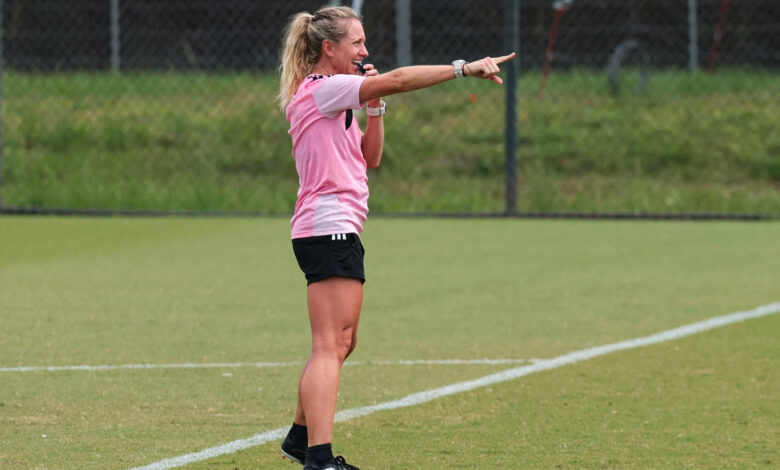
It’s not often soccer match officials continue to have an impact after a game ends.
That’s exactly what Tori Penso, Brooke Mayo and Kathryn Nesbitt will do, however. The trio assigned to the South Africa-Czechia match on Thursday, June 18, are only the second all-female crew to officiate a match at the men’s World Cup, and the first to all be from the United States.
“It’s been my life’s mission to prove that women can do anything,” said Kari Seitz, who before she became the senior vice president of refereeing for U.S. Soccer was FIFA’s head of refereeing.
“You’re showing the world what’s possible.”
Only second men’s World Cup with female referees
It was only four years ago that women referees worked games at the men’s World Cup for the first time. There were six female officials at the tournament in Qatar, three referees and three assistants.
Stephanie Frappart of France was the first woman to referee a men’s World Cup match, the Poland-Mexico game during the group stage. Frappart later led the first all-women officiating crew at the men’s World Cup, assisted by Neuza Back of Brazil and Karen Diaz of Mexico for Germany-Costa Rica in the group stage.
This year’s tournament also has six women referees, though Nesbitt is the only holdover from Qatar.
“Truthfully, we should have more women at this World Cup than we do,” Seitz said. “So we’ve got to keep fighting.”
Seitz, who began refereeing when she was 14, has been one of the most influential officials in the game. She worked her first World Cup game at the 1999 women’s tournament in the United States, and went on to officiate nine matches at the World Cup and six at the Olympics.
She is still the only referee, male or female, to work four World Cups.
Creating opportunities for women referees
Seitz never realized her dream of officiating at a men’s World Cup. So when she went to work for FIFA, she was determined to make sure other women would.
“I felt it was my obligation when I moved to FIFA. That was truly my mission, to ensure that women had that opportunity,” said Seitz, who was inducted into the National Soccer Hall of Fame last month. “My job is to open the door, and for them to run through it.”
By the time Seitz left FIFA, women were officiating at every major men’s competition, including the World Cup.

Despite that progress, the number of women referees remains stubbornly low. Even, or especially, in the United States. While women make up about 30% of the referees in each country, in the United States it’s only around 22%.
“We see the women’s numbers growing. We’re seeing the number of women referees growing. We’re seeing the number of people who want to upgrade growing. But not at a large enough percent,” Seitz said. “We’ve got to find the secret to break through that.”
Extra hurdles for female referees
Part of the reason is that refereeing, at any level, is a hard job. There’s the physical aspect of it, running up and down the field for the entire game. Then there are the overzealous parents, multi-millionaire professionals and know-it-all fans who criticize, scream at and harass officials. It takes a special person to be able to put up with that.
But there is an underlying sexism, too.
“We have to evolve people’s way of thinking,” Seitz said. “Some of it is … how (people) think about women and what we’re capable of doing. With pressure and quality, at some point in the future, people won’t care. They’ll just care about the quality of the work on the field.”
U.S. Soccer has a program, the Women’s Initiative, designed both to increase the number of female referees and retain them. The federation wants to build the ranks at all levels but is particularly interested in getting more girls and young women to be referees.
“It’s a great opportunity for women to develop themselves,” Seitz said. “I know I became a better leader through refereeing.”
A lasting legacy
The best way to get more women into officiating, however, is through representation. As with everything with women in sports, you have to see it in order to believe you can be it. When Penso, Mayo and Nesbitt walk onto the field before the match, it will send a powerful message to everyone who sees them.
That, Seitz hopes, will encourage girls and young women to want to be like Penso, Mayo and Nesbitt.
“In the future, we won’t be celebrating this,” Seitz said. “It will be normal.”
What a wonderful legacy of this World Cup that could be.
This article originally appeared on USA TODAY: All-woman World Cup officiating crew could inspire future female refs