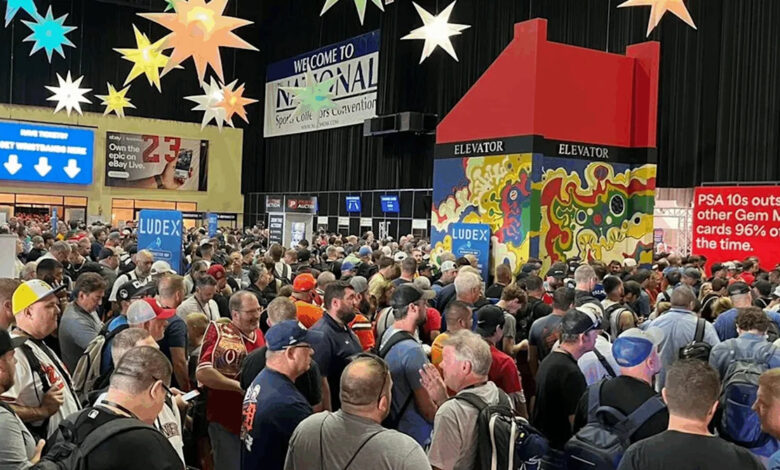

Chicago native Brian Ludden was among the millions of sports fans worldwide that started, or re-started, collecting during the COVID lockdowns of 2020. However, unlike those that stuck to scouring their parents’ basement for their old stash or made mad dashes to Target to scoop up packs, Ludden began building. A year later, Ludex made its debut.
In the five years since, Ludex has become an essential part of the hobby, helping everyday enthusiasts and professional pack-rippers alike not only determine what they’ve got in front of them, but how much it’s worth, too. According to Ludden, the app now sees roughly 12 million card scans per month, a testament to how vital the cataloging of cards has become in the age of never-ending parallels.
With The National Sports Collectors Convention set to take place in Ludex’s backyard next week, Mantel sat down with its Founder and CEO to talk about his personal collection, how tech has transformed the hobby, Ludex’s role within the NSCC, and more.

By now, most folks within the Hobby are very aware of the platform you’ve created, but I want to track back to the genesis of it all: using sports cards as a way to bond with your son. What do you two collect together? What do you collect that he doesn’t?
It was interesting, because when we started, I was a derivatives trader in the financial markets. I had a company I started in 1999, and it got acquired in 2018. We traded S&P 500 derivatives, and then I had to work for the people who bought the company. I was a terrible employee.
During COVID, my son and I were looking at cards. I hadn’t collected cards since I was in the ’90s, and then parallels come along and I’m like, “What the f*** is this?” I started googling, thinking there’s got to be a better way, and there wasn’t. In my career, I was ready to leave trading, and then this happened, and I just decided I was going to take it on.
[Ludex] had a lot of card shows pretty quickly after we started. I’d give my son $20, and there were 110 tables, and I knew most of the people in there. He’d turn $20 into $25, $25 into $30, and so on. He collects more of the modern stuff, and I collect vintage: Kobe, Jordan, that kind of thing. Then last year he started selling some of his modern stuff and buying Jordans, so now we have that in common. It’s like the growth stocks are the new stuff, and the bonds and annuities are the older stuff, but Jordans have gone up so much that now we collect very similar things.
I love the industry, too. I love the fact that it can teach your kid at a young age to go up and communicate with adults, learn, do their homework, make sure they understand what they’re buying and selling, and then how to handle money. In that room is such a beautiful life lesson, because you can make some mistakes. He came back a couple times crying because he didn’t know enough information on his stuff. But I love watching this industry, because age doesn’t matter.
As a collector yourself, you’re intimately aware of the changes taking place in the Hobby. What trends are you noticing, and how is Ludex, a 2025 Hobby Awards “Innovation of the Year” nominee, capitalizing on them?
I think the biggest change I’ve seen in the last year is the repackers. I think they’re instrumental in why prices are higher, and why they’re going to stay higher. There are people who’ll have a million dollars in their backpack to buy as many graded cards as possible from PSA and then resell them through repacking. That’s going to keep the prices of the industry up.
The other thing I’m seeing is a lot of multinational, big companies coming in. Dick’s, Walmart is making a big play, I’ve heard Best Buy is getting into it, and then GameStop, which we know what they were doing. All these companies are hearing about this industry growing, and once you get big companies in, they just keep the industry growing and growing. So on the corporate level, I’ve seen some really big companies come in, which is good for everybody.
On the more unique or niche side, I think the repackers are shaping this for now. I don’t know what’s going to happen legally, whether there’s a class-action lawsuit or it gets treated like gambling, but they’ve definitely changed the industry.
The National is coming up soon, and that’s got to be like Christmas for you guys. Roughly how many cards are scanned each year at the show?
Every month we get about 12 million scans, that’s 3 million a week. During the National, we’ll double that to 6 million in a week, so we’re getting about 800,000 scans a day. That’s what we see for the National, a little bit before it, during it, and about a week after, and then it goes back down. We get that uptick because of the map. (Desktop version here).
You download Ludex, and it shows all the booths. You can search for anyone, add any table, put in your own notes, star tables, and the people at the booths can put up what they have at their table. The interactive map is a big reason we get that spike, and it’s always tech at some level for us. We like to migrate tech into the social platform, and that hits our bottom line.
How do you guys create the map?
This is year four of this iteration. There’s design, obviously, which is important, and then the back end, so it’s fast—but really it’s about the information the National trusts us with. We map it out; it’s really a matrix, a grid system, and we design it around that.
It’s great that it’s been in Chicago for three years, but when we have to change it—like in two years, to Detroit—that’ll be a big lift. There are little nuances that change, and everyone changes where they’re at.
Touching on the hometown aspect of it, what does The National being in Chicago mean for you and your brand?
I just think it’s such a great opportunity for Ludex and the brand, in Chicago. I play up Chicago a little bit because I’m born and raised. I went to NIU, played baseball, and I love it here. Being able to do what we’re doing for the National in our own hometown is an honor, and we’re really blessed to be a part of it.
I saw Ludex’s recent blog post on tips for folks attending the National. What personal tips do you have for surviving the show?
I’ll toot my own horn a little, but the interactive map is huge. There’ll be QR codes everywhere—you scan it, download Ludex, and hit the map. It’s super important, especially your first time, because you can plan out your trip and get the lay of the land ahead of time. It’s a couple of days, so you don’t have to see everything on day one.
Also, if you need an Uber, order it early, because you’ll wait a long time.
Everyone creates their own journey inside the National, but don’t miss trade night. The energy is amazing. My favorite thing, though, is after trade night, after 11pm, you go to the hotel across the street and there’s 500 to 1,000 people sitting on the ground trading more until 3 in the morning. It’s an insane ecosystem of fandom and passion. You see the show, then trade night, then the hotels. It’s an awesome experience to see it all.

I’m sure you get a lot of feedback after big events like this, where so many folks rely on your product to buy, sell, and trade cards. What are some of the most frequently requested features you hear about from users?
Different verticals. People will ask for comics—we’re adding comics by Q4—albums, whatever. Our technology is agnostic; it doesn’t know that’s an album, it just sees a card. So training the verticals is something people ask for a lot. We just added One Piece, we’re adding Yu-Gi-Oh, and then we’ll do comic books, coins, stamps, stuff like that.
The other big ask is an inventory management system, a real collection management tool. That’s coming out at the National. It’s sortable, and you’ll be able to list straight to eBay from there, submit to our graders, and filter. Say I want to see all my Michael Jordan cards priced over a thousand bucks, and I can share that list with someone directly.
On that note, how do you see current trends in technology, specifically AI, changing the card space?
It’s changing it. It’s insane how fast it’s changing tech. I thought we had a tech moat, and we did, until we didn’t. Now there are 60 scanning apps out there, so it’s degrading technology. But what I believe in, and what I put my team in, the mindset we’re in—I say we have four pillars that are going to separate us and make us survive: relationships, partnerships (the Texas Rangers invested in us, and we’re leveraging those partnerships), first-party data, because that’s unique to us, and brand. An LLM can’t compete with those four things.
The issue they’re going to run into is dilution, and it’s also very expensive to scale on LLM models. Our whole back end is proprietary, built by us; it would cost us too much money if we had to make 12 million calls a month just to get pricing. It’s changed incredibly fast, but the companies that survive will have to adapt; dinosaurs die, and adaptation is the success. We’re building all these other things that are going to separate us in the long term.
You’ve spent the past five years trying to revolutionize collecting. What do you see over the next five years?
Just keep building out the product and listening to our collectors and our users; they have the answers for us, and companies that keep their ears open, that’s the most important thing. Someone out there in our ecosystem [has the answers], and people love to share what they think Ludex should do next.
On our app, we have a feedback and idea page—a feature request page—where people post ideas and others upvote them, and it changes what we build. We always keep a certain part of the company limber enough to add what people want. We’re going to keep building the brand, building relationships, and growing this industry, doing the best we can for it. The next five years will be fun.