
On Wednesday, Brazil faces Scotland in Miami at the 2026 World Cup.
But Brazilian football had already forged a connection with Scotland more than 130 years before this match.
That link is Charles Miller, who is known as the “father of Brazilian football”.
When Miller arrived in Brazil in 1894 with two footballs and a set of rules, he became a key part of the nation’s rich history with the sport.
An early education in football
Charles’s father, John Miller, was born in 1844 in the small village of Fairlie, on Scotland’s west coast, one of 10 children of Andrew Miller and Elizabeth Brown.
As a young man, he emigrated to Brazil to work for the São Paulo Railway Company. In 1870, he married Carlota Fox, a Brazilian woman of English descent. Four years later, in 1874, Charles William Miller was born in São Paulo.
At the age of 10, he was sent to England to study at Banister Court School in Southampton — a common choice among British families living overseas at the time. It was there that he discovered football, then little more than an English school pastime, and quickly excelled. He even played for St Mary’s FC, the club that would later become Southampton FC.
It was also in Southampton that Miller crossed paths with Corinthian Football Club, an amateur side from London famous for its international tours. In 1892, Corinthian travelled to Southampton to play a Hampshire representative team but arrived with only 10 players. A teacher suggested that they recruit a promising pupil to make up the numbers — and Miller, playing on the left wing, became the star of the match.
According to the story still told by Corinthian today, the club was so impressed that, upon learning it would be Miller’s last match in England before returning to Brazil, they presented him with two footballs as a farewell gift.
This specific account, however, does not appear in the most rigorous biographies of Miller, which merely state that he brought footballs back with him, without attributing them to the English club.
Return to Brazil and the birth of the first football clubs
In 1894, at around the age of 20, Miller returned to São Paulo. In his luggage were the two footballs and a copy of the official rules of the Hampshire Football Association.
Legend has it — a story repeated in almost every account of his return, although without primary documentary evidence — that his father, upon seeing him disembark at the port of Santos, asked what he had brought with him.
“My diploma,” Charles is said to have replied. “Your son has graduated in football.”
The sport was virtually unknown in Brazil at the time. The few enthusiasts were mainly fellow British expatriates working on the railways.
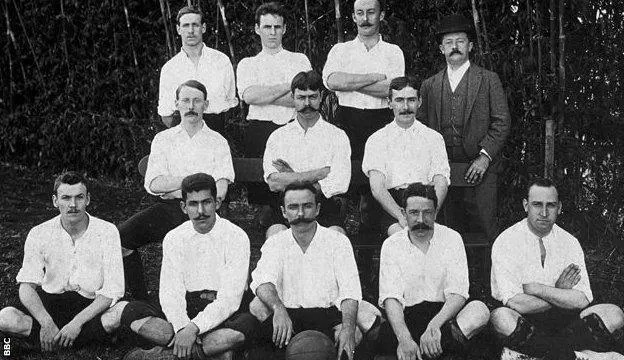
Against this backdrop, Miller organised what is regarded as Brazil’s first official football match on 14 April 1895: a team from São Paulo Railway, the British company where he worked, against the São Paulo Gas Company team, also made up of British expatriates.
The match took place at Várzea do Carmo, on an improvised pitch in the Brás district of São Paulo. Decades later, in an interview with Gazeta Esportiva, Miller recalled that his first task that day had been to chase away cattle belonging to a transport company that were peacefully grazing on the field.
His team won 4-2, with Miller scoring two of the goals.
Around the same time, Miller established a football department within the São Paulo Athletic Club (SPAC), a sports club founded in 1888 that had previously focused on other sports. It became the institutional foundation from which football developed in the city.
Six years later, on 14 December 1901, Miller helped found the Liga Paulista de Football, Brazil’s first organised football league. Five clubs took part in its creation: SPAC, Internacional, Mackenzie, Germânia and Paulistano.
Miller remained actively involved with SPAC in the following years, even playing as a goalkeeper from 1906 onwards.
In 1910, 18 years after that match in Hampshire, Miller arranged for Corinthian Football Club to tour Brazil. The English side played six matches and won them all, with an aggregate score of 38-6 — including an 8-2 victory over Miller’s São Paulo side, in a match in which he played.
Five railway workers who attended the game were so impressed by Corinthian’s style that they decided to found a club of their own. It was Miller who suggested naming it after the English team — giving birth to Sport Club Corinthians Paulista, today one of Brazil’s biggest football clubs.
Miller also represented the São Paulo state team and played unofficial matches for Brazil against Argentina in 1914. As a referee and administrator, he remained involved in São Paulo football until his fifties.
When professionalism arrived in Brazilian football in 1933, Miller — faithful to an amateur ideal of sport, closer to the ethos of England’s Corinthian FC than to financial interests — withdrew from football altogether, disappointed by the direction the game had taken.
In his personal life, he married the pianist Antonietta Rudge, with whom he had two children, Carlos and Helena. He died in São Paulo on 30 June 1953, aged 78, and is buried at the city’s Protestant cemetery.
His name also left a mark on football’s vocabulary itself: the skill of flicking the ball up with the heel is still known in Brazil as a “chaleira”, a word derived from “Charles”. Praça Charles Miller, the square in front of São Paulo’s Pacaembu Stadium, is also named in his honour.
Another Scot, another story

Charles Miller is not, however, the only Scottish name associated with the origins of Brazilian football. In the Bangu district of Rio de Janeiro, another version of the story has long existed — and it is Scottish too.
Thomas Donohoe, a factory worker born in 1863 in Busby, near Glasgow, travelled to Brazil to work as a dyer at a textile factory in Bangu, arriving in May 1894 — theoretically several months before Miller returned to São Paulo.
Unable to find anyone in the area who knew the sport, he wrote to his wife, Elizabeth, who was still in Scotland, asking her to join him — and to bring a football.
Shortly after her arrival, in September 1894, a football match between British workers took place on a field next to the factory: eight months before the match organised by Miller in São Paulo.
Miller’s supporters do not dispute these facts but argue that there is a distinction between an informal game among friends and the creation of a club, a league and an official championship — achievements attributed to Miller.
The debate has never truly been settled. Today, both Bangu and Busby, Donohoe’s hometown in Scotland, have statues honouring him.
Brazil and Scotland’s World Cup history
More than a century after two Scots helped, each in his own way, shape Brazilian football, Brazil and Scotland meet again this Wednesday in Miami — this time at a World Cup, rather than on the improvised pitches of São Paulo or Bangu.
The two sides have met four times previously at World Cups, and Brazil have never lost.
Their first encounter came in 1974 in West Germany and ended in a goalless draw, with Scotland holding the then four-time world champions.
In Spain in 1982, Scotland took the lead, but Brazil — featuring Zico, Sócrates, Éder and Falcão — came from behind to win 4-1.
At Italia ’90, Brazil won 1-0.
And in France in 1998, Brazil beat Scotland 2-1 in the opening match of the tournament — the last time, until this week, that the two nations met at a World Cup.