
|
Nate Edwards, BYU Photo
An ailing superstar, Jane Hedengren, struggled to match her record-breaking indoor national championship freshman season. Still, two BYU teammates, steeplechaser Taylor Lovell and decathlete Ben Barton, rose to the call.
I like this story. Two hardworking seniors with careers of grinding, hoping and dreaming win. A freshman sensation who has won a national title and set records learned that there will be other days, another time. She can see and follow how these seniors left BYU.
One could call it BYU’s golden hour in Eugene: two seniors, two titles, one lasting legacy.
In Eugene, Oregon, where so many dreams have either soared or been shattered, two BYU seniors refused to let their stories end quietly.
At the 2026 NCAA Outdoor Track and Field Championships, Lovell and Barton turned years of near misses, quiet grind and relentless belief into pure championship gold.
This wasn’t just another meet. This was redemption splashing through water barriers and a decathlon crown seized by the narrowest of margins after a 10-event war of attrition.
Two Cougars. Two dramatically different paths. One unforgettable chapter in BYU track lore.
The steeplechase Cinderella
From ninth place to Queen of the Water Jump, Lovell had tasted the bitterness of the big stage before. Ninth in 2024. Ninth again in 2025.
The Gilbert, Arizona, senior carried those heartbreaks like extra weight on every water jump — until she finally shed them all in spectacular fashion.
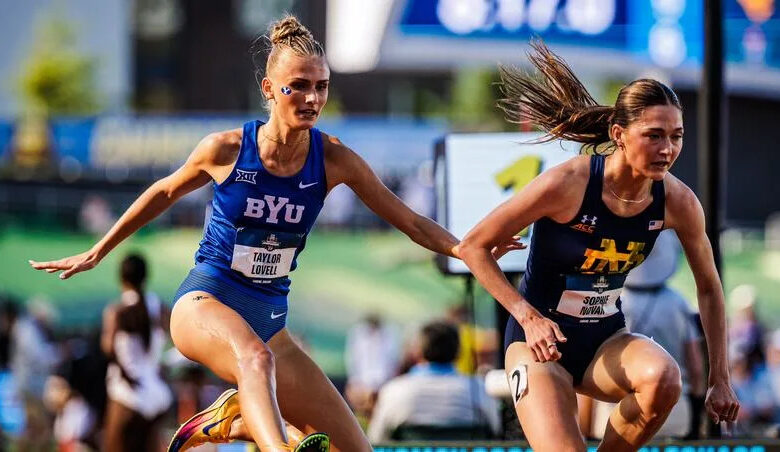
On the final day of the championships, Lovell exploded into the lead late in the women’s 3,000-meter steeplechase and refused to be caught. She crossed the line in a stunning personal best of 9:21.03, arms outstretched, the weight of past disappointment gone.
It was more than fast. It was transformative. Just weeks earlier she had run 9:26.99 at the Bryan Clay Invitational (third-fastest in BYU history) and earlier claimed the Big 12 title in 9:40.98.

|
Nate Edwards
In the prelims, she cruised to a 9:38.36 victory. But in the final? She became something different. A champion. This victory wasn’t born in isolation. It came straight from the well of BYU’s legendary “Steeple U” tradition — home to water-jump wizards like Kenneth Rooks, James Corrigan and a proud line of national champions before them.
Lovell didn’t just win an event; she extended a dynasty. Afterward, still catching her breath and processing the moment, she spoke with the honesty of someone who had waited her turn.
“I didn’t fully appreciate it until later.”
The decathlon thriller
Nine points, 40 years, and a final-lap masterstroke took Barton to a place BYU track and field hadn’t been in nearly half a century. His victory in the decathlon was that intense, that good.
The decathlon is a grueling test of human strength, agility, endurance and speed. BYU hadn’t had a winner since Tito Steiner, not until Barton gutted it out in the final event, placing two seconds ahead of where he needed to be to win the title in the final event.
I remember covering Steiner’s career at BYU. He and I are the same age. He was a machine. I was a watcher of machines.

|
Nate Edwards
Steiner remains one of the most accomplished multievent athletes in BYU and Argentine track and field history. The Paraguayan-born, Argentine-raised decathlete dominated the collegiate scene in the late 1970s and early 1980s, while representing the Cougars. He was a three-time NCAA champion in an era when the decathlon demanded exceptional versatility across 10 events.
To understand what Barton did, you have to understand what Steiner did and why it has been so difficult for another Cougar star to match Steiner.
Steiner’s 1981 performance in Baton Rouge, Louisiana, was particularly historic. It set a new collegiate and meet record (surpassing the previous 8,079 by former Cougar Raimo Pihl), though it was wind-aided in some events. Under modern adjusted scoring tables, it converts even higher (around 8,304). This victory marked him as the first three-time NCAA decathlon champion in that stretch.
BYU All-Time Decathlon Rankings as of this past week:
- Tito Steiner — 8,279 (1981)
- Ben Barton — 8,169 (2026)
- Raimo Pihl — 8,079 (1975)
Steiner’s marks held as the program record for over four decades until Barton’s close challenge in 2026.
Steiner’s absolute personal best came later: 8,291 points on June 23, 1983, in Provo. This remains the Argentine national record to this day. Note that the 1983 mark was hand-timed, which modern standards view as less precise than fully automatic timing, but it still stands as a landmark for Argentine athletics.
In Eugene this past week, decathlete Barton waged a different kind of battle than Lovell — one measured in points and sheer willpower across 10 grueling events.
Barton built a commanding 138-point cushion on Day 1 with explosive efforts in the 100 meters (10.65), high jump (6-11.75) and 400 meters (47.25). But decathlons are cruel by design.
On Day 2, he kept clawing but by the time the final event — the 1,500 meters — arrived, Barton trailed Louisville’s Kenneth Byrd and needed to do something heroic.
He delivered.
Barton unleashed a personal-best 4:32.61, storming home roughly eight seconds faster than his rival when he needed about seven. When the final tally hit the scoreboard, the numbers told an epic story: 8,169 points to 8,160. Nine measly points.
Think about what that meant.
BYU had not claimed an NCAA decathlon title in more than four decades — not since the great Steiner dominated the event in 1977, 1979 and 1981.
Barton’s total now sits as the second-highest in program history, trailing only Steiner himself.
After the final points were posted, Barton gave a champion’s answer: “Coach (Tiffany) Hogan put me in a really good spot … I made a few mistakes, but was able to make up for it and ultimately win it.”
More than medals
This is a time of roster turnover and instant transfers, but Lovell and Barton represent something rarer: athletes who stayed, grew and peaked exactly when their program needed them most.
Lovell’s breakthrough reaffirmed BYU’s unmatched mastery of the steeplechase; Barton’s razor-thin triumph proved that the Cougars can still produce complete, battle-tested decathletes capable of thriving in the ultimate test of versatility.
Hedengren will be back. She will heal up and be involved in many national races and win her share.
But for the moment, for this weekend, Lovell and Barton finished BYU’s 2026 track and field story.

|
Nate Edwards, BYU Photo