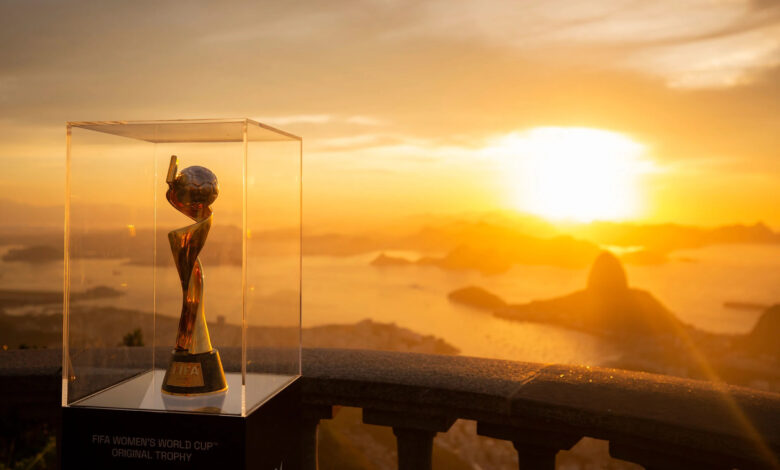

For the first time, Brazil will host a FIFA Women’s World Cup; and there is exactly 1 year to go until kickoff. The tournament will begin on June 24, 2026, and the final is scheduled for July 25. After hosting two men’s World Cups, in 1950 and 2014, Brazilians will now welcome the biggest women’s football event in the world.
The competition has been growing exponentially. The 2023 edition, held in Australia and New Zealand, made history by setting records for attendance, global viewership, digital engagement, and commercial interest, cementing women’s football as one of the fastest-evolving sports in the world.
The tournament’s success demonstrated the strength and potential of the competition, expanding its relevance on and off the pitch. Now, with one year to go until the Women’s World Cup in Brazil, the country is preparing to host the event with the opportunity to elevate that legacy even further.
CBF president Samir Xaud emphasized that the event will be historic and will have a major impact in Brazil.
“There is only one year left until the moment that will be etched in our country’s history. For the CBF and for all Brazilians, it is a source of great pride to host the Women’s World Cup. It will be an opportunity to show the world our passion for football and, above all, the strength of Brazilian women’s football. We are certain that this will be a transformative World Cup, capable of inspiring girls in every region of Brazil and leaving a lasting legacy,” he said.
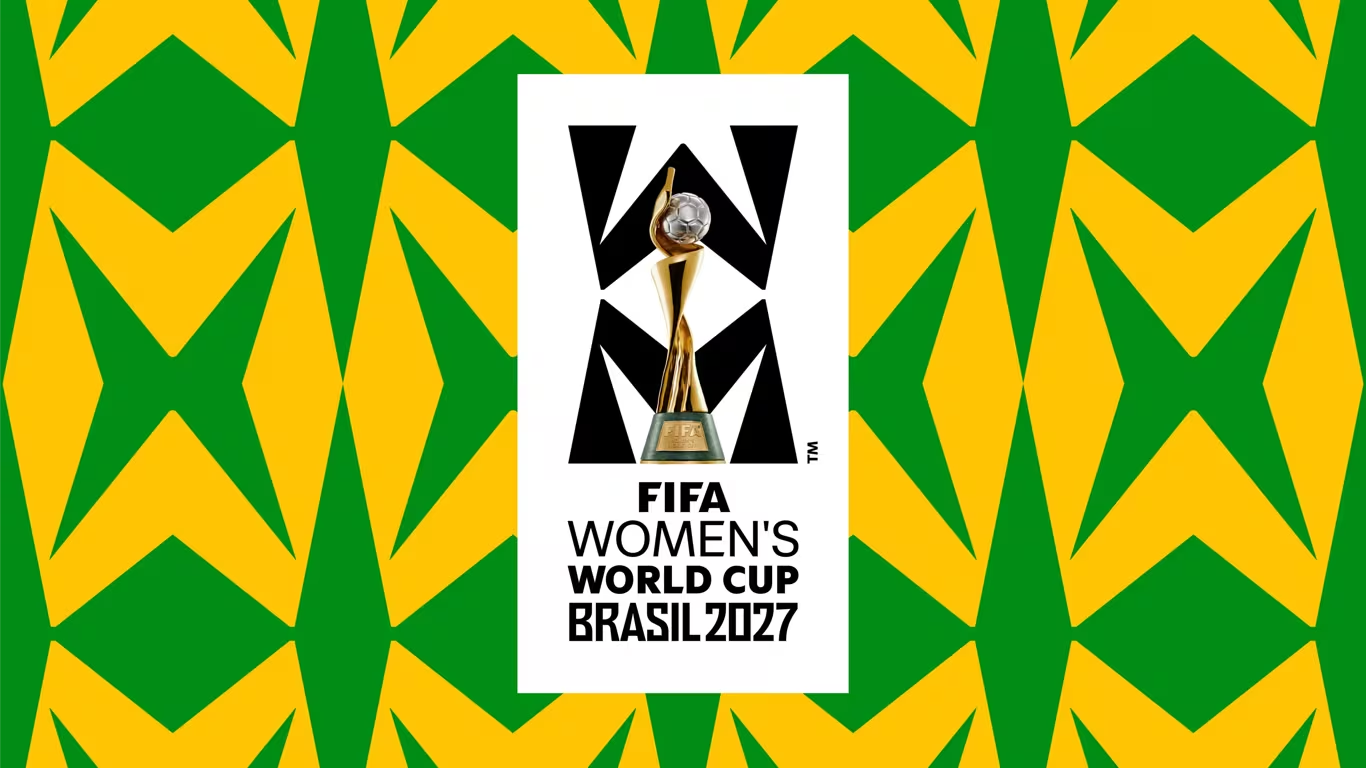
FIFA Women’s World Cup 2027 logoCredits: FIFA
CBF vice president, president of the Paraíba Football Federation, and member of FIFA’s Women’s Club Competitions Committee, Michelle Ramalho, stressed that the CBF and the whole country have already started preparations.
“The work we are doing now will be essential to delivering a successful competition. We are building something that will inspire future generations of girls and women in football,” she said.
CBF competitions manager and executive director of Legacy and Institutional Relations for the 2027 Women’s World Cup, Aline Pellegrino, shared her expectations about welcoming the event to Brazil.
“I believe this World Cup will leave a real legacy of cultural and social change. Ever since I played for the national team, I spoke of this dream of seeing women’s football take root in Brazil. I think we are on the right path,” she said.
According to the former center back and captain of the Brazilian National Team, who was a World Cup runner-up with Brazil in 2007 and a silver medalist at the 200 Olympics, Brazilians are passionate about football and experiencing a World Cup in Brazil is always special. “I believe football has this power to create change, to transform. There is one year left until the World Cup, and we still have a lot to do to leave solid foundations that will allow more girls to have access to football,” she added.
BRAZIL AS HOST
It was on May 17, 2024, that Brazilians learned they would host the Women’s World Cup at home. The host of the competition was decided in an open vote at the FIFA Congress in Bangkok, Thailand. Brazil competed against the joint bid from Germany, Belgium, and the Netherlands, and received 119 votes, while the Europeans got 78.
__instagram:https://www.instagram.com/p/C7DvffEO9v-/__
HOST CITIES AND STADIUMS
The eight host cities are: Belo Horizonte, Brasília, Fortaleza, Porto Alegre, Recife, Rio de Janeiro, Salvador, and São Paulo, all of which already have experience from being part of the organization of the 2014 FIFA World Cup.
Mineirão, Arena BRB Mané Garrincha, Arena Castelão, Beira-Rio, Arena Pernambuco, Maracanã, Arena Fonte Nova, and Neo Química Arena will be the stadiums hosting matches in the tournament.
QUALIFIED TEAMS
Just like the 2023 tournament in Australia and New Zealand, the 2027 Women’s World Cup will feature 32 national teams. So far, 14 have already qualified: Brazil, Australia, the Philippines, Japan, North Korea, China, South Korea, Argentina, Colombia, New Zealand, Germany, France, Spain, and Denmark.
__instagram:https://www.instagram.com/fifawomensworldcup/p/DZY39vDDGVK/__
THE FIFA WOMEN’S WORLD CUPS
In the nine editions of the FIFA Women’s World Cup, only five teams have lifted the trophy. They are: the United States (4), Germany (2), Norway (1), Japan (1), and Spain (1).
Brazil appears more than once in the competition’s historical rankings. Among the players with the most World Cup appearances, Formiga is in second place, having played 27 matches. The unforgettable number 8 trails only Kristine Lilly of the United States, who played in 30 games.
In addition, it is a Brazilian who leads the ranking of top scorers in FIFA Women’s World Cup history. Marta, the Queen, found the net 17 times. The number 10 shares the top 3 with Germany’s Birgit Prinz and the United States’ Abby Wambach, both with 14 goals.

Marta kisses her right foot after the decisive goal in the 2025 Copa América Credits: Lívia Villas Boas / CBF
FIFA Women’s World Cup editions:
1991 – China
1995 – Sweden
1999 – United States
2003 – United States
2007 – China
2011 – Germany
2015 – Canada
2019 – France
2023 – Australia and New Zealand
It is worth noting that, in 1988, FIFA organized the Experimental Tournament in China. The aim was to assess the feasibility of creating a Women’s World Cup. A total of 12 teams took part, and Brazil finished in third place. With the success of the competition, world football’s governing body officially launched the World Cup in 1991.
IN SEARCH OF THE FIRST STAR
With one year to go until the World Cup in Brazil, the Brazilian National Team remains driven by the dream that inspires generations: winning its first star. With a history marked by talent and pioneering spirit, the Canarinha enters the cycle toward a World Cup at home carrying the hopes of millions of Brazilians. More than chasing an unprecedented title, the players represent the evolution and strengthening of women’s football in the country, which continues to grow more and more.

The Women’s National Team won the Copa América in August 2025Credits: Lívia Villas Boas / CBF
BRAZIL’S WORLD CUP CAMPAIGNS
1988: Experimental Tournament – third place
1991: eliminated in the group stage
1995: eliminated in the group stage
1999: third place
2003: quarterfinals
2007: runner-up
2011: quarterfinals
2015: Round of 16
2019: Round of 16
2023: eliminated in the group stage
PLAYERS WHO REPRESENTED BRAZIL IN WORLD CUPS
At the World Cup, 110 players have worn the Canarinha shirt. Among those who have been to the tournament the most times are: Formiga (7), Marta (6), Cristiane (5), and Bárbara (5).

Formiga made history wearing Brazil’s number 8 shirtCredits: Thais Magalhães/CBF
players who represented Brazil:
China Experimental Tournament – 1988
Goalkeepers: Lica and Simone Carneiro; Defenders: Elane, Marisa, Sandra Duarte, Suzana, and Suzy; Midfielders: Fanta, Fia Paulista, Lúcia Feitosa, Márcia Russa, and Marcinha; Forwards: Cebola, Flordelis, Michael Jackson, Pelezinha, Roseli, and Sissi.
1991 World Cup
Goalkeepers: Meg and Miriam; Defenders: Daí, Elane, Marisa, Rosa Lima, and Soró; Midfielders: Cenira, Fanta, Fia Carioca, Márcia Taffarel, Marcinha, Nalvinha, and Rosângela Rocha; Forwards: Adriana Viola, Pelezinha, Pretinha, and Roseli.
1995 World Cup
Goalkeepers: Eliane and Meg; Defenders: Elane, Nenê, Soró, Suzy, Tânia Maranhão, Valéria Pretinha, and Yara; Midfielders: Cenira, Fanta, Formiga, Leda Maria, Márcia Taffarel, and Nalvinha; Forwards: Kátia Cilene, Michael Jackson, Pretinha, Roseli, and Sissi.
1999 World Cup
Goalkeepers: Andréia Suntaque and Maravilha; Defenders: Elane, Juliana, Marisa, Nenê, Suzana, Tânia Maranhão, and Valéria Pretinha; Midfielders: Cidinha, Deva, Fanta, Formiga, and Raquel; Forwards: Grazi, Kátia Cilene, Maycon, Pretinha, Priscila, and Sissi./
2003 World Cup
Goalkeepers: Andréia Suntaque and Giselle; Defenders: Juliana, Kelly, Mônica, Renata Diniz, Simone Jatobá, and Tânia Maranhão; Midfielders: Dani Alves, Formiga, Michele, Milene Domingues, Rafaela Moraes, Renata Kóki, and Rosana; Forwards: Cristiane, Kátia Cilene, Marta, Maycon, and Priscila.
2007 World Cup
Goalkeepers: Andréia Suntaque, Bárbara, and Thaís Helena; Defenders: Aline Pellegrino, Bagé, Mônica, Simone Jatobá, and Tânia Maranhão; Midfielders: Dani Alves, Elaine, Ester, Formiga, Michele, Renata Kóki, and Rosana; Forwards: Cristiane, Grazi, Kátia Cilene, Maycon, Marta, and Pretinha.
2011 World Cup
Goalkeepers: Andreia Suntaque, Bárbara, and Thaís Helena; Defenders: Aline Pellegrino, Bagé, Érika, Fabi Simões, and Zizi; Midfielders: Elaine, Ester, Formiga, Fran, Maurine, Renata Kóki, Rosana, and Thaisinha; Forwards: Bia Zaneratto, Cristiane, Daniele Batista, Grazi, and Marta.
2015 World Cup
Goalkeepers: Bárbara, Lelê, and Luciana; Defenders: Fabi Simões, Géssica, Mônica Hickmann, Poliana, Rafaelle, Tamires, and Tayla; Midfielders: Andressa Alves, Formiga, Gabi Zanotti, Maurine, Rosana, and Thaísa Moreno; Forwards: Andressinha, Bia Zaneratto, Cristiane, Darlene Reguera, Marta, Rafa Travalão, and Raquel Fernandes.
2019 World Cup
Goalkeepers: Aline Reis, Bárbara, and Lelê; Defenders: Daiana Santos, Kathellen, Letícia Santos, Mônica Hickmann, Poliana, Tamires, and Tayla; Midfielders: Andressa Alves, Camilinha, Formiga, Luana Bertolucci, and Thaísa Moreno; Forwards: Andressinha, Bia Zaneratto, Cristiane, Debinha, Geyse, Ludmila, Marta, and Raquel Fernandes.
2023 World Cup
Goalkeepers: Bárbara, Camila Rodrigues, and Lelê; Defenders: Antônia, Bruninha, Kathellen, Lauren Leal, Mônica Hickmann, Rafaelle, and Tamires; Midfielders: Ana Vitória, Andressa Alves, Angelina, Ary Borges, Duda Sampaio, and Luana Bertolucci; Forwards: Adriana, Bia Zaneratto, Debinha, Gabi Nunes, Geyse, Kerolin, and Marta.
This article was translated into English by Artificial Intelligence. You can read the original version in 🇧🇷 here.