LOS ANGELES — Midway through the final round of the U.S. Women’s Open, Nelly Korda wondered if she was ever going to win the coveted major.
The world’s top-ranked player was grinding all week and made a grip change on the advice of her sister, Jessica, after the first day. She’s used powerful affirmations on Post-it notes to fuel her incredible season, which is why she shook off those mid-round negative thoughts. After a birdie at 17, Korda walked up the iconic 18th fairway that leads to Riviera Country Club’s iconic amphitheater scene, needing only a par to win.
Her approach shot was to 35 feet, and her lag putt gave her a three-foot putt to win. As she would later say with a laugh, it went into ice cream-swirl mode, catching the lip before dropping in for her fourth major victory.
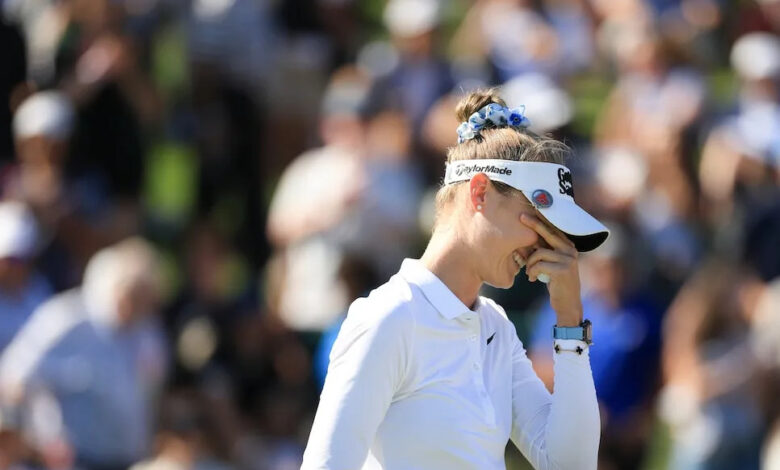
After nearly missing the winning putt, Korda’s face looked like the shocked emoji. She covered her mouth with her hand in disbelief, then raised both arms.
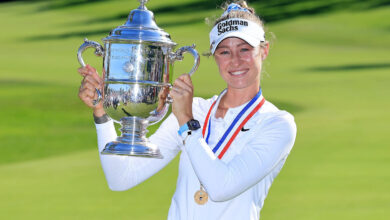
Korda shot a two-under 69 on Sunday to win her first U.S. Women’s Open at eight under, beating Charley Hull and Gaby Lopez by one shot. Had Korda missed her putt, there would be at least a two-hole playoff among the three women.
Korda continues her run at history. At 27, she is the youngest American to win four majors since Mickey Wright in 1960. She also is the first woman since Inbee Park in 2013 to capture two majors in a season following her victory in April’s Chevron Championship. She earned two more points in her bid for the LPGA Hall of Fame and needs only two more point to reach 20 ad clinch that honor.

Nelly Korda reacts to nearly missing her winning putt.
Sean M. Haffey
She needs to win a major overseas—the Amundi Evian Championship or the AIG Women’s British Open—to complete the career Grand Slam, which is four of the five majors on the LPGA Tour.
Asked how the victory will define her legacy, Korda said, “I’ve never really thought about the legacy of my career, if I’m being completely honest. I just really love competing and I love being in this position, sometimes having a big lead going into Sunday and or being tied for the lead and having to absolutely grind it out.
“I didn’t feel my best on the back nine. I had a lot of emotions kind of swirling in my stomach. I would say it’s just a dream come true. I have dreamt about this moment since I was a little girl. I watched my sister compete in the Women’s Open from a really young age. I mean, she started at the age of 15. It’s honestly just a dream come true sitting next to this trophy.”
After she signed her scorecard, Korda walked out of the clubhouse wiping tears from her eyes. She cried through speech during the 18th green ceremony. And her caddie, Jason McDede, held back tears as well.
“It’s the biggest tournament in golf, so to win it and come close last year,” McDede said. “We’ve had some interesting U.S. Opens the last nine years. We’ve made 10s, we’ve missed cuts, we’ve been through every possible situation I feel like. Obviously, as an American player this is the one you want to win. As an American caddie, this is the one you want to win, too.”
Last year, Korda finished in a tie for second at Erin Hills. This year, she shot 73-67-67-69–281 to clinch the tournament she dreamed about winning while growing up playing golf with her older sister, Jessica.
It was her sister who sat next to her stall on the driving range on Thursday after an opening two-over 73 and offered advice to tweak her grip. Jessica knows Nelly’s swing as well as anybody, so her sister went with it. Nelly gave her credit every round after that. Korda was seven shots off the lead after the first round and rallied back to win with that grip change.

Nelly Korda holds up the trophy after winning the U.S. Women’s Open.
David Cannon
“We’re very much involved in each other’s business when it comes to that. I just couldn’t believe she trusted it,” Jessica Korda said. “I was very nervous. I didn’t sleep very much [Thursday night]. I don’t know how coaches do it. … Every day just going back and being like, ‘do it a little more.’ And her kind of arguing back with me that it doesn’t feel good. That’s fine, just keep trying. The way she can execute on the golf course is unbelievable. She’s unbelievable.”
Korda shared the co-lead of the tournament after 54 holes. There was a bunch of movement at the top of the leaderboard on Sunday, especially because there were 13 players four shots or closer to the lead. Hull made an early charge before ending up with a 67, and Lopez rallied late and scored 68.
Korda was in a four-way tie for the lead at the turn as well. But by the time she got to the par-5 17th tee, she looked at the leaderboard and knew she had to break out of the pack with a birdie. It was on the penultimate hole that she chipped her third shot to nine feet and made the birdie putt. From there, she needed a par on 18 to win, but after a 288-yard drive, she left her approach 34 feet from the cup.
“I was, like, ‘Why did I leave myself such a long putt? It was a left-to-righter, the wind off of my left,” Korda said. “I knew that I didn’t want to miss it right, so I like maybe had aimed a little bit too far left and pulled it. I mean, your heart rate is going. I wish I had my WHOOP to showcase my heart rate because it was definitely high.”
Korda won $2.5 million of the $12.5 million purse. She already has an extraordinary resume’, and she’s still got plenty of career left. Her place in women’s golf—and American female athletes—is arguably right there at the top.
On Sunday, she got congratulations on Instagram from LeBron James, and she told Golf Channel that Tiger Woods texted to close out her 54-hole lead.
Korda is on a heater this season, having won four times in eight starts with three runner-up finishes. She’s won 19 LPGA titles over, and now the trophy she most dreamed of is in her hands.
“That 14-year-old girl that stepped on the range at Sebonack in 2013, her dream has just come true sitting next to this trophy right now,” Korda said. “It’s really hard to put into words. This week was definitely a grind. I don’t even feel like I had my B-game. I was just grinding out there. And that’s what I guess major championships are all about, right? It doesn’t matter if you have your B or C game, you have to be there mentally.”
It came with a grip change, the shelving doubts and her own successful pep talks.