Bring the adverts up on YouTube now and what will strike first is how dated it looks. The production, the concept: it all belongs to a bygone era. From the airport to the dressing room, the Three Rs are very much not in 4k.
For fans of a specific age, Brazil and Nike’s series of promos still stir up reminders of a golden era, supported by the idea – so eloquently expressed in a piece by the author Paul Howard last week – of everyone’s favourite World Cup being the one closest to when they are 10 years old.
For the Selecao, however, that last globally successful period of joga bonito is a peak that feels more and more difficult to reascend with each passing tournament. Before Carlo Ancelotti’s team open Group C against Morocco at 11pm BST on Saturday they are at the foot of the climb with an ageing core that struggled through qualification, no longer considered certainties to reach the latter stages.
Even more indicative of such dwindling status is the realisation that their 1970 apex is now far closer to an era before the World Cup existed to this latest tournament.
Which goes a long way to explaining why the yellow shirts that would have been easy to find in every British town centre through the 90s to the beginning of their downfall in 2006 are no longer coveted garments for younger generations.
Brazil may retain an expectation and pressure that is intolerable at home but their brand, once among the most revered in all of sport, is weakening outside of Rio or Sao Paulo.
The relationship with Nike remains eye-wateringly lucrative. In December 2024, accompanied by a press release featuring Vinicius Junior delivering some marvellous corporate speak, it was announced that their partnership would be extended to 2038, worth a reported £75m per year.

But the visibility is a fraction of what it used to be. It is not all about the action, though a winning team playing beautifully would certainly help. It is also not even about how, domestically, the shirt became a symbol for far right politics in the past 15 years – that would not have permeated the minds of impressionable young football fans.
Instead it seems mostly a reflection of how the sport is changing in a way that threatens to leave its most obsessed nation in the dust. Football in 2026 is consumed increasingly as a sport of outsized personalities more than adoration of specific teams.
In 2002 the mere mention of Brazil carried an abundance of mystique and romance in the absence of social media. That is gone now; it takes two seconds to find a profile of every single one of the 1,248 players dreaming of delivering the moment of a lifetime this summer.
Ronaldo, Ronaldinho and Rivaldo were idolised but never to the level applied to the current biggest names, the phenomenon spawned by the rivalry between Cristiano Ronaldo and Lionel Messi coinciding with the use of Twitter, among other platforms, proliferating to create a new frontier of oneupmanship.

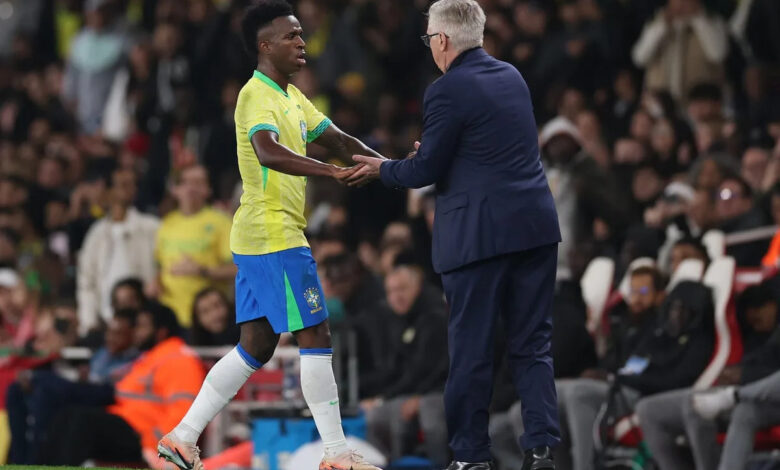
Vinicius, despite his abundance of talent, has become such a divisive character, mostly through no fault of his own, that he will never garner the same level of recognition. Plus, he is yet to transfer his Real Madrid highlights reel to the national team. Since the Three Rs era, Neymar has come closest on the adoration scale but his best years were spent in the shadow of Messi while the 2014 injury, before the team fell apart, remains a millstone around his neck.
Compile a world XI and the only member of the 2026 squad who may fit in is defender Gabriel Maghalaes but centre backs, no matter their talent, are not shifting shirts. Instead Ancelotti – and this is worth a raised eyebrow – may be their most impressive figure in North America, a trump card considering international football, with a couple of exceptions, remains short of top-tier coaches.
Maybe the former Real Madrid head coach can sprinkle his magic for them to find form at the right time, reaching a first semi-final since the humiliation of Belo Horizonte a dozen years ago or even a final since 2002. Maybe Vinicius will reach a new level, the one that he has been unable to hit for whatever reason on the international stage. And maybe those two combined can provide one of football’s great brands with a resurgence.
Most probable, though, is another crushing disappointment, TV shots of crying supporters beamed across the world and a reminder, much like those era-defining adverts, that a dazzling past is never the guarantee of a successful future.