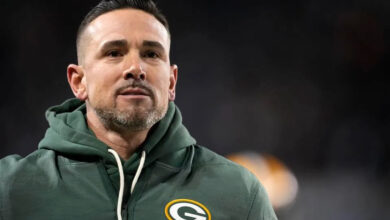
DeMeco Ryans brings elite Texans defense to Landover vs Jayden Daniels & the Commanders in Week 14 – 5 O’Clock Club

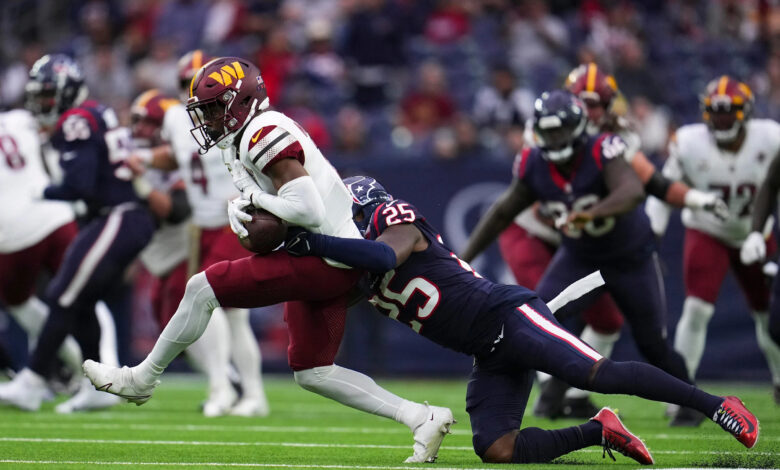

It’s 5 o’clock somewhere…
The 5 O’Clock Club
The 5 o’clock club is published from time to time during the season, and aims to provide a forum for reader-driven discussion at a time of day when there isn’t much NFL news being published. Feel free to introduce topics that interest you in the comments below.
CLICK HERE to see the full 5 o’clock club archive
2026 opponent preview series: Wk 1 Eagles | Wk 2 Cowboys | Wk 3 Seahawks | Wk 4 Colts | Wk 5 Giants | Wk 6 49ers | Wk 9 Rams | Wk 11 Bengals | Wk 12 Cardinals|Wk 13 Titans
Previewing Washington’s 14 opponents of the ‘26 season — one at a time
In 2026, the Commanders will, like every other team in the NFL, play 17 games against 14 opponents. With the amount of roster change that NFL teams undergo annually along with the unusually large number of head coach and coordinator changes in 2026, it seems useful to spend some time to review each of Washington’s regular season opponents.
TEXANS
After playing 3 road games in 4 weeks, the Commanders play the Texans at Northwest Stadium, December 13th at 1 p.m. ET. The Texans won 12 games last season, but finished in 2nd place (behind the 13-4 Jaguars) in the AFC South. They fell to the eventual AFC Champion Patriots in the divisional round after beating the Steelers decisively in the wild card round.
The Texans are ranked #13 on the ESPN preseason Power Index.
Week 14 Preview: Houston Texans at Washington Commanders
Date: December 13, 2026, 1:00 p.m. ET
Location: Northwest Stadium in Landover, Maryland
By Week 14, the playoff picture is likely starting to shaking out. The Texans will be looking at 3 tough games after their visit to Washington — with Jacksonville, Philadelphia, and Green Bay in Weeks 15, 16, and 17. The Commanders will have the Falcons, Vikings, and Jaguars in the same three weeks. Houston will be looking for a win before 3 tough games, two of them on the road. Washington will, hopefully, be trying to keep a winning streak alive after road games against the Cardinals and Titans.
This has the makings of a very good Sunday afternoon game between two teams, each in pursuit of a playoff spot and in need of every possible win.
The All-Time Series Numbers
This series has a very short history, dating back only to 2002, when the Texans played their first season of NFL football.
Washington and Houston have played one game every four years since that time and have never met in the playoffs. In fact, no team in the NFL has played fewer games against the burgundy & gold than the Texans.

In the 6 games played between the two teams, things stand even at 3-3-0.
The Commanders won the most recent game in November 2022, when a Taylor Heinicke-led team held a 20-0 halftime lead built on a Curtis Samuel TD run early in the 2nd quarter, and a Kendall Fuller pick-6 less than two minutes into the first quarter, along with a pair of Joey Slye field goals.
Was that REALLY the Washington roster just 4 short years ago?!?
The Redskins won the first two games (2002, 2006) by a combined score of 57-25, but Houston won the three games that followed, in 2010, 2014, and 2018.
The winner of this year’s Week 14 game will re-take the series lead and will likely have bragging rights for quite a while.
Texans Coaching Staff
While the Texans made a few changes among positional coaches, the head coach and coordinators all returned following a pretty successful 2025 season.
Head coach: DeMeco Ryans
Offensive Coordinator: Nick Caley
Defensive Coordinator: Matt Burke
Special teams coordinator: Frank Ross
Offense
The Texans were largely carried by their defense in 2025. The team’s offense enters 2026 under OC Nick Caley with a focus on stability and physical execution. After statistical mediocrity and inconsistency in ‘25, the unit is relying on roster upgrades and system familiarity to establish a more dependable identity.
Schematic Identity and Differences
The defining attribute of Caley’s scheme is the deliberate use of heavy personnel packages to dictate defensive match-ups. Houston frequently utilizes 12 personnel (one running back, two tight ends) and 21 personnel (two running backs, one tight end) to force opponents out of nickel and dime defensive alignments.
What makes this system unique is how it transforms the tight end position into an extension of the offensive line to control the edges of the formation. By doing so, the offense builds its foundation on downhill running and under-center play-action passing. The strategy moves away from spread alignments, relying instead on pre-snap motion to reveal defensive coverages and create structural advantages before the ball is snapped.
Featured and Impactful Players
- C.J. Stroud (Quarterback): Stroud remains the focal point of the passing game. Caley’s playbook demands that the quarterback operate efficiently on play-action designs.
- David Montgomery (Running Back): Acquired via trade from the Lions in March, Montgomery takes over as the primary rushing option. His physical running style is central to improving the team’s first-down efficiency and goal-line production. His workload directly determines whether the play-action passing windows open up downfield.
- Dalton Schultz (Tight End): Even at 30 years of age, Schultz serves as a vital component in the passing game, not unlike the role played by Zach Ertz for Washington in ’24 & ‘25. In an offense that expects tight ends to handle a higher volume of snaps, his consistency in short-to-intermediate routes provides a safety valve for the quarterback.
- Nico Collins and Tank Dell (Wide Receivers): Collins and Dell provide perimeter production. Alongside 2025 2nd-round pick Jayden Higgins, they face less defensive congestion because the heavy tight end packages draw safety help toward the line of scrimmage.

Areas of Vulnerability
The primary risk for the offense rests on the interior line. The Texans replaced multiple linemen by acquiring veterans like Wyatt Teller and Braden Smith in free agency this offseason. If this group fails to gel with Montgomery as the new ball carrier, the running game could stall, forcing the offense into third-and-long situations. Because Caley’s concepts require time to develop, a failure to establish the ground game removes the strategic advantage of his heavy formations. The Commanders’ reconstituted defense could cause problems for this group, though, by Week 14, the Texans offense will have had plenty of time to work out any kinks – as will the Commanders defense.
From USA Today:
Six NFL quarterbacks who could lose starting jobs in 2026
C.J. Stroud, Houston Texans
Texans general manager Nick Caserio gave Stroud a vote of confidence after the quarterback’s four-interception performance in a divisional round loss. Caserio did not give Stroud an extension in his first offseason eligible.
Stroud struggled in 2025, continuing an alarming pattern of regression since his outstanding rookie season in 2023. Much of that can be chalked up to the issues with the Texans’ reworked offensive line. For a second straight year, Stroud faced pressure on more than 37% of his dropbacks. More notably, in 2025, Stroud’s decision making regressed. His 14 turnover-worthy plays (per Pro Football Focus) were tied for fourth-most in the NFL under pressure. His 35.5 PFF grade under pressure was third-worst in the league.
Things got worse in the playoffs vs. the Patriots, with a four-interception performance in the divisional round.
During three games that Stroud missed with a concussion, backup Davis Mills went 3-0 with 915 passing yards, five touchdowns and one interception. Mills is also likely not the long-term answer for Houston given he already lost his starting quarterback job to Stroud in 2023. But if Stroud starts the 2026 season playing like he did in the 2025 playoffs, questions will be raised about whether or not Mills should get a second crack at the starting gig.
Defense
The Houston Texans’ defense may be the NFL’s best, and it will likely provide a massive challenge to the Commanders offense. The defensive scheme has its roots in the Seattle-style 4-3 under front (as did the Dan Quinn/Joe Whitt defense), but it relies on specific schematic adjustments that differentiate it from other versions of this system across the league. Under Ryans and Burke, it has been an extremely effective defense.
Schematic Identity and Differences
The primary characteristic of the Ryans/Burke defense is the emphasis on a “9-tech” DE alignment combined with a strict split-safety coverage shell. The defensive ends line up far outside the offensive tackles, which alters the angles for offensive blockers and creates immediate edge pressure. This alignment forces opposing quarterbacks to release the ball quickly, which directly aids the secondary.
Unlike defenses that rely on blitz packages to disrupt the pocket, Houston generates pressure almost entirely with its four-man defensive line. By keeping seven players in pass coverage, the Texans minimize big plays down the field. The system utilizes “Quarters” (Cover 4) and more than traditional Cover 3 employed by Quinn, meaning the safeties split deep responsibilities based on the alignment of the receivers. This approach requires the linebackers to be highly proficient in space, as they must handle intermediate crossing routes without assistance from the safeties.

Featured and Impactful Players
- Will Anderson Jr. (DE): Anderson is the engine of the pass rush. The wide alignment in this system isolates him against offensive tackles without tight end help. His ability to win individual matchups determines whether the defense can maintain its practice of rushing only four players.
- Azeez Al-Shaair (LB): Al-Shaair operates as the green dot player on D. Because the scheme demands that LBs cover significant ground in the passing game while remaining responsible for inside run gaps, his lateral speed and tackling efficiency dictate the success of the front seven.
- Derek Stingley Jr. (CB): Stingley is featured in match-quarter coverages where he frequently lines up in isolated coverage against the opponent’s primary receiver. His positioning and tracking limit downfield targets, forcing quarterbacks to check the ball down to shorter options.
- Kamari Lassiter (DB): Lassiter’s versatility allows Burke to shift coverages without changing personnel groups. Whether playing on the boundary or moving inside to the slot, his spatial awareness in zone coverage prevents completions in the seam.
Areas of Vulnerability
The main risk to this defensive structure is vulnerability against standard, downhill rushing attacks. Because the defensive ends wide-9 alignment splits the front, it creates wider gaps between the defensive tackles and the edge. If the interior defensive linemen fail to hold their ground, or if linebackers misread their keys, opposing offenses can exploit these spaces for consistent gains on first down. It’s not hard to imagine the Commanders employing a game plan that relies on heavy doses of Kaytron Allen, Bill Croskey-Merritt and Rachaad White to dictate the pace of the game. The strength of Laremy Tunsil, Sam Cosmi, and Josh Conerly combined with the excellent blocking skills of John Bates may also frustrate some of the Texans defensive sheme.
Additionally, if the four-man rush does not bother the quarterback, the secondary is forced to sustain coverage longer than the zone rules intend, leading to breakdowns in the intermediate areas of the field. Short passes with run-after-catch by Chig Okonkwo and slants to wide receivers may also be tools that OC David Blough can employ against the Texans, but this is a defense that should not be under-estimated; it is well-coached and loaded with talent.
Key statistical 2025 rankings
Offensive Statistics
- Points Per Game: 23.8 (Ranked 13th in NFL)
- Total Offensive Yards: 5,559 yards (Ranked 327.0 yards per game)
- Passing Yards: 3,956 yards (218.1 yards per game, Ranked 14th)
- Rushing Yards: 1,852 yards (108.9 yards per game, Ranked 22nd)
- Passing Efficiency: 62.5% completion rate, 24 TDs, and 9 INTs
- Rushing Efficiency: 475 attempts; 3.9 yards per carry; 9 touchdowns
- Third-Down Conversions: 37.2% success rate (86 of 231, Ranked 23rd)
Defensive Statistics
- Points Allowed Per Game: 17.4 (Ranked 2nd in NFL)
- Total Yards Allowed: 4,713 yards (Ranked 1st , 277.2 yards allowed per game)
- Passing Yards Allowed: 3,120 yards (183.5 yards allowed per game, Ranked 6th)
- Rushing Yards Allowed: 1,593 yards (93.7 yards allowed per game, ranked 4th)
- Sacks: 47 sacks (4th)
- Takeaways: 19 INTs (3rd-t) and 14 forced fumbles (1st-t)
- Turnover Margin: +17 ratio (2nd in NFL)
- Opponent Third-Down Success: 34.0% conversion rate allowed (2nd)
Roster Moves: Trades, Free Agency and the Draft
Trades
Houston was fairly active in the trade market this offseason. Interestingly, they did a pick-swap to acquire punter Kai Kroeger from the Saints, and another swap to get LB/S Mart Mapu from the Patriots. But the two signifcant trades sent one player out and brought one player in:
- RT Tytus Howard was traded to the Browns for a 2026 5th-round pick. He will be replaced by former Colts OT Braden Smith, who was signed in free agency.
- One of the more high-profile trades of the offseason saw the Lions send RB David Montgomery to Houston in March for a backup OG, Juice Scruggs, and a 2027 7th round pick.
Free Agency
Houston was very active in the free agent market this offseason, including multiple extensions for key starters, backups and the place kicker.
Key Free agent signings
- S Reed Blankenship
- TE Dalton Shultz (extension)
- TE Foster Moreau
- WR Nico Collins (extension)
- Edge Will Anderson (extension)
- Edge Danielle Hunter (extension)
- RG Ed Ingram (extension)
- RT Trent Brown (extension; backup)
- DT Logan Hall
- DT Sheldon Rankins
- LB Azeez Al-Shaair (extension)
- LB EJ Speed (extension; backup)
- K Ka’imi Fairbairn (extension)

Free agent losses
- DT Tim Settle (Returned to Washington)
- P Tommy Townsend
The 2026 NFL Draft
Round 1, pick No. 26: Keylan Rutledge, OG, Georgia Tech – Aggressive All-American run-blocker; can play multiple interior line positions and is expected to start immediately.

Round 2, pick No. 36: Kayden McDonald, DT, Ohio State – Massive 330-pound first-team All-American; specializes in stuffing the run and absorbing double teams.
Round 2, pick No. 59: Marlin Klein, TE, Michigan – German-born former soccer player; provides depth and will compete for the open #2 tight end spot.
Round 4, pick No. 106: Febechi Nwaiwu, G, Oklahoma – Affordable, developing young blocker; helps the team manage their salary cap on the interior offensive line.
Round 4, pick No. 123: Wade Woodaz, LB, Clemson – Productive defender with 28.5 career tackles for loss; provides depth and serves as a potential future replacement in the linebacker room.
Round 5, pick No. 141: Kamari Ramsey, S, USC – Speedy defensive back with a 4.47-second 40-yard dash; projects as developmental depth for the secondary.
Round 6, pick No. 204: Lewis Bond, WR, Boston College – 5-foot-10 wideout; faces an uphill battle to make the roster due to a very crowded WR room.
Round 7, pick No. 243: Aiden Fisher, LB, Indiana – Highly productive defender with 328 college tackles; must compete for special teams to secure a spot on the roster.
Betting Lines
Oddsmakers have established the home team as the underdog for this matchup.
- Point Spread: Texans -2.5
- Game Total (Over/Under): 44.5 points
A 2.5-point spread favoring the road team indicates that bettors lack confidence in the Commanders in this late-season home game. The point total is set at 44.5, reflecting expectations of a strong defensive performance from the favored Texans.
CONVERSATION STARTERS:
Which defense do you expect to have the better game: DeMeco Ryans’ Texans or Daronte Jones’ Commanders?
Which QB will have the better game, Jayden Daniels or CJ Stroud?