
There’s nowhere to hide in racing, at times a brutal competition that decades ago inspired the aphorism, “When the green flag drops, the bullshit stops.” For Genesis Magma Racing, the new factory-backed FIA World Endurance Championship team, first announced just a year and a half ago, the 2026 24 Hours of Le Mans contested over this past weekend was always going to be a learning experience more than a quest for a podium finish, let alone a win.
Genesis as a whole faced the immense challenge with nary a hint of trepidation. On the Friday before the race, there was José Muńoz, Hyundai Motor Co. president and CEO—and MotorTrend’s 2025 Person of the Year—along with other top Genesis executives addressing more than 100 global media members and invited guests inside the brand’s luxurious three-story hospitality unit overlooking Circuit de la Sarthe’s Ford and Raccordement Motul chicanes. The overarching message: Hyundai and Genesis are on a roll in the marketplace, with Genesis selling 50,000 new vehicles in the first quarter of 2026; total Q1 global revenue of $31 billion across the company; record year-to-date sales growth of 8.5 percent in North America and Europe; sales records for Genesis models like the G70, GV7, and GV80; and a resultant stock valuation of more than 200 percent gain. And those were just the main highlights.

Still, there are plenty of people around the world who don’t know what Genesis is, let alone its Magma performance arm. So the brand’s entry onto the world’s biggest sports car racing stage with its Genesis Magma Racing GMR-001 Le Mans Hypercar (it runs to LMDh specifications, which are a bit simpler and cheaper than the LMH class it goes head to head with in races) is meant to boost that awareness. The racing program just “happens” to coincide with Genesis’ push into more European markets, including France (home of Le Mans), Italy, the Netherlands, and Spain. (A planned IMSA WeatherTech SportsCar Championship campaign in North America, planned originally for 2027, has been pushed back to at least 2028; team principal Cyril Abiteboul said at Le Mans a decision in that regard could be made around the time of the WEC’s Austin, Texas, round later this year in early September.)
Regardless, no salesfloor momentum or PowerPoint bullets are worth a damn on the track, especially in the 24-hour sprint-paced pressure cooker of modern Le Mans.
Before the French race, the two factory GMR-001s finished 15th and 17th in the season-opening round at Italy’s Imola circuit in Italy after one car encountered a sensor problem and the other took a dice roll on strategy. In the race just prior to Le Mans—the Six Hours of Spa-Francorchamps—the team brought home commendable finishes of eighth (a points-paying position ahead of established entries from Cadillac, Toyota, Alpine, Aston Martin, Ferrari, and Peugeot) and 13th.

So it was no big surprise in the end that one of GMR’s entries failed to finish when the No. 17 GMR-001, which qualified sixth on the grid and was shared by drivers Pipo Derani, Mathys Jaubert, and André Lotterer, retired from the race after 16 hours with a terminal suspension failure, the cause of which wasn’t immediately clear. Well, no big surprise to most longtime Le Mans observers, anyway, who expect teething moments like this; we heard unconfirmed reports at the track that Genesis’ star designer, Luc Donckerwolke, who we were attempting to schedule time with to chat about the program, was bothered enough by that outcome to no longer be available. However, that’s telling when it comes to Genesis’ high expectations even this early in its big-time racing life.
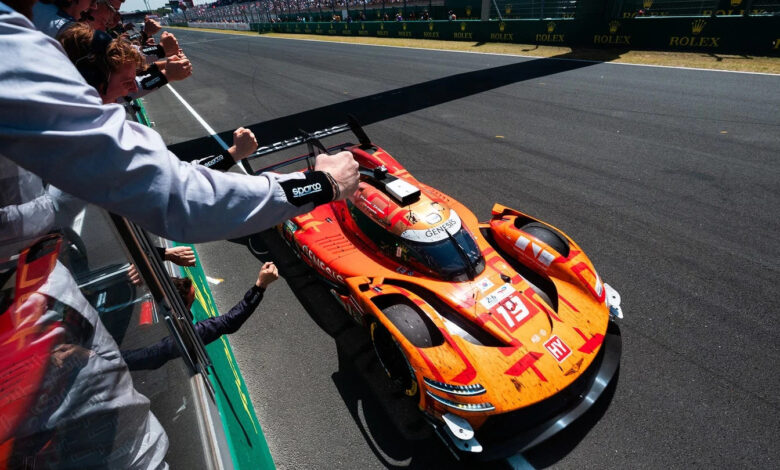
That race-ending hiccup aside, the No. 19 GMR-001 started in ninth, at one point cracked well into the top 10, and was driven by Paul Loup-Chatin, Mathieu Jaminet, and Dani Juncadella to finish the full 24 hours in 13th after recovering from several mechanical gremlins. Those troubles included a power issue that required full ignition re-cycles, the first of which occurred as it ran in 12th place. It crossed the line nine laps down on the winning Toyota Racing TR010 Hybrid of former IndyCar drive Mike Conway and ex–Formula 1 racers Kamui Kobayashi and Nyck de Vries.

For fans new to racing, and even more so endurance racing, it’s common for new cars to experience major issues in their first Le Mans outing—see the Ferrari 499P in 2023 (despite one of them winning, another endured hybrid system issues) and Porsche 963 (sensor failures and on-track incidents, also in 2023) as two recent Hypercar examples. That’s why Genesis Magma team members found big positives in their de la Sarthe debut.
“This is a great achievement for Genesis Magma Racing,” said Gabriele Tarquini, Genesis Magma Racing’s sporting director. “In the beginning, especially last year when we started this project, it was impossible to even imagine that by our third race we could score points in Spa and finish the race in the 24 Hours of Le Mans. That’s great. That’s unbelievable. Even in our dreams, the best dreams, we cannot imagine to finish this race. The big race started last year the first time Pipo jumped in the GMR-001 Hypercar in Le Castellet, and it’s not finished today, and probably it will not finish at the end of the season. It will be a long race, and in this race, the target is to fight for the win.”

Chief engineer Justin Taylor echoed the sentiment. “First 24 Hours of Le Mans and first finish,” he said. “No one can ever do that again for Genesis or for South Korea. That was the first time. I can’t believe it, honestly. I knew we could do it, but seeing it now in person, it’s still surreal. I’m just so proud of all the people. … We’ve got 364 days from tomorrow to get going for the 2027 24 Hours of Le Mans.”
Certainly not quite as significant but worth noting, loads of spectators at Le Mans embraced this new team, sending up a loud roar as its gradient Magma Orange car (the name and color is a nod to South Korea’s volcanic history) crossed the finish line at race’s conclusion. On top of that, we witnessed countless people rocking the squad’s signature black-and-orange GMR hats and shirts throughout the weekend, the outcome of a steady lineup of folks waiting to get inside GMR’s merchandise store in the Le Mans fan village. It will be more than a little interesting to see if this kind of motorsports-derived consumer enthusiasm carries over into the regular world and translates to sales success with upcoming high-performance road cars like the GV60 Magma.
It could take years to legitimately establish the brand’s bona fides in that regard, but in addition to Genesis’ Friday reveal of its Magma GT3 race car concept and the Hyundai Motor Co.’s big-time backing of the brand (we don’t know the figure, but large money is being spent here on and off the track; hell, Genesis footed the bill to helicopter journalists from countryside hotel to Le Mans and back all weekend), the overall takeaway is this: Plenty of signs point to GMR being a committed sports car racing player for seasons to come—and that, too, is no bullshit.