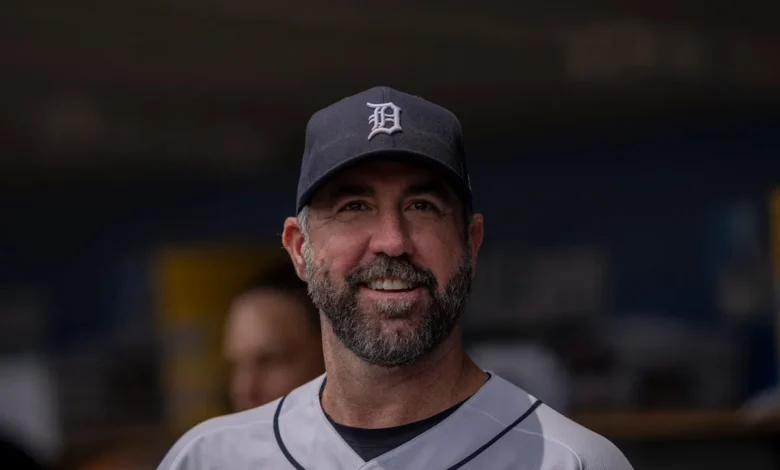
PHILADELPHIA — Justin Verlander smirked.
He laughed.
Then, he sneered.
Verlander was almost in utter disbelief that someone could seriously ask him the question.
“Justin, have you ever been pulled out of a perfect game or no-hitter in your career?“
Are you kidding?
“No,’’ he said. “It was never even a conversation. No!”
How could someone ask?”
This is a man who has pitched for 22 years, won three Cy Young awards, two World Series championships, an MVP award, been selected to 10 All-Star teams, and will have his plaque mounted in Cooperstown in six years.
Do you actually believe that he would allow a manager to pull him out of a game when he has the opportunity to make history?
“It’s very hard,” Verlander said in disgust, “for me to watch.”

There was not a single pitcher who ever had a perfect game through six innings who was ever pulled from a game from 1901-2015.
In the last 10 years, it occurred three times.
It happened twice in four days last week.
Verlander can’t comprehend it, but then again, he has difficulty understanding how people actually believe that wins are overrated for starting pitchers, knowing the impact of individual victories.
‘‘I know that wins is a stat that people kind of are poo-pooing now,’’ Verlander says, “but you look around. Starting pitchers definitely don’t go as deep in the game. They don’t throw as many pitches. And because of that, wins are coming way down.
“I think maybe on a given year or a given day, the win isn’t a great stat. But over time, if you consistently win baseball games, you’re doing all of the things that you want as a starting pitcher. You’re going deep. You’re limiting runs. You’re giving your team a chance. And if they start winning more often than not, then you’re doing a good job.
“So maybe short term, I get it, but macro view, I think wins tell you a much larger picture.’’
Verlander, who won at least 15 games in 12 seasons, pitching more than 200 innings 12 times, badly wanted to win 300 games before he retired. He knew he could be the last 300-game winner in baseball history. Now, even with 266 victories, he wonders if anyone will ever win 250 again.
He’ll fall short of 4,000 strikeouts, but with 3,554, it’s still the eighth-most all-time, with only two current pitchers within 1,000 strikeouts of him.
Verlander, 43, the oldest athlete in North American team sports, doesn’t want to sound like he’s Bob Feller, and that the game stinks compared to how it was when he broke in on July 4, 2005, but man, are times different.
He worries about the game, too, particularly with the potential of a lengthy lockout on the horizon threatening the integrity of the 2027 season.
“Obviously, I want the players to to get what they’re deserved,” Verlander says, “but I think you want the game to just be in a great place. That’s it.
“But I’m really worried about it, to be frank, because the game is, in my opinion, in a really great place. Its viewership is doing great. The fan bases are responding. ..Ultimately, the game’s in a good place, and I would hate to see that get disrupted and lose momentum that we have, and the opportunity that we have to continue to grow the sport.
“There are so many reasons why I think a real work stoppage in losing games would be detrimental.”
Simply, if the system ain’t broke, Verlander claims, why fix it?
“This current system must be working OK if the game is as popular and rising as it is, right?” Verlander says. “I don’t see any shortage of people wanting to buy a MLB team, so it must be a decent investment, right? You know, people are fighting for the chance to buy an MLB team, so it can’t be that bad.”
Then again, Verlander says, nothing is like it used to be upon his arrival. When he came up and made his first All-Star Game at the age of 24, he was too scared to say a peep in the American League clubhouse, intimidated by the sight of Derek Jeter, Ichiro Suzuki, David Ortiz and Alex Rodriguez, and not worrying about his brand or silly social media accounts.
Even today, he politely declines to talk about his future entrance into the Hall of Fame, or what cap he’d wear on his plaque.
When he came up and developed into one of the most dominant right-handed pitchers in the last 50 years, he never forgot to praise Nolan Ryan for being his all-time idol and the impact Kenny Rogers made on his career, even recommending the purchase of a designer bed to reduce his back woes.
“He just taught me how to be a professional,” Verlander said. “He’d been in the game so long, and I just always admired the older players. Whenever I had a chance to speak to them, All-Star games or whatever, trying to absorb information, I would do it.”
Well, here we are 20 years later, and Verlander is that man.
Verlander announced last week that he would retire after the season, and since the decision became official, Verlander has everyone from Bryce Harper and Mike Trout requesting autographed jerseys and balls, with others seeking advice.
“Looking forward to talking to him these next few days,” Trout said. “He’s one of the toughest pitchers I ever faced. I was messing with him the other day when he said he’s retiring.
“I said, ‘Bro, you threw me a slider, and I hit in in our bullpen. And the next 48 or 50 at-bats, I didn’t see one slider. And if he did, he bounced it.
“He’s just a competitor, one of the toughest I’ve ever faced. He’s going out strong.’’
This is why Verlander, who has made just one start this season, desperately wants to pitch again this year. He wants to step on that Comerica Park mound at least one more time. He still dreams of being on the mound in October, helping the Tigers win their first World Series since 1984.
“Look, it’s not like I’m sitting here saying like this is going to be it for the season,” Verlander confidently says. “I wholeheartedly believe that I can come back and pitch, and hopefully pitch well on a team that has a chance to be in the playoffs. So, it’s something I’m still working daily at.
“I got agonizingly close there. I made my like final rehab start, and then had my hamstring pop on me. You know, it’s just like really frustrating. I’m trying to do everything I can and take the big picture.’’
He really didn’t want to retire, hoping to pitch until he’s 46 and he had those 300 wins, but his body simply wouldn’t cooperate. It was his hip that put him on the IL. Then, his hamstring.
“You know, I feel like I’ve been like plugging holes in a leaky boat,” Verlander says. “I think the one thing I’ve done really well in my career is be objective about myself, and that’s allowed me to adapt when I need to and be successful on the mound. I know what I need to do mechanically to be healthy and compete at this level, but my body’s not letting me do that.’’
He also believes this might be the ideal time to leave, with the collective bargaining agreement expiring Dec. 1.
“Nobody knows what’s going to happen at the beginning of next season,’’ Verlander says. “There’s a lot of conversation about that. I just feel like it’s the right time. And if I want to control my own destiny, which I do, I don’t want to leave a game when I’m ready to go and not have the game force me out.’’
Now that he’s been sidelined since the first week of the season, selected to the All-Star Game by Commissioner Rob Manfred as one of his legend picks, it has allowed him time to reflect, knowing the end of a fabulous career and glorious era is ending.
“I think the game has changed a lot,” Verlander says. “When I first came in, I think the average length of game wasn’t long enough that the pitch clock was an issue. But I saw it evolve into games that were taking routinely three hours, 40 minutes, and the pitch clock has resolved that. That’s been a great addition.
“I think the advent of analytics has positives and negatives. I have definitely benefited from it, but it it can become a crutch for people and organizations. … That’s made a dramatic difference in the game.”
And now, here he is, wondering where time has gone, while knowing his time is near.
“You know, it’s such a blur while you’re in it,’’ Verlander says, “and then you know you get towards the end and say, “Man, I wish I had enjoyed X, Y, and Z a little bit more. So, to have the opportunity to come back in this situation and really absorb it and know it’s your last time, it’s a really special feeling.
“I think it’s cool for the game. Seeing some of the greats that I played against and admire for a long time. Just get the opportunity on a national stage to be sent off and be involved in the game again in a big way is a cool thing the commissioner did.’’
Now, for perhaps the final time on the national stage, Verlander has a chance to say good-bye, perhaps even getting an ovation to remember Tuesday night from the sellout crowd at Citizens Bank Park. He pitched in the American League all but two seasons but baseball fans know he played the right way, always respecting the game, with the game respecting him right back.
“It’s hard for me to look back in hindsight and change anything,” Verlander says. “I honestly believe that. I made some mistakes for sure, but that really is what led me to being where I am today, and I don’t regret those things.
“I think I did a lot of things right.”
Follow Nightengale on X: @Bnightengale
This article originally appeared on USA TODAY: Why Justin Verlander is ‘really worried’ about MLB after he retires