In some ways, installing grass for the men’s FIFA World Cup has gotten easier over the decades. And in other ways, it has gotten a lot harder.
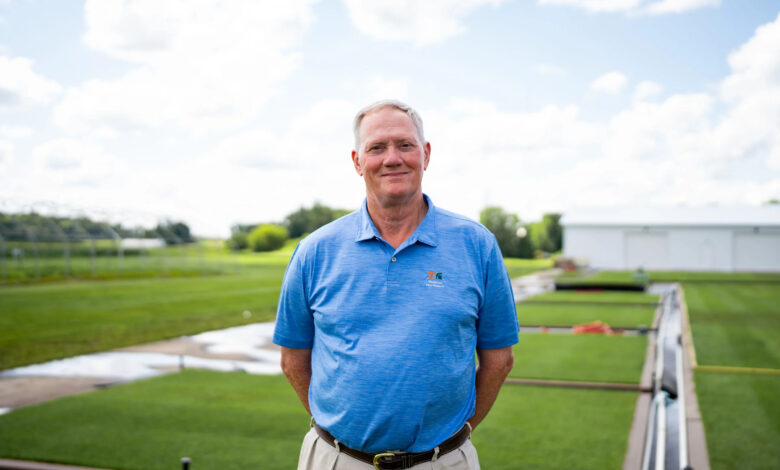
Just ask Michigan State professor John “Trey” Rogers III, whose unprecedented feat 32 years ago set a standard that has only been rising since.
Rogers, one of the world’s leading turfgrass experts, is best known for leading the effort to install natural grass inside the Pontiac Silverdome for the 1994 World Cup. The tournament had never held a game indoors before the ’94 edition, giving Rogers (nickname “Sultan of Sod”) and his team at MSU a groundbreaking opportunity that ended up a wild success.
But that was just one stadium.
Now that his team has helped design the turfgrass system at all 16 venues at the 2026 World Cup – in three different countries, no less – the challenge for Rogers, 66, and his team has only amplified, especially with FIFA’s expectations for world-class playing fields at an all-time high.
“That’s like comparing an adult to a child,” Rogers said Monday, June 8.
This is how the legacy of Michigan State’s turfgrass program has grown, one blade at a time, from plots of land in East Lansing to fields, stadiums and golf courses all around the world.
Where MSU’s turfgrass program started

MSU’s Hancock Turfgrass Research Center sprouted in 1979, with Rogers, who received his doctorate in agronomy from Penn State, joining as a professor in 1988. The program has grown to become the largest turfgrass research center in the U.S., helping to design and install playing surfaces for two Olympic games (Athens 2004 and Beijing 2008) and putting greens at various PGA Tour venues.
But the program’s first claim to fame was its biggest challenge to date – installing natural grass inside the Pontiac Silverdome, home of the Detroit Lions, which at that point only used artificial turf, for the biggest sporting event in the world.
Turfgrass, to be clear, refers to naturally grown grass, which in 1994 was used in zero major U.S. domes and arenas. But FIFA wanted to make a splash for its first U.S. World Cup by hosting a game in an indoor stadium for the first time in Cup history, tabbing Rogers to figure out how to bring world-class turfgrass into a place where it could not reliably grow.
“We were trying things that hadn’t been tried before,” Rogers said.
Rogers and his team designed a modified grass surface installed with a revolutionary portable system, allowing them to grow the grass outdoors on portable pallets and re-arrange them like a puzzle for indoor use. And after a trial during a friendly tournament in 1993 and the Silverdome’s four group stage games in 1994, FIFA gave the turf (and its portable system) high marks.
“They loved the field that they got in ’94 for the most part,” Rogers said.
So after plying its trade at Summer Olympics, PGA Tour events and stadiums around the world, it shouldn’t be a surprise that MSU Turfgrass got the call again for the 2026 World Cup. But with both technology and expectations advancing beyond what they were in 1994, the World Cup project Rogers is taking on looks very different from the one 32 years ago.
MSU Turfgrass at 2026 World Cup

Though FIFA’s request for the ’94 World Cup wasn’t simple, it was relatively straightforward: Get natural grass in the Silverdome for four games.
FIFA’s demands are a lot more rigorous this time around.
“They have a vacuum ventilation [specification] now and each stadium has to have the ability to suck water out if they get a rainstorm,” Rogers said. “They also have a light specification, meaning that you have to have portable LED lights too. And that seems very obvious in a dome situation, but they have them for all the outdoor [stadiums] too, because if there’s any shade issues on the corners or anything, they need to be able to put down the LED grow lights to help things recover.
“These [specifications] did not exist in ’94.”
The flip side to this challenge is that turfgrass technology, thanks in large part to the efforts of MSU Turfgrass, has advanced greatly and made grass installation in indoor stadiums much easier. That improved tech includes LED grow lights and portable wheeled systems featured at temporary grass fields at eight of the 16 World Cup venues.

Partnering with the University of Tennessee, MSU has designed the temporary grass systems to be used at the Atlanta, Boston, Dallas, Houston, Los Angeles, New York, Seattle and Vancouver World Cup venues, all of which normally use artificial turf for their respective NFL and MLS tenants. All of these fields will use a hybrid of Kentucky Bluegrass and Perennial Ryegrass (with the exception of New York, which will use Bermudagrass) placed on layers of sod, reinforcement, a sand-based rootzone, drainage and a vacuum system.
It is much more complex than the playing surface used at the Silverdome, though Rogers and company have had six years to plan and have much more help than they did in the early 1990s.
“[The technology] makes a big difference, of course,” Rogers said.
The future of playing fields

Rogers has seen turfgrass technology advance beyond where he previously imagined, but he still believes there are some advancements to be made. For example, he believes robotic mowing can be used to make healthier, denser playing surfaces without needing a person to mow a field “five, six times a week.”
But even as technology has changed, the root at the problem of poor playing surfaces has remained constant, according to Rogers.
“One of the things I think is always true about natural grass athletic fields is that if you abuse the grass, it will die. And there’s nothing that can change that,” he said.
Rogers doesn’t expect that to happen at the 2026 World Cup, where FIFA standards are high enough to prevent the kind of abuse that leads to problems. MSU’s system relies on third-party providers for the installation and maintenance of the grass at every venue, but Rogers isn’t worried about how the grass will turn out.
“I’m very, very confident in the sod growers as they followed our specifications very nicely,” he said. “I’m also extremely pleased with the construction of these temporary fields by these companies, and they followed our specifications very nicely, as well as FIFA’s specifications.”
The World Cup, which runs from Thursday, June 11 through Sunday, July 19, has expanded from 32 to 48 teams, making this the largest World Cup ever.

And with more than a billion people worldwide watching the event, a less-experienced crew might feel nervous in the days leading up to kickoff.
But unlike his grass, Rogers isn’t green to these type of events.
“Let’s rock and roll. Not sure what else can be done,” he said.
Need to catch up on the news during your lunch break? Sign up for our Sports Briefing newsletter to get daily summaries of Detroit sports!
You can reach Christian at cromo@freepress.com.
This article originally appeared on Detroit Free Press: World Cup 2026 goes back to roots with Michigan State Turfgrass