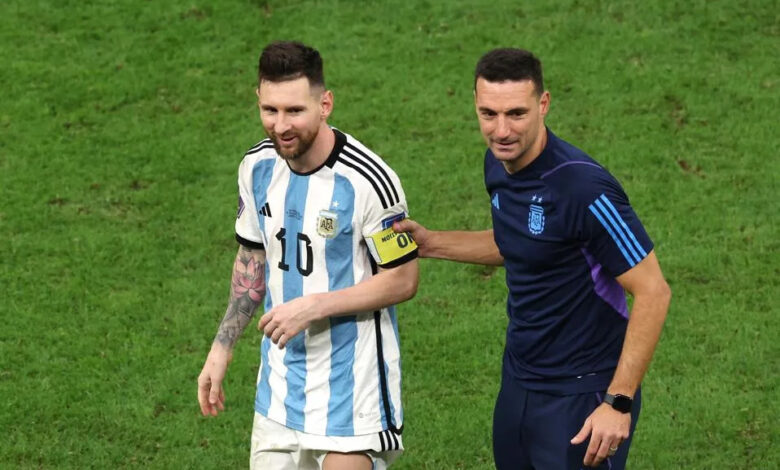

LUSAIL CITY, QATAR – DECEMBER 09: Lionel Scaloni, Head Coach of Argentina, celebrates with Lionel Messi after the win in the penalty shootout during the FIFA World Cup Qatar 2022 quarter final match between Netherlands and Argentina at Lusail Stadium on December 09, 2022 in Lusail City, Qatar. (Photo by Alexander Hassenstein/Getty Images)
Getty Images
No record is safe when Lionel Messi is around. And as the little Argentinian peeled away towards his jubilant team-mates, smile painted across his face, another had fallen at his magical feet.
The first goal in yet another brace, this time swept home against Austria, saw Messi become the World Cup’s all-time record goalscorer, with a late second pulling him two clear from previous record-holder Miroslav Klose’s total of 16.
The Little Flea’s 17th goal involvement in his past 10 World Cup matches – including a six-game goalscoring streak to equal another tournament record – is an unrivalled output for a player of his age and cements his place as the greatest player of all time.
But while Messi’s golden touch has spanned more than two decades, he hasn’t always produced his best at international level. For years, there was a suggestion that he only truly flourished in a Barcelona system made to accentuate his talents.
Countless Argentina bosses tried and failed. Diego Maradona, Alfio Basile and Jorge Sampaoli couldn’t crack the code, with Alejandro Sabella coming the closest when he led La Albiceleste to the 2014 World Cup final.
Four goals and an assist during that run were pivotal for Argentina’s progress, but those numbers don’t look as impressive alongside this latest run.
Since current boss Lionel Scaloni took charge of the South Americans in 2018, Messi has scaled new heights. Now an elder statesman who by all anatomical metrics should be well past his peak, the 38-year-old is still central to everything Argentina do.
In many ways, that’s the secret. Scaloni has built a team around Messi, compensating for his talisman’s waning physical attributes to maximise the technical ability that still shines so brightly. Even Julian Alvarez, the Atletico Madrid forward valued at more than £100 million, can’t break into the starting line-up for fear of disrupting the system.
Messi’s displays in the opening two matches of this World Cup show he is worthy of such status. Anything good came through Messi in the 3-0 victory against Algeria in Argentina’s opening match of the tournament, while he was the chief goal threat against Austria too.
How is Scaloni using Messi?
Scaloni knows that if he gives Messi space and service, he can do the rest. But Argentina have spent almost two decades learning that building around Messi is not as simple as making him the main man.
Ironically, Sabella was criticised by the Argentinian press more than a decade earlier for doing something similar when he made Messi the central figure of his team.
Upon his appointment in 2011, Sabella dropped Carlos Tevez and made a big play to place Messi as his side’s main attacking thrust instead. It was a controversial call, but it removed some of the friction that had existed between the two under Maradona and Basile in the preceding years.
There were constant rumours that Messi’s influence did not end there. There were even reports that the Barcelona man was allowed to make tactical adjustments at half-time in Argentina’s World Cup opener in 2014 against Bosnia and Herzegovina.
Whatever the truth, it almost worked, with Sabella leading La Albiceleste to the final, only losing 1-0 in extra time to Germany. Messi picked up the Player of the Tournament award too, although there was a feeling that he could have achieved even more with greater balance in the team.

RIO DE JANEIRO, BRAZIL – JULY 13: A dejected Lionel Messi of Argentina reacts after being defeated by Germany 1-0 in extra time during the 2014 FIFA World Cup Brazil Final match between Germany and Argentina at Maracana on July 13, 2014 in Rio de Janeiro, Brazil. (Photo by Matthias Hangst/Getty Images)
Getty Images
Gerardo Martino leaned the other way during his two Copa Americas in charge of Argentina, with Messi netting five goals and four assists in 2016 – albeit international silverware still eluded a team accused of being too top-heavy.
Even Maradona, who had experienced special treatment from his international boss Carlos Bilardo on the way to winning the 1986 World Cup and reaching the final four years later, could not master Messi. El Diez’s desire to get the most out of his star man may have proved a hindrance for another natural talent who needed space to thrive.
“Maradona was all about the Argentina national team and he wanted Messi to be his successor,” said 2010 squad member Jonas Gutierrez in book, How to Win the World Cup. “He tried to get the best out of him and tried to speak to him in the best way. You have to treat Messi in a different way because there aren’t many players like him, so Maradona tried to share all his experience with him to make him a better player.”
Learning from past Argentina coaches
All of those experiences have led to this point. Scaloni has not simply handed Argentina to Messi, he’s created a team that feeds his strengths and maintains enough structure around him at the same time – something that’s even more important given his age.
The team is better with its mercurial man as its heartbeat, even if he is in the twilight of his career and has played for Inter Miami since 2023.
Arguably, the less intense environment of MLS has helped Messi manage the effects of Father Time, allowing him to peak for the World Cup in the same way as an ageing tennis player does for Grand Slams.
The national team has undoubtedly become Messi’s priority in more recent years, although building a team around that could have backfired on Scaloni if his playmaker could not reach the heights expected of him.
Instead, all of those previous experiments have culminated in Messi’s World Cup zenith now. Nobody could have foreseen that it would be in his late 30s, but there is little question that player and manager have found the formula.
The next question is whether Scaloni and Messi can turn an impressive start into becoming the first nation to retain the World Cup in 64 years.
This article was originally published on Forbes.com