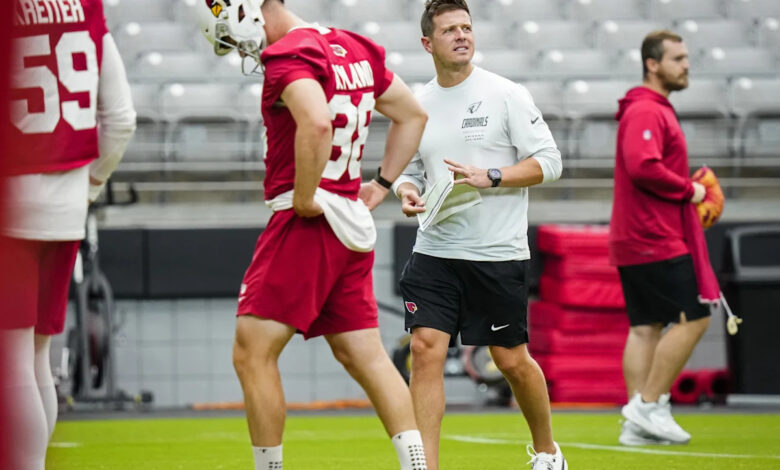
Remember when the Arizona Cardinals hired Mike LaFleur, back in February? It was as if a wave of cautious optimism swept through the Valley.
A frustrating, meandering coaching search had found a conclusion that fomented hope. LaFleur, after all, had spent the previous three years working in one of the NFL’s best organizations (the Los Angeles Rams), under the sport’s best offensive mind (Sean McVay).
Since McVay was hired in 2017, the Rams are 92-57. In that same span, the Cardinals are 54-94-1, a franchise wandering in football’s wilderness, desperately searching for a path to emulate their rivals. Here, in LaFleur, they believed that they found it.
We don’t yet know what that looks like on Sundays, when it really matters. NFL history is littered with those who worked under brilliant coaches, only to struggle when cut loose on their own. But if you peer toward the end zones at training camp and crane your neck, you’ll find a microcosm of what it looks like when an organization is infused with new ideas.
Immediately after each snap of 11-on-11 drills, the jumbotrons at State Farm Stadium display an all-22 replay. One shows the end zone angle; one shows the sideline angle. By the time the next play begins, the previous one has typically been shown three or four times.
“It’s something we had at the Rams that was extremely beneficial,” LaFleur said. “It’s going around the league now.”
The Rams, under McVay, were the first to implement the technology, back in 2018. It spread to Minnesota in 2022, when Kevin O’Connell left his post as McVay’s offensive coordinator to take the Vikings’ head-coaching job. Two years later, Raheem Morris brought it to Atlanta, where he was hired as the head coach after three years as McVay’s defensive coordinator.
The Lions, Eagles and Seahawks are among those who have since experimented with it.
Perhaps it’s a coincidence that those organizations are among the NFL’s best. Certainly, having access to a few replays won’t immediately catapult the Cardinals into the league’s elite. Or, perhaps, it’s emblematic. Good organizations open their eyes and ears, scouring the sport for ideas. By hiring LaFleur, the Cardinals aimed to tap into that network.
With the replay boards, the benefit is simple.
“It is instant feedback,” senior defensive analyst Teryl Austin said. “… So that way, the same mistakes don’t continue to happen over and over in practice. You have instant feedback, you can get things corrected and fixed immediately.”
Austin, who spent nine years as an NFL defensive coordinator, appreciates the objectivity provided by replays. For as long as he has been in the league, players would debate him on mid-practice coaching points. Now, there’s no room for uncertainty.
“No, no, this is what happened,” Austin can tell his players.
The benefit might be most pronounced for backups. As the fourth-string quarterback, Kedon Slovis rarely gets live practice reps. So from the sidelines, he tries to put himself in the mind of the active quarterback, going through his reads as if he were playing. Now, he can check whether his instincts are right in real time, looking up at the video boards to see whether he made the correct read.
“You have 30 seconds of dead air time so that gives you something to do,” Slovis said. “It’s like you’re watching tape.”
All of this, LaFleur believes, makes the Cardinals’ operation more efficient.
“If we’re doing this the right way, this should streamline and make our post-practice meetings as a staff go way quicker,” LaFleur said. “Cause we’ve already seen practice, and we’ve seen the corrections. So it’s extremely beneficial.”
In training camp, the days are already long enough. Players go through hours of film review early in the morning at the team hotel, then work through a lifting session before heading to the stadium for walkthrough and practice. By the time the coaches reconvene in the evening to break down the film from practice, their days are already approaching 12 hours. Every minute is valuable.
In the regular season, that effect may be even more pronounced. The staff has only three days of practice to correct mistakes from the previous week and install a new game plan.
So, at LaFleur’s behest, the Cardinals are installing two big screens on the sidelines at their Tempe practice facility, meaning they’ll get the benefit of live replays all season long. It’s among a series of changes that he’s brought over from the Rams, along with afternoon practices and increased usage of 11-on-11 drills.
It might not instantly translate to wins. But over time, these are the small tweaks that can accumulate — the Cardinals hope — into something bigger.
Cardinals place DT on IR
The Cardinals placed defensive tackle P.J. Mustipher on injured reserve, effectively ending his season. Mustipher was called into significant action on an injury-riddled defensive line last season, playing 300 snaps. But he struggled to make an impact, finishing the season with three pressures and zero sacks, and was likely below the cut line on this year’s roster as camp began.
In his place, the Cardinals signed Brodric Martin, a 2023 third-round pick of the Detroit Lions. Martin has appeared in six career games across his three NFL seasons.
This article originally appeared on Arizona Republic: Cardinals’ new replay boards show they’re catching up to rivals