Boy, 11, Who Lost His Leg to Cancer Is Now Chasing His Biggest Dream: Becoming Formula 1’s First Amputee Champion (Exclusive)


Credit: Pedro Cueto
NEED TO KNOW
- Pedro Cueto overcame Ewing sarcoma and a leg amputation to return to competitive kart racing within months
- His kart is specially modified to allow him to accelerate using his residual limb after surgery
- Pedro hopes to inspire others by placing racing simulators in children’s hospitals worldwide and becoming a Formula 1 champion
The first time Pedro Cueto climbed into a rental go-kart, he didn’t want to get out.
He was around 5 years old, and although he’d only driven rental karts a handful of times for fun, he had already decided exactly what he wanted to do with his life.
“He was always saying he wanted to be a Formula 1 driver,” his mom, Laetitia Cueto, 32, tells PEOPLE exclusively. “He was always begging to go go-karting.”
As the years passed, that childhood fascination became something much bigger. While other kids bounced from one hobby to the next, Pedro spent his childhood counting down the days until he could get back behind the wheel. He memorized Formula 1 drivers, studied racing lines and dreamed of climbing motorsport’s competitive ladder all the way to Formula 1 — a journey that, for nearly every professional driver, begins in karting.
“It wasn’t ever, ‘When I grow up, I’m going to be a race car driver,’ “ Laetitia says. “He was like, ‘Nope. I’m doing everything it takes right now.’”

Credit: Pedro Cueto
Before long, Pedro’s dream had become the rhythm of the entire family’s life.
At the time, Laetitia, her husband, Alejandro, 37, and their three sons were living in Arvada, Colo. Weekends revolved around racetracks instead of birthday parties. Family vacations were planned around competitions. Nearly every decision centered on helping Pedro pursue the dream he already treated like a career.
Looking back, Laetitia says the signs had been there long before he ever climbed into a kart.
“In preschool, every child had to bring a comfort toy for nap time,” she recalls. “Pedro didn’t want a teddy bear. He wanted a little Hot Wheels car. I actually had to explain to the teachers that his comfort item wasn’t stuffed — it was a race car.”
“When he was about 2 years old, he came to me one day holding his stomach and said, ‘Mom, my engine hurts,’ “ she adds with a laugh. “Everything in his world related back to racing.”

Credit: Pedro Cueto
As Pedro grew older, his natural talent behind the wheel quickly became apparent. He began competing against some of the country’s top young karting drivers, dedicating nearly every free moment to becoming faster.
Then, in September 2021, everything stopped.
Pedro was just 6 years old when he woke up complaining that his leg hurt a few days after spending hours bouncing in a bounce house during his younger brother’s birthday party.
At first, no one thought much of it.
“I told my mom my leg was really hurting,” Pedro recalls. “She thought I’d probably just jumped too much the day before.”
But when the pain refused to go away, Laetitia knew something wasn’t right. She immediately brought her son to Children’s Hospital Colorado.
“It was simply the obvious choice in my head when I took Pedro in for the pain,” she says. “I never went anywhere else.”

Credit: Pedro Cueto
Doctors initially suspected an infection in Pedro’s knee and performed surgery to treat what they believed was the problem. Instead, further testing revealed something far more devastating: Ewing sarcoma, a rare and aggressive form of bone cancer.
According to Johns Hopkins Medicine, the disease most commonly develops in the long bones of the arms and legs, the pelvis or the chest wall.
“When your child gets diagnosed with cancer, your whole world changes,” Laetitia says. “You’re obviously terrified about whether they’re going to survive. But one of the things that broke my heart the most was wondering if he was ever going to get to live out the dreams he’d been working toward his entire life.”

Credit: Pedro Cueto
Almost immediately, the family’s world shifted from race weekends to hospital stays.
In October 2021, Pedro began chemotherapy at Children’s Hospital Colorado, where he endured months of intensive treatment, surgery and lengthy hospitalizations. Many treatment cycles meant spending nearly a week in the hospital before returning home just long enough to recover ahead of the next round.
Dr. Jenna Demedis, Pedro’s pediatric oncologist, still remembers meeting the family during those overwhelming first days after his diagnosis.
“Pedro’s parents were incredible advocates for him from the very beginning,” Demedis tells PEOPLE. “They never stopped asking questions or looking for ways to help him continue doing the things he loved.”
The hospital staff also found meaningful ways to preserve Pedro’s childhood amid the endless appointments and procedures.
One of the family’s best investments was a Nintendo Switch. Between chemotherapy sessions, they spent countless hours racing one another in Mario Kart, transforming long hospital days into spirited family competitions.
“We played so much Mario Kart,” Laetitia says with a laugh. “Nobody can beat Pedro anymore.”
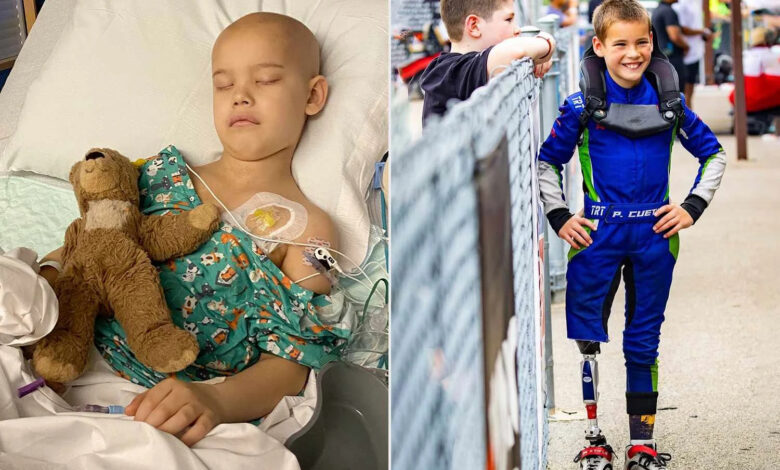
Pedro also had another companion by his side throughout treatment: a teddy bear that underwent every procedure alongside him.
Whenever Pedro needed an IV, surgery or another medical procedure, his doctors performed the same “treatment” on the stuffed bear first, helping him better understand what was happening.
“If he was getting an IV placed or having surgery, his bear would undergo all the same procedures,” Demedis says. “It went through everything with him.”
Even in the middle of chemotherapy, the hospital staff did everything they could to accommodate Pedro’s racing schedule, recognizing that getting back behind the wheel wasn’t simply something he enjoyed — it was the goal that kept him moving forward.
“The hospital was incredible,” Pedro says. “They believed in my dream.”
Seven months after beginning treatment, Pedro reached a milestone his family had desperately hoped for. At 7 years old, he completed treatment and was declared to have no evidence of disease. But while the cancer was gone, his journey was far from over.
Doctors had reconstructed Pedro’s leg using a limb-salvage procedure, replacing part of the diseased bone with a large metal implant in hopes of preserving both the limb and his mobility. At the time, it felt like the best possible outcome.
“He kept saying, ‘I need my foot because I have to push the gas pedal,’ “ Laetitia recalls. “In his mind, there wasn’t another way.”
For a while, it seemed like that dream might still be possible. But over the months that followed, complication after complication emerged.
The implant fractured. Hardware failed. Pain became a constant part of Pedro’s daily life. Surgery followed surgery as doctors worked to repair his leg and preserve the limb they had fought so hard to save.
Instead of returning to the active childhood he had imagined after finishing treatment, Pedro found himself trapped in another cycle of hospital visits, rehabilitation and recovery.
By then, he had already undergone more than 20 surgeries. Yet through every setback, one thing never changed.
“He never complained,” Laetitia says. “He wasn’t asking, ‘Why me?’ He just wanted to know what the next step was to get him back in a race car.”
Eventually, in 2024, doctors sat down with the family to discuss the option they had hoped they’d never have to consider: amputation.
The conversation wasn’t entirely new.
When Pedro was first diagnosed, doctors had explained that removing his leg would likely offer the best long-term outcome. At the time, however, Pedro and his family believed saving the limb would give him the best chance of continuing to race.
Years of complications changed that calculation.
Around the same time, Laetitia began connecting with other families whose children had undergone amputations. They spoke with adaptive athletes and learned about advances in prosthetic technology that were allowing amputees to compete at the highest levels of motorsports.
For the first time, Pedro realized something that changed everything. He didn’t need two legs to become a race car driver.
“He basically said, ‘Okay … let’s chop it off,’ “ Laetitia recalls with a laugh.

Credit: Pedro Cueto
Even the timing reflected Pedro’s determination. On a Sunday, he squeezed in one final karting race in Las Vegas. Three days later, he was in the operating room.
Just 48 hours after surgery, nurses rolled a wheelchair into his hospital room so he could leave comfortably.
“They handed him the wheelchair,” Laetitia recalls. “And he said, ‘Nope. I’m using my crutches.’”
His determination only intensified from there. While many children would have spent weeks simply adjusting to life after an amputation, Pedro was back in the gym just five days later. He approached rehabilitation the same way he approached racing — with relentless discipline and an unwavering goal.
Six weeks after losing his leg, he climbed back into a kart. The comeback exceeded even his own expectations. Within months, Pedro was once again competing against many of the country’s top young karting drivers. Then, in May 2025, another opportunity changed the trajectory of his career.
The family relocated overseas so Pedro could compete in his first Italian race. Since then, they’ve been based largely in Europe, traveling the international karting circuit as Pedro races against some of the world’s top young drivers.

Credit: Pedro Cueto
Since returning to competition, he’s collected podium finishes around the world while adapting to an entirely new way of driving.
His kart has been specially modified with a custom throttle system that allows him to accelerate using his residual limb — a setup that has continued to evolve as he’s grown and advanced through the ranks.
“It’s been working great,” Pedro says.
Once his visor comes down, however, he rarely thinks about what’s different. Instead, he focuses on what has always been the same.
“One of the reasons I love motorsport so much is that anybody can race,” he says. “When I’m on the track, I don’t like to think I’m different. I just want to race everybody else.”

Credit: Pedro Cueto
Then, in June 2026, came another milestone neither Pedro nor his family will ever forget.
Competing in the prestigious IAME Series Italy — one of Europe’s premier international karting championships and an important proving ground for young drivers hoping to climb the ladder toward Formula racing — Pedro crossed the finish line first.
“When the checkered flag came out and I was first,” he says, “I was just super happy.”
For a brief moment, every chemotherapy infusion, hospital room, surgery and painful step of recovery faded into the background.
“Everything,” Pedro says, “finally paid off.”
Today, Pedro’s recovery is measured less by doctor’s appointments than by lap times.
Most mornings begin long before he climbs into a kart. Between competitions across Europe, he balances online school with strength training, simulator sessions and workouts designed to build the endurance and explosiveness needed to compete at the highest levels of karting.
“I’m working with a mental trainer because instead of thinking, ‘What if I crash?’ I have to think, ‘What if I win?’ “ Pedro says. “On the days I’m not racing, I work out really hard. Then it’s back to full focus on racing.”
That relentless work ethic has already begun opening doors.
Last year, Mercedes invited Pedro and his family to the Mexico City Grand Prix, where he met several Formula 1 drivers, including seven-time world champion Lewis Hamilton — someone he’d admired for years while watching races from home.
For Laetitia, watching her son walk through the Formula 1 paddock felt almost surreal.
“When he was diagnosed, I was so scared he’d never get to live out his dreams,” she says. “Now, I get to watch him chase them every single weekend.”
His story is also inspiring children far beyond the racetrack.
At a children’s hospital in South Africa, videos of Pedro are shown to young amputees recovering from surgery as a reminder that losing a limb doesn’t have to mean giving up on the future they imagined for themselves.
“That meant everything to us,” Laetitia says. “Because that’s exactly why we share his story.”
Now 11, Pedro hopes to offer that same sense of hope to other children.
One of his biggest goals away from racing is to place driving simulators in children’s hospitals around the world, giving young patients something to look forward to during long hospital stays — just as racing gave him something to fight for during his own treatment.
“Even if it only makes one kid excited to come to the hospital,” he says, “that would already be incredible.”

Credit: Pedro Cueto
For Laetitia, watching her son inspire others has become just as meaningful as watching him stand on podiums.
“I’m proud of the driver he’s becoming,” she says. “But I’m even more proud of the person he’s becoming.”
There was a time when she feared cancer had stolen the future her son had dreamed about since he was a little boy clutching a Hot Wheels car instead of a teddy bear.
Now, every weekend, she watches him chase that dream all over the world. Pedro, meanwhile, hasn’t changed his answer when people ask what comes next. The dream that began in a rental go-kart when he was 5 years old remains exactly the same.
“I’m going to be the first Formula 1 amputee world champion,” he says matter-of-factly. “That’s my goal, and it’ll be my goal until I win a Formula 1 world championship.”
Read the original article on People