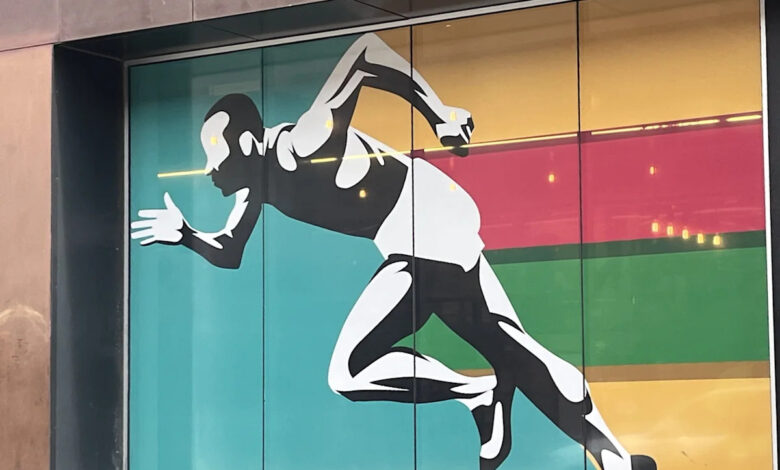
Aug. 3 marks the 90th anniversary of the first day of Jesse Owens’ dominance in the 1936 Summer Olympics in Berlin, Germany.
On that day – which, like this year, falls on a Monday – the former Ohio State great won a gold medal in the 100-meter final (10.3 seconds). He went on to set a world record in the 200 (20.7), won the long jump (26 feet, 5 inches) and helped establish a new mark in the 400 relay (39.8) over the next six days.
Here is a timeline of some of the prominent moments in Owens’ life:
Sept. 12, 1913: James Cleveland Owens is born in Oakville, Alabama.

1922: The Owens family moves to Cleveland. When Jesse entered Bolton Elementary School, a teacher misheard “J.C.” as “Jesse,” and Owens was henceforth known by that name.
1933: In the National High School Championship in Chicago, Owens sets a national high-school record in the 220 (20.7) and ties the world record in the 100 (9.4). The Cleveland East Tech graduate also leaps 24-9½ in the long jump and singlehandedly accounts for 30 of his team’s 54 points.
After these achievements, Owens is invited to compete at the Ohio State Fair, where some of his opponents include future Buckeye teammates. He wins a sprint event by four seconds, according to Dispatch archives.
Feb. 24, 1934: In the USA Indoor Track and Field Championships, Owens goes a world-record 25-3⅛ in the long jump. He also wins the 100 in 10.4.
Owens would break his own long jump record in the outdoor meet two years later (26-8¼).
May 25, 1935: Despite a lower-back injury, Owens sets five world records and ties a sixth in 45 minutes during the Big Ten meet at Ferry Field in Ann Arbor, Michigan. Those marks are in the 220-yard dash (20.3), 220-yard hurdles (22.6) and long jump (26-8¼), and he tied the record in the 100 (9.4). The 220 records count twice because they also eclipsed metric records in the 200-meter dash and 200-meter hurdles.
Combined with conference titles in the 100, 100 hurdles, 220 and long jump the next year, Owens ended his college career with nine Big Ten wins in as many events.
Although Ferry Field closed in 2018, a bronze plaque listing Owens’ feats in 1935 is at the site.
June 7, 1935: Owens sets the Central Intercollegiate Meet long-jump record of 25-9.
July 5, 1935: Jesse and Minnie Ruth Solomon marry. They have three daughters – Gloria (1932-2024), Beverly (1937- ) and Marlene (1939- ). They remain married until Jesse’s death in 1980.

Aug. 3, 1936: Owens’ first win of the Berlin Olympics comes in the 100.
Aug. 4, 1936: Owens wins the long jump, known then as the broad jump.
Aug. 5, 1936: Owens’ third win of the event is in the 200. He finishes four-tenths of a second ahead of teammate Matthew “Mack” Robinson, whose younger brother Jackie would become Major League Baseball’s first Black player 11 years later.
Aug. 9, 1936: As a last-minute addition to the 400 relay, Owens teams with Foy Draper, Ralph Metcalfe and Frank Wykoff to set a world record of 39.8.
Aug. 28, 1936: Owens is honored by the city of Columbus with a parade and ceremony at the Ohio Statehouse.
1955: Owens is named an “Ambassador of Sports” by President Dwight D. Eisenhower and tours several Asian countries to promote physical exercise and general American values in the Cold War era. Owens also represented the U.S. at the 1956 Summer Olympics in Melbourne, Australia.
1960: Jesse Owens’ youngest daughter, Marlene, is crowned Ohio State’s first Black homecoming queen.
Feb. 10, 1965: The New York Mets hire Owens as a spring training instructor, specializing in speed and fundamentals.
March 31, 1980: Dies in Tucson, Arizona.
Owens is buried at Oak Woods Cemetery on the South Side of Chicago. Others at Oak Woods include physicist Enrico Fermi – whose work in nuclear fission helped pave the way for the first atomic bomb, civil-rights leader Jesse Jackson and Harold Washington, the first Black mayor of Chicago.
High school sports reporter Dave Purpura can be reached at dpurpura@dispatch.com and at @dp_dispatch on X.
This article originally appeared on The Columbus Dispatch: A timeline of Jesse Owens’ gold-medal legacy