Ohio high school track and field athletes who earn their way to the season’s final weekend do so knowing they will compete in a stadium named after one of the best to make a name in their craft.
Ohio State’s Jesse Owens Memorial Stadium has hosted the state meet every year but two since 2004. In 2020, all spring sports were canceled during the COVID-19 pandemic. In 2024, construction necessitated a move to Welcome Stadium in Dayton.
The state meet was renamed the Jesse Owens Track and Field State Championships in February by the Ohio High School Athletic Association, and Owens’ granddaughter, Marlene Dortch, presented some medals during this year’s meet June 4-7.
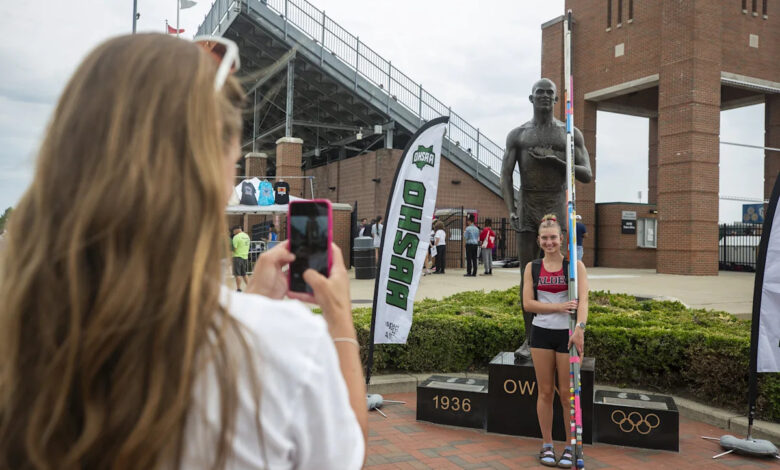
Athletes have made sure to be photographed next to the 8-foot bronze statue of Owens located at the southwest corner of the 10,000-seat stadium. But when it comes to knowing the legacy of the man who won four gold medals at the 1936 Summer Olympics in Berlin, Germany, in the face of racism and the early years of Adolf Hitler’s Nazi regime, current competitors admit it takes work to learn more about a figure who died in 1980, almost three decades before today’s oldest high school athletes were born.

“He is a huge role model to me, not just because of the sport but just … for standing for what’s right,” said 2026 Olentangy Liberty graduate Elena Aldrink, a two-time state champion in the 3,200 meters and The Dispatch’s Girls Athlete of the Year for 2025-26, who will run collegiately at Washington. “That’s really important and it should be really important to everyone.”
Owens won the 100 (10.3 seconds), 200 (20.7) and broad jump (26 feet, 5 inches) – now known as the long jump – and was part of a world record in the 400 relay (39.8) in Berlin. Aug. 3 marks the 90th anniversary of the start of those accomplishments.
Fourteen months before the Olympics, in the Big Ten championships at the University of Michigan, Owens set five world records and tied a sixth in a 45-minute span in the 100, 220, 220 hurdles and long jump despite a back injury.
The 220 records counted twice because they also eclipsed metric records in the 200 and 200 hurdles.

Jimmy Gaul, a longtime cross country and assistant track coach at Westerville South, vividly recalls writing an essay on Owens in seventh grade.
“We had to do a report, like an investigative thing, learn how to write an essay and present things, and Jesse Owens was my choice,” said Gaul, a social studies teacher at South. “Given the timeframe of what was going on in the United States as well as in the world, him competing in Nazi-controlled Germany and the message that sent and the beacon of hope that he was for people who weren’t in positions of glory and power and stature, that is a pretty remarkable thing.”
Marlene Owens Rankin, Jesse Owens’ youngest daughter and a co-founder of the Jesse Owens Foundation, told The Dispatch that students across the country have contacted the Chicago-based organization for research on their own history projects.
“Young kids, fifth and sixth grade up to eighth, would write to the foundation and ask for information because they had chosen Jesse Owens as the person in history that they wanted to write about,” Rankin said. “I found that really interesting. These are young kids who made a point of wanting to make him the subject of their history project. So I give schools a good deal of credit for perpetuating his celebrity.”
As for how that made Rankin feel?
“It’s very heartwarming.”
High school sports reporter Dave Purpura can be reached at dpurpura@dispatch.com and at @dp_dispatch on X.
This article originally appeared on The Columbus Dispatch: What today’s Ohio track stars know, and don’t know, about Jesse Owens