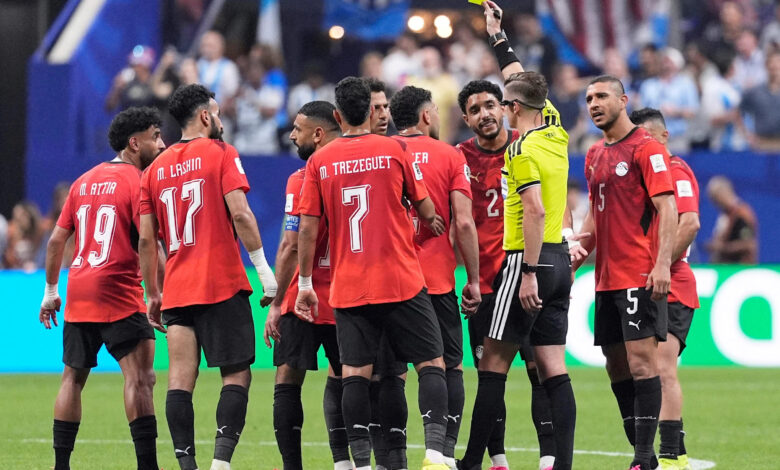
FIFA’s Chief Refereeing Officer defended a pair of controversial officiating decisions made in Argentina’s 3-2 win over Egypt in the World Cup round of 16 and stressed that match officials are free from the influence of the governing body when calling games.
“Nobody can question the integrity of the FIFA World Cup match officials. When this happens, it may provoke reactions that lead to threats against them and their families. This is not right,” Pierluigi Collina said in an interview on the governing body’s website. “Equally, nobody can claim that FIFA Refereeing can be influenced by anyone, not even by the FIFA President.”
What were the controversial calls in Argentina’s World Cup win over Egypt?
In that match, what appeared to be Egypt’s second goal was called out after a VAR review, with the referee bringing the play back for a foul in the build-up. Egypt still went on to score a second and take a 2-0 lead before Argentina stormed back and drew level at 2-2.
Egypt nearly had a 2-0 lead over Argentina but the goal was called back after a VAR check pic.twitter.com/nc2DbvOONP
— FOX Sports (@FOXSports) July 7, 2026
As the Albiceleste chased the winner, Julian Alvarez won a ball off Mo Salah in the Egypt area − with Egypt’s players asking for a penalty instead of play being allowed to run by the referee and the VAR declining to intervene. Alvarez played a pass to Lautaro Martinez, who set up Enzo Fernandez for the winner.
After the match, Egypt players and manager Hossam Hassan were furious, with the manager alleging “the outcome was influenced by internal factors on the pitch inside the game and external factors ahead of the game. There seemed to be pressure on the Argentina side on the referee on this outcome.”
Mo Salah could not believe this late goal pic.twitter.com/voBlWSdPfp
— FOX Sports (@FOXSports) July 7, 2026
But Collina took the unusual step of going over the plays in the interview.
“Usually, during a competition, we prefer not to focus on specific incidents,” he said. “However, as we recently clarified what match officials would be looking for when attacking players try to prevent the opposing goalkeeper from moving and being able to defend the goal, we also wanted to clarify another topic that has generated debate.”
The Italian ex-referee noted that “There is no defined limit regarding either the distance from goal or the amount of time between the incident and the goal,” when the VAR is checking to see if a foul was committed that led to the attacking possession phase.
“Stepping on an opponent’s foot is a foul, whereas a defender who touches the ball first and then makes normal football contact has not committed a foul,” the referee chief said.
He said Alvarez winning the ball late was an example of a play in which the referee and VAR were right to avoid intervening.
“Of course, there will always be an element of subjectivity in some decisions, but we are happy with how this principle has been applied throughout the tournament,” Collina concluded.
Argentina now faces Switzerland in a World Cup quarterfinal, with officiating still a hot topic. A crew of entirely Argentine officials was named to call France’s quarterfinal with Morocco, the first time this tournament a crew has been made up entirely of one nationality − though the VAR team will be made up of officials from another nation.
This article originally appeared on USA TODAY: FIFA Refereeing Officer defends officials after Argentina-Egypt controversies