Folarin Balogun red card, explained: What controversial call means for USMNT star’s availability for Round of 16


Folarin Balogun red card, explained: What controversial call means for USMNT star’s availability for Round of 16 originally appeared on The Sporting News.
Add The Sporting News as a Preferred Source by clicking here.
The United States felt they had a soft draw when they were matched up against Bosnia and Herzegovina to begin the 2026 FIFA World Cup knockout stage.
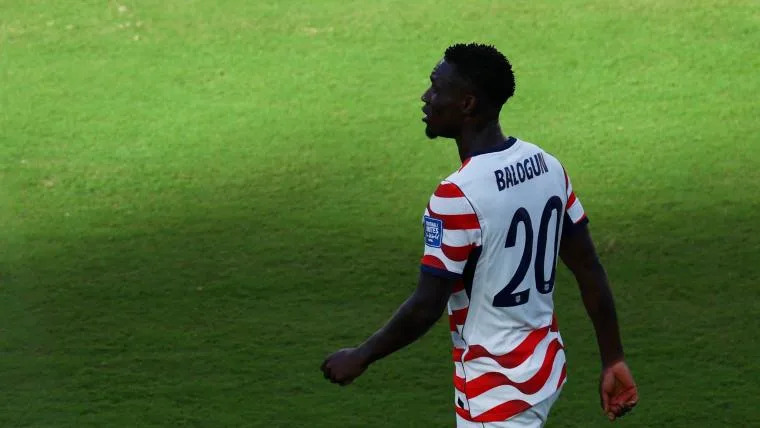
However, the task became much more difficult just past the hour mark as Folarin Balogun was sent off after a pitch-side review by the referee.
With the USMNT leading 1-0 on a first-half goal from Balogun, the AS Monaco striker was given a straight red card that reduced Mauricio Pochettino’s side to 10 men, forcing the World Cup co-hosts to protect their slim lead for half an hour in order to reach the Round of 16.
The Sporting News explains why Balogun was dismissed and what it means for the USMNT going forward in one of the most pivotal and game-changing referee decisions of the World Cup thus far.
2026 WORLD CUP HQ:Latest World Cup news | Full World Cup schedule | Buy World Cup tickets
Why was Folarin Balogun red carded?
Folarin Balogun was sent off in the 65th minute of the World Cup Round of 32 match against Bosnia and Herzegovina for serious foul play.
During a 50/50 challenge for the ball, Balogun caught Tarik Muharemovic on the ankle as the two came down to the turf.
This play is being reviewed for a potential red card against the US pic.twitter.com/EdyPpgpycA
— FOX Sports (@FOXSports) July 2, 2026
It was a truly ludicrous decision. Brazilian referee Rafael Claus had let tons of physical play go all throughout the match, refusing to give yellow cards as Bosnia and Herzegovina battered U.S. players repeatedly. He also refused to initially show even a yellow card for this tackle, judging it to be nothing more than a common foul live.
Then suddenly, the VAR Juan Ernesto Soto Arevalo buzzed in and changed the game, reacting to the injury rather than assessing the play itself. The play looked much worse in slow motion, as Balogun’s foot landed on the back of Muharemovic’s ankle turning it.
In reality, both players were in the air when contact began, with Balogun looking at the ball the entire time. It was a fluky play rather than a malicious tackle from the U.S. striker, but he has been punished as if it was an intentionally dangerous play.
MORE:Can FIFA rescind a red card on appeal?
How long will Folarin Balogun be out?
Folarin Balogun will now be suspended for at least the next match, meaning the USMNT striker will be absent should they advance to the Round of 16.
He could be out even longer if FIFA decide to extend the suspension further, which they have the capability of doing.
Unfortunately, it’s not possible for the U.S. can appeal the decision in the hopes of having the suspension reversed, as there is reportedly no appeal process in the 2026 World Cup.
Reaction to Folarin Balogun red card
Live on the Fox broadcast, former Premier League referee Mark Clattenburg showed clear disdain for the decision to show a red card to Folarin Balogun.
“This is not consistent with what I’ve seen the rest of this tournament,” Clattenburg said on the broadcast while the play was being reviewed. “When this type of challenge comes, it’s more of a stepping action, and when it’s a stepping action it lacks force and aggression. The problem you have is when he puts his foot down, he puts it down on the foot of the Bosnia and Herzegovina player. So that’s what creates the movement down and creates the ankle twist. So does it endanger the safety of the opponent? You could argue it does, but I think it’s slightly unfair because it’s more of a stepping action and lacks force and intensity.”
Clattenburg would later go on the Fox postgame show and reiterate his opinion, saying that he believed the incident did not meet the criteria for a red card.
Former FIFA Referee & FOX Sports Rules Analyst, Mark Clattenburg, gives his thoughts on the Balogun red card.@MelissaMOrtiz | @SachaKljestan | @bguzan | @MauriceEdupic.twitter.com/D7UKGxQmCk
— FOX Soccer (@FOXSoccer) July 2, 2026
Fox analyst Stuart Holden, a former USMNT international himself, also disagreed with the call, pointing out that Balogun “didn’t even see Muharemovic coming,” with the Bosnia defender “jumping in front” of Balogun at the last moment.
After the match, USA head coach Mauricio Pochettino said he wholeheartedly disagreed with the decision to show Balogun a red card.
“For me, never it’s a red card,” Pochettino said in his post-match press conference. “Watching on TV after the match, never was it his intention to step up to the player. It was a normal action of football, it was by accident, and never intentional, and that’s why for me it was never a red card.
“Today, of the 50/50 decisions, not one was for us,” Pochettino continued on the refereeing throughout the match. “The players reacted very well, we controlled the emotional actions of the game. How they managed the situation was amazing, and showed we are mature enough to keep fighting.”
Many fans and media members have pointed to the decision NOT to show Lionel Messi a red card for his tackle on Aissa Mandi which caught the Algeria captain in the back of the ankle with his studs. In this instance, Messi was not punished for the stamp, which prompted Algeria to issue a formal complaint to FIFA regarding the incident. The incident was similar to that of Balogun, frustrating many over a lack of consistency regarding the application of the rules.
Can World Cup teams appeal red cards?
Contrary to most soccer competitions worldwide, teams can NOT appeal red card decisions which occur during 2026 FIFA World Cup matches.
This is according to both The Athletic and GiveMeSport, who reached out to FIFA and received confirmation from the football governing body which stated there is no appeal process for red card decisions.
FIFA’s 2026 World Cup regulation 9.6 states:
No protests may be made about the referee’s decisions regarding facts connected with play. Such decisions are final and not subject to appeal, unless otherwise stipulated in the FIFA Disciplinary Code.
This is surprising, given FIFA has a dedicated disciplinary committee, chaired by Emirati legal advisor and sports governance executive Mohammed Al Kamali, which has experience adjudicating these appeal decisions. Additionally, many club and international competitions, such as the English Premier League, the UEFA Champions League, and the Copa America, all have a dedicated appeals process by which red cards can be appealed after the match.