
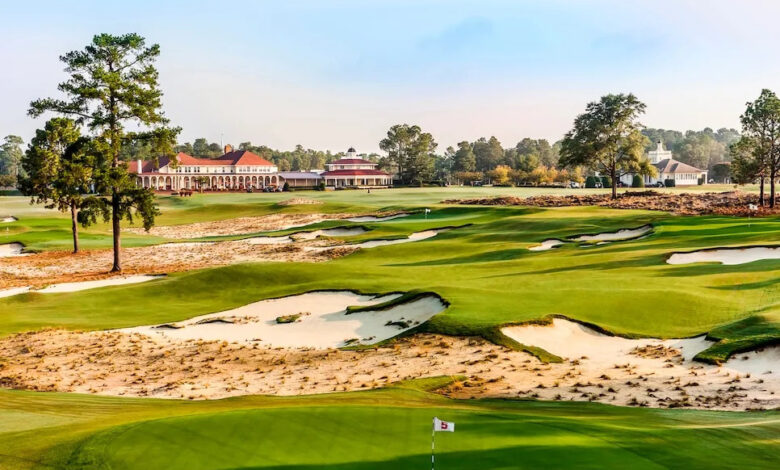
When Marvin Leonard,the Texas retail visionary, was building Shady Oaks Country Club, he started with the “Little Nine,” which sits completely within the routing of the main course. At just 1,200 yards, a mix of par 3s and short par 4s, it was built for children and beginners while Robert Trent Jones, Sr. worked on the main course.
A year after the Little Nine opened, in 1958, its undulating terrain became the preferred practice area for Ben Hogan.
“I watched Mr. Hogan practice out there,” Ben Crenshaw says. “It was peaceful and solemn, and no one would bother him. He was a bit of a loner.”
At the time, a course like the Little Nine was an oddity. No price was ever disclosed for its construction, though Shady Oaks cost $3.5 million to build when a car cost $2,000—and $11 million to restore in 2020. Short courses had historical connections to short courses in Great Britain like the Children’s Course at North Berwick, but in the post-war American golf boom, they weren’t anyone’s focus. Today, we’re living through a revival for interesting short courses, and the number of holes—6, 9, 12, 13—doesn’t matter so much as the experience.
The Preserve at Bandon Dunes, designed by Crenshaw and his partner, Bill Coore, is 13 holes with great views and one of the most coveted short-course tee times in America. At $125 for a peak-summer green fee, it’s also one of the most expensive. The resort doubled-down by opening the 19-hole Shorty’s course in 2024. In the past five years, 41 short courses have opened in the United States, mostly at private clubs and resorts. Meanwhile, old-school “executive” par-3 courses have suffered. The National Golf Foundation reports more than 800 closed between 2004 and 2024, a 20 percent decrease. These closures charged an average of $15 per round.

FOR EVERYONE: The Cradle at Pinehurst opened in 2017 and measures just 789 yards. (Photograph courtesy of Pinehurst Resort)
MORE: How are indoor clubs profiting from the golf boom?
If you’re lucky to play, say, one of the three new short courses Gil Hanse has designed (The Cradle at Pinehurst, The Barefoot 9 at Ohoopee Match Club or the short course at Ladera), it’s easy to get swept up in the zeitgeist. Returning enamored, a golfer might wonder,Is it worth it for my home club to build a short course?
“If you’re building completely on sand, say nine holes, you could do it for $750,000,” Hanse says. “If you want to construct USGA greens and full-size golf holes, you’re in the $2 million to $3 million range. Or you could go nuts and put in SubAir and PrecisionAire systems, and you’re looking at, on the high end, $4 million.”
But before the money, the first question to ask, Hanse says, isWhat is a club trying to achieve with the land?Does it want to use the course for juniors to free up the main course? Does it want to use it for practice? Is it for just a little bonus golf? (The latter is what Chechessee Creek Club is doing across the street from its main Coore-Crenshaw design.)
“At Ladera, it was a more traditional nine-hole course where the ninth green is also the short-game area,” Hanse says. “At High Grove, we were in the 12-hole category because that’s how the land set up, and it also gave us cross-country options for drivable par 4s. We did a very small version at Ohoopee with the Barefoot 9. It’s like [the basketball game] H.O.R.S.E. You drop balls, pick a space, and say ‘here to there.’”
The Creek Club in Locust Valley, N.Y., is an old-line private club hard against the Long Island Sound with a Gatsby-esque view of Greenwich, Conn., across the water. C.B. Macdonald designed it in the 1920s, while Hanse restored it in 2017. As part of that work, the club wanted to rethink the driving range, which was too small. In the process of clearing out brush, trees and bringing in 30,000 cubic feet of fill to expand the practice area, Hanse suggested adding greens—but not just any greens. The club went with five famous template holes—Short, Punchbowl, Redan, Biarritz and Eden—to mirror the greens on the course. The area is used on Sunday afternoons by families and during tournaments as a fun add-on. The rest of the time members use it as a regular range.
“We had the benefit of having this land already,” says Colin Hannaway, a Creek member who was a club liaison to Hanse. The practice area redo cost a little more than $1 million, and each year adds an additional $20,000 to $30,000 to the maintenance budget. “We maintain the range like we do the golf course,” Hannaway says.
Before the money, the first question to ask, Hanse says, is ‘What is a club trying to achieve with the land?’
Clubs that add short courses, which are by default unique assets, fund them in unique ways. At Deerwood Country Club, a residential golf community in Jacksonville, the members voted to add the short course to give themselves a place to play during the yearlong renovation of the main course. Since it was golf-centric, the club financed The Approach through member donations rather than a club-wide assessment.
“We had 30 donations from a few hundred dollars up to $30,000,” says Thayer Kern, general manager. Then, “One family contributed $50,000 for the naming rights.”
The Approach Presented by the Eiras Family is six holes in what used to be the driving range.
“Supporting the club, knowing our name would be up there, that legacy was important for my kids and for us,” says Erin Eiras, a local businesswoman who grew up at the club. She is also using her name on the course to promote more access for female members.
While short courses are en vogue today, they have a history of being a curse. The same year Shady Oaks opened the Little Nine, Cliff Roberts, co-founder of Augusta National, teamed up with the architect George Cobb to build Augusta’s par-3 course, the most famous short course in America.
In 1987, Crenshaw was in contention to win the Par-3 contest. “I had a good round going,” he said. “I was one stroke back on nine.”
Knowing that a winner had never gone on to win the Masters, his father found him and scolded him, “Son, what are you doing. Hit it in the water!”
Two-time Masters champ Crenshaw won that Par-3 contest with a score of five-under score, three shots better than his T-4 finish that year.
More From Golf Digest 


