
Today, the Spa 24 Hours stands as the ultimate GT3 spectacle on the sports car calendar. Yet, this remains a relatively modern phenomenon. Following the race’s revival in 1964, it spent nearly half a century as a permanent, iconic fixture of the touring car world.
Naturally, the lines between touring cars and GT sports cars blurred on more than one occasion during that era. The Porsche 911 claimed three victories in the 1960s, and a case could certainly be made as to whether the victorious 1981 Mazda RX-7 was a touring car or a GT machine.
The same ambiguity surrounds the historic 1991 triumph of the legendary Nissan Skyline GT-R R32 “Godzilla,” which completely blew away the factory-backed BMW M3 E30s.
Nevertheless, the event was the touring car race of the year and served as the marquee event for the European Touring Car Championship (ETCC) from 1966 to 1988.
Even after the championship’s demise, the race retained massive manufacturer appeal during the golden era of Group A—most notably with BMW and its iconic Bastos-sponsored M3 E30 screamers.
By the 1990s, however, the race began to suffer a significant loss of prestige. Following the end of the Group A regulations, an initial attempt was made in 1993 to position the newlyrevived European GT scene as the main attraction.
At the time, GT racing was far from professional. The Porsche 911 RSR was the only truly established platform. Most other projects were privately built entries that spent more time undergoing repairs in the pitlane than turning laps on the circuit. Unsurprisingly, a grid dominated by a single-make Porsche Cup format failed to resonate with the spectators.
1990s: First too expensive, then too slow
So the Royal Automobile Club of Belgium (RACB) turned its focus back to touring cars in 1994, banning sportscars entirely from the entry list—a move mirrored by the organisers of the Nurburgring 24 Hours.
The Super Touring category emerged as the logical successor to Group A. While the two-litre touring cars represented a technical step down from the latest Group A generation, the formula initially worked. BMW returned with a massive factory effort, dominating the Super Touring years uninterruptedly.
Yet, the magic of the Group A era could not be replicated. “The Super Touring cars became more and more sophisticated, but they were increasingly developed for sprint racing. As a result, they became very expensive,” Stephane Ratel told Motorsport.com.
With championships like the BTCC capturing global headlines, manufacturers—with the notable exception of the BMW 320i—tuned their packages strictly for short sprint formats. “There were many manufacturers, but the cars simply weren’t designed to last for 24 hours,” Ratel said.
When only a handful of Super Touring cars turned up for the 24-hour race in 1997, the RACB pulled the emergency brake. The regulations were dialed another step back, adopting Group N rules and the production-based Superproduction category.
While this shift guaranteed massive grids from 1998 to 2000 and embodied the true grassroots touring car spirit originally intended for Super Touring—modified production cars without aerodynamic aids—it created a new problem.
The public wasn’t interested in watching field-filling showroom cars capped at a mere 220 horsepower. “They had to go with models that were less and less appealing. At the end, it really looked like everyday cars running for 24 hours,” Ratel said.
The century gamble
Following back-to-back victories for Peugeot in 1999 and 2000, the RACB decided it had seen enough of the lacklustre pace. In a high-stakes gamble that would fundamentally reshape the event, they contacted the SRO Motorsports Group.
At the time, nobody could have predicted that the touring car era in motorsport was coming to an end, making way for a golden age of GT racing.
“In 2000, the organizer at the time, the RACB, and the promoter that was organizing it for the RACB came to see us and asked if we would like to come with GT racing,” Ratel said.
For SRO, the proposal arrived at the perfect moment. The organisation had professionalised GT racing so rapidly during the 1990s that its initial, manufacturer-heavy GT1 class had just collapsed under the weight of skyrocketing costs.
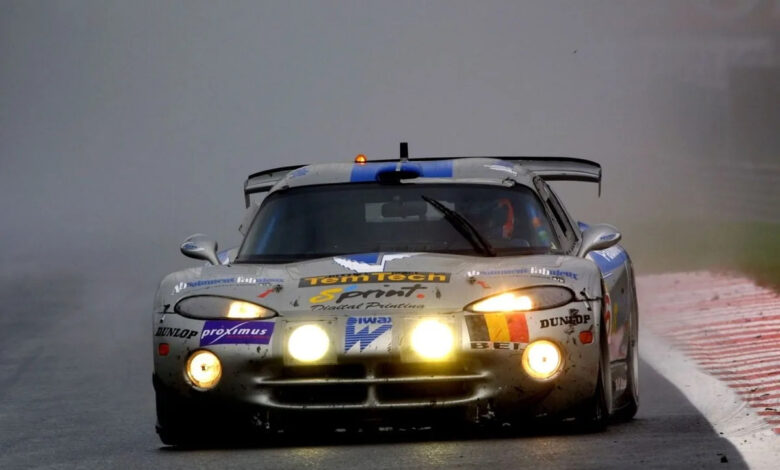
While the FIA GT Championship had taken a massive hit, its secondary tier, headlined by the likes of Dodge Viper GTS-R, Lister Storm, and Porsche 911 GT2, remained exponentially more spectacular than the low-powered Superproduction grids, and vastly more professional than anything that had raced at Spa in 1993. What better way to cement the identity of this grid than giving it a crown-jewel endurance event?
Ratel said: “Of course, we were delighted because that’s really what we needed. Every important category has a headline event, IndyCars at the Indy 500, sports cars at Le Mans, and back in the old days, Formula 1 at Monaco. Every category needs a real big event that is the headline of the season. So taking Spa immediately became the most important milestone.”
Convincing the paddock
While organising the logistical side was one thing, gathering enough entries proved to be an entirely separate hurdle. The contemporary crop of GT machinery was built around 500-kilometer distances or a maximum three-hour time limit.
“We also had to convince our teams because we were doing three-hour, four-hour endurance races, and to go and tell them they have to go for 24 hours with all the additional costs going with it. It was not an easy transition,” Ratel said.
But SRO pushed forward. From 2001 onward, the Spa 24 Hours became an official round of the FIA GT Championship, offering double points to incentivise teams. Expectedly, mechanical reliability over the grueling distance was a massive hurdle initially.
This famously culminated in 2003, when a less powerful Freisinger Porsche 996 GT3 RS from the secondary N-GT class pulled off a sensational overall victory against the fragile top-tier machinery, winning the race by eight laps.
Despite the early pains, it quickly became undeniable that GT racing was the only viable future for the event as every stakeholder benefited: The race instantly regained its global significance, FIA GT secured its defining headline event, teams capitalised on unprecedented media exposure, and fans returned in droves to witness spectacular GT cars tackling the iconic circuit.
In 2010, the event faced another brief crossroads. The original GT class had evolved into the official GT1 World Championship, an ambitious project that ultimately proved economically unsustainable.
Meanwhile, a planned GT2-centric future evaporated when the class couldn’t get enough entries for a proposed European Championship, ultimately giving it away to the Le Mans-governing ACO who rebranded the class into GTE and ran it until 2023.
New Promoter, new heights
Fortunately, the rapidly growing GT3 category offered the ideal escape route for the Spa 24 hours. Having navigated this transition successfully, RACB reposed total confidence in SRO, handing the entire promotion and operational execution of the event over to Ratel.
“And now we promote entirely the event, and it has become undoubtedly the biggest GT race in the world. It’s really an extraordinary event,” Ratel said. “It’s the only grid of 70-plus cars of a single category where only the drivers make the difference.
“You could take the drivers of the car which is on pole to put them in the car which is last on the grid, and they could win the race. It really only comes down to the drivers. And the only classes we have are just based on what we call the driver categorisation.
“But out of the 70-plus cars, you usually have about 25 that are Pro cars, and most of them are supported directly or indirectly by car manufacturers.
“So you have about eight manufacturers officially entered, a number matched only at Le Mans. Le Mans and Spa are the two races in the world where you have the largest number of drivers paid by a manufacturer on the grid.”
The shift to an all-GT3 format also triggered a complete evolution in the competitive nature of the race. “Endurance racing used to be quite boring. I remember when we started, on Sunday morning you had one car that had one lap, two laps, three laps over the second car. And then basically nothing was happening,” Ratel said.
“If you look at the last 10 years, every year we had between three and eight cars, and more often five to eight cars, on the same lap after 24 hours. It is a sprint from beginning to end with a margin at the finish of just a few seconds. It’s really so highly disputed. And the result is that over the last six editions, we had six different brands winning.”
Today, the Spa 24 Hours operates at a level of professionalism that completely eclipses even the most celebrated touring car eras of its past. Looking back, the visionary gamble taken in the summer of 2000 has paid off for the entire motorsport world.
Read Also:
Stephane Ratel on WEC’s BoP secrecy: “There is no conspiracy”
How GT3’s rise surpassed its creator’s wildest expectations


To read more Motorsport.com articles visit our website.