Giants-Rams ‘Kudos and Wet Willies’: Well, Jevon Holland and Jordan Stout had good nights

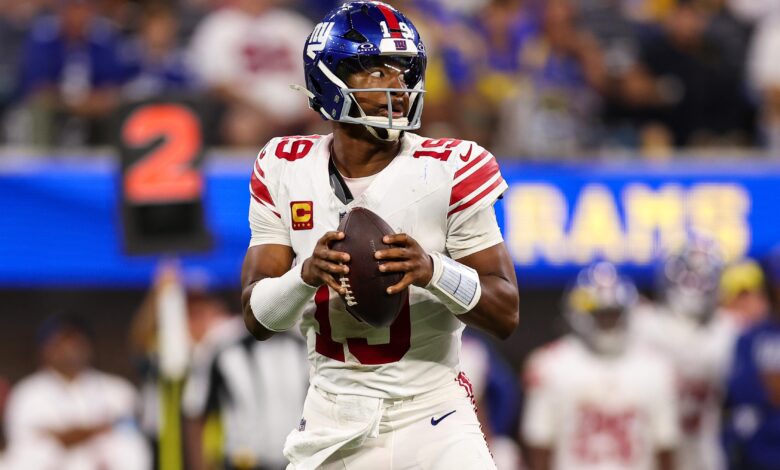

As much as we may not want to, let’s review the New York Giants’ humbling 28-6 loss to the Los Angeles Rams on Monday night in our unique ‘Kudos & Wet Willies’ style.
Kudos to …
Jevon Holland — The veteran safety had an interception and then a forced fumble/fumble recovery on back-to-back snaps in the first half. The fumble recovery gave the Giants the ball at the Rams’ 11-yard line, but they could only convert that into a field goal. Holland forced another fumble in the fourth quarter.
Jordan Stout — Yes, this is one of those games where we end up talking about what an amzing weapon the Giants’ punter is. But, well, he is an amazing weapon. Stout punted six times for an average of 52.5 yards per put. He had a 78-yard punt from deep in his own end zone and a 61-yard punt, as well as three punts downed inside the 20-yard line. He was ridiculously good Monday night.
Dominic Zvada — The rookie placekicker made the first two field goals of his NFL career, the second of which was from 52 yards.
Wet Willies to …
Jameis Winston — The Giants’ backup quarterback wasn’t good at all in relief of the injured Jaxson Dart. He looked unsettled all night. He was off target and unsure. He looked a lot like a quarterback who had worked very little with the first team, which he hadn’t.
Winston finished 11 of 27 for 111 yards passing and an interception. If Dart is going to miss time, which seems likely, Winston needs to be better than that. Much better. If not, the Giants are going to have a difficult time winning games.
Pass protection — Dart got hurt in the pocket, which is supposed to be the safest place for a quarterback, when he got sandwiched between defenders. Winston never looked like he was sure he would be protected in the pocket, and sometimes he wasn’t.
The Rams had just two sacks of Giants’ quarterbacks and eight overall hits, but there was disruptive pressure all night.
The running game — The Giants managed just 52 yards on 21 carries, 2.5 yards per attempt. They desperately need a running game, especially if Dart is sidelined, and couldn’t generate one Monday.
After taking over following a Jevon Holland fumble recovery at the Rams’ 11-yard line, the Giants ran the ball four times (including a play that didn’t count because of a Los Angeles penalty), got to the 6-yard line, and kicked a field goal when trailing 14-0. Not good.
The interior of the Giants’ offensive line seemed overmatched much of the night.
The secondary (other than Holland) — Thank goodness Puka Nacua didn’t play! The Giants couldn’t cover the star wide receiver who did play for the Rams, Davante Adams. He educated rookie Colton Hood, and was too much for everyone who tried to cover him. Adams finished with xx catches for xx yards. The Giants couldn’t cover tight end Terrance Ferguson, either. He finished with xx catches for xx yard, and a touchdown.
Pass rush — Abdul Carter got a sack. That was about it for the Giants’ pass rush. In fact, that is about all the supposedly terrorizing pass rush has done in two games. Matthew Stafford threw the ball 31 times Monday night. The Giants sacked him once and hit him two other times. That’s it. And, that’s not nearly enough.
The Football Gods — Are the Giants simply not supposed to have nice things? Are there fans not supposed to be allowed to have more than fleeting feelings of optimism? Jaxson Dart, Andrew Thomas, Brian Burns, and Malik Nabers all getting hurt in the same game is ridiculous.
Maybe none of these things is, as Harbaugh said, “life-threatening.” Still, though, an awful night for a team that has generated such good vibes thus far.