
The Yankees of the mid-to-late 1990s are the standard. Every single team the Yankees have constructed since that era of stardom for the pinstripes has had the cloud of comparison hovering above it. Those teams dominated, and the Yankees faithful expect every aspect of the current teams to be similar to those squads who could suit up every game and come out of the clubhouse with the “we are going to win every game, and we’re going to win in every important moment” attitude.
Just as Yankees fans expect the players and management to have that attitude, they also expect the manager to instill confidence in the players and the fanbase. And the comparison for Aaron Boone (and every bench boss after him) is Joe Torre, a four-time World Series champion, six-time American League pennant winner, and one of the most decorated leaders in the history of the game of baseball.
Joseph Paul Torre Jr.
Born: July 19, 1940 (Brooklyn, NY)
Yankees Tenure: 1996-2007 (Manager)
Before Torre became a well-decorated manager, he spent his fair share of time gathering accolades in his own major-league career. He was native New Yorker who was steeped in just about as much baseball as one could imagine. Although he grew up on the sandlots of the Brooklyn, he was a Giants fan, but also was enough of a diehard that he was attendance as a fan at a Subway Series game that didn’t even feature his preferred team: Don Larsen’s perfecto in Game 5 of the 1956 World Series.
Torre had a tough background, as his father was the center of an abusive household for years until Joe’s older brother Frank confronted his dad and told him to leave for good. These experiences later motivated Joe to establish the Safe at Home Foundation to aid youth in abusive households. Thanks in part to his brother, Joe was in a better situation to thrive, and he did so at St. Francis Preparatory School in Queens. He was well-built for his age, garnering the attention of scouts from clubs including Frank’s Milwaukee Braves, with whom he would eventually sign his first pro contract.
Torre began his MLB journey at the age of 20 on September 25, 1960, against the Pittsburgh Pirates. He recorded a hit in his only at-bat as a pinch-hitter, and he appeared just one more time that season. The next year, though, he finally received a real shot at the highest level. As a younger kid, Frank told Joe that if he switched to catcher, then he would be recognized more. And that was the position he played for his first MLB season, over 100 games, and exclusively until 1963, when he played first base as well.
In 1961, Torre finished second to Cubs Hall of Famer Billy Williams in the NL Rookie of the Year. He went on to play four more years with the Braves before they moved to their present-day location of Atlanta, garnering his first three All-Star appearances and then a Gold Glove in ’65.
From their 1966 inception down south, Torre would play another three full seasons with Henry Aaron and company. He added two more All-Star appearances to his name before being traded in spring training the following season to the St. Louis Cardinals.
Torre began his time in St. Louis at age 28 and collected four more All-Star appearances to bump his career total up to nine. The zenith of his Redbirds career was an MVP win in 1971 after leading the major leagues in hits (230), RBI’s (137), and batting average (.363). His final OPS+ for the season was 171, the highest of his career. He beat two NL legends in the race that year: his former teammate Aaron and the Pirates’ Willie Stargell.

For the final time in his career in 1974, Torre was traded, this time to the New York Mets. He played three seasons with them before retiring as player/manager in 1977 with nine All-Star appearances, a Gold Glove, a batting title, an MVP, and a TSN Major League Player of the Year Award. However, playoff success—or even an appearance in the postseason at all as a player—eluded Torre. So, when he found his way back into baseball, he was looking to write and finish that chapter.
Long before Torre became the Yankees’ skipper, he returned to all three of his former teams as bench boss. First, he started with the Mets from 1977 to 1981, but in his five years as manager (including a strike-shortened 1981), he never finished with a winning record. He was fired and moved on to Atlanta, replacing Bobby Cox as manager for the ’82 campaign. Led by MVP Dale Murphy, the Braves won 13 consecutive games to open the year, and the team finished with an 89-73 record that was good enough for the NL West division title. But Atlanta didn’t win a single playoff game, as the eventual champion Cardinals swept them away in the NLCS. Still, Torre was voted the Associated Press Manager of the Year as a result of his work in his first season.
Torre finished his final two years in Atlanta with slightly worse records than his first season, with 1983 at 88-74 and ’84 at 80-82. He was fired and had to spend the next few years away from the dugout, broadcasting games for the California Angels. In 1990 though, his old Cardinals gave him another shot. Success remained difficult to come by, as his career managerial record with St. Louis was 351-354, sitting around the 85-win mark for most of his tenure there. His best season was 1993, when his club posted an 87-75 record, but the Cards went 53-61 in the strike-shortened ’94 and got off to a 20-27 start in ’95. For the third time in his career, Torre was fired, and he figured he was out of chances since all his old teams had tried him out and let him go.
Nonetheless, the chance of a lifetime fell in Torre’s lap. Despite breaking their 14-year playoff drought in 1995, disagreements with Yankees owner George Steinbrenner over his coaching staff motivated manager Buck Showalter to turn down his contract offer. So a talented team was looking for a new skipper, and it just so happened that one of Torre’s old friends from his Mets days, Arthur Richman, was working for Steinbrenner. He encouraged the Boss to give Torre an interview, and the rest is history.
Yankees fans were initially opposed to the idea, given his unsuccessful track record, but with the winning that followed his hire, opinions quickly turned. In 1996, the Yankees finished with a 92-70 record and their first division title since 1981. They dispatched Texas and Baltimore in the playoffs to win the pennant and finally get Torre to his first-ever World Series after over 4,000 games between his playing and managerial careers. It was an emotional scene at Camden Yards when rookie Derek Jeter threw to first base for the final out of the ALCS.
That made for a nice story, and many thought that it would end right there. After all, Torre’s Yanks were stacked up against the then-consensus Team of the ’90s, Torre’s old Braves. Cox had returned to Atlanta and helped build an outstanding club that was laden with future Cooperstown honorees. Entering the ’96 Fall Classic, they’d won four pennants already in the decade and captured their first championship in ’95, silencing an overpowering Cleveland offense in the process with their Greg Maddux/Tom Glavine/John Smoltz pitching staff.
Atlanta was red-hot coming into Game 1 of the World Series in the Bronx. They’d overcome a 3-1 NLCS deficit against St. Louis by outscoring the Cards 32-1 across the final three games, and at first, the Yankees didn’t have an answer. Cy Young contender Andy Pettitte was clobbered in the Fall Classic opener, 12-1, and Maddux led a 4-0 shutout in Game 2. The World Series shifted to Atlanta with the Yankees already in an 0-2 hole and season obituaries already written. Torre later recounted a story where he told a doubting Steinbrenner that they would win the next three games in a row in Atlanta, return to New York, and win it in Game 6. The skipper said the Boss “looked at him like he had three heads.”
But Torre proved prescient. His team had a stirring comeback, taking Game 3 before rallying from a 6-0 deficit to win Game 4 on the back of Jim Leyritz’s big homer in the eighth, and then ekeing out a 1-0 win in Game 5 with 8.1 brilliant innings from Pettitte. The Yankees beat Maddux in Game 6 back in the Bronx, and they were champions for the first time since 1978. The man who was dubbed “Clueless Joe” when joining the team on November 2, 1995 was named 1996 Co-AL Manager of the Year Award alongside the surprising Rangers’ Johnny Oates.

The Yankees actually improved in the 1997 regular season to a 96-66 record, but had to settle for a Wild Card spot behind Baltimore and then suffered a early elimination at Cleveland’s hands in the ALDS. The shocking loss—one that featured a Game 4 comeback against no less a force than Mariano Rivera—set the stage for one of the greatest dynasties in baseball history to be born.
The Yankees of 1998 would become the winningest team in baseball under Torre’s calm leadership, always a strong shield to his team’s owner’s barbs in the press. Of course, he had an incredible core of players to lean on and lead by example on the field and in the clubhouse, but 114 wins aren’t just stumbled upon. The club finished with just 48 losses in the regular season, then went on to dominate the postseason, dropping only two games throughout October. Torre won his second American League Manager of the Year Award in three years as a result.
While it was going to be almost impossible to replicate the success of the 1998 season, the goal remained the same for everyone involved: win the whole thing. Yes, the regular season record dropped back to Earth (although 98 wins and 64 losses is still a heck of a bargain), but it was still the same Yankees who had won two championships in their last three seasons, and it was the same manager who was voted best amongst his peers two of the last three seasons as well. It wasn’t an easy season for Torre personally, though, as he was diagnosed with prostate cancer in spring training, and when he came back after making a full recovery, he had to help some of his players who were going through their own struggles. But they still found a championship, sweeping the Braves in the process.
Despite an 87-win season in 2000 with his aging and somewhat-underperforming club, the Yankees took the division anyway and Torre still managed the Yankees through the water rushing against them. Everyone wanted to dethrone the kings, but Torre, along with his core group, would not let that happen. They came up against the crosstown rival Mets (the second of two former clubs Torre would face in a World Series), and bested them in five games for their third consecutive title. Torre is one of only three managers to achieve that feat, alongside Yankees legends Joe McCarthy and Casey Stengel.
The 2001 season was extremely difficult, particularly toward the end of the year. The Yankees had an easier road to the division title with 95 wins, but the attacks of September 11th left the entire city scarred and shaken. Under Torre, the Yankees helped lead the way to bringing light and soul back into the city. In the 2001 ALDS, Jeter made one of the most legendary plays of his career — the backhand flip to Jorge Posada against Oakland, giving hope to all fans that this team could do the impossible. And the Yankees followed that 0-2 series comeback by defeating the 116-win Mariners in the ALCS. However, the hope would run dry in the 2001 World Series against the Arizona Diamondbacks, despite incrediblystirringwins in the Bronx. In Game 7, it was the person you would least expect—Rivera—who gave up the winning run in the most heartbreaking of ways. And although the Bombers were not going to remain kings of the hill forever, it was a brutal way to go in a season that meant so much to the city of New York.
Following all that postseason success from 1996-2001, the remainder of the 2000s decade was a challenge. In 2002, the 103-win Yankees were upset in a four-game ALDS loss to the Angels, and while they returned to the Fall Classic in 2003 in dramatic fashion, they were again dispatched by a surprising club. The Marlins won three in a row to shock the Yanks in a Game 6 shutout clincher, and the first of those three featured an infamous Torre decision to not use Rivera in extra innings on the road. Instead, it was Jeff Weaver who gave up a walk-off homer to Alex Gonzalez, sparking the Florida comeback.
2004 was the hardest loss of them all — blowing a 3-0 series lead to the rival Red Sox on their way to winning their first World Series since 1918, thus breaking the Curse of the Bambino. Then from 2005-07, the Yankees lost in the first round for three years in a row. Torre was facing more criticism than ever for his tactics, and the non-Rivera relief aces like Tom Gordon, Paul Quantrill, and Scott Proctor were getting gassed down the stretch. 2007 marked the end of Torre’s career with the Yankees, as he turned down what he believed to be an insulting contract offer from the club to return.
Torre went on to manage the Dodgers from 2008 to 2010 and winning two more division titles. The Phillies eliminated them in the NLCS both years, and he stepped down after 2010 with 2,326 career wins. Since 2011, he has worked in the commissioner’s office, handling all kinds of managerial work across MLB. Time heals all wounds, and Torre received a big ovation when his No. 6 was retired in 2014.
Torre served as the Yankees’ manager for a dozen seasons. He managed 1,942 regular-season games, with a win-loss record of 1,173–767. In all 12 of those seasons, the Yankees reached the playoffs; during that time, they won six American League pennants and four World Series. He is one of the most legendary managers in all of baseball history for the turnaround he helped guide the Yankees through, and his playing days weren’t short of impressive as well.
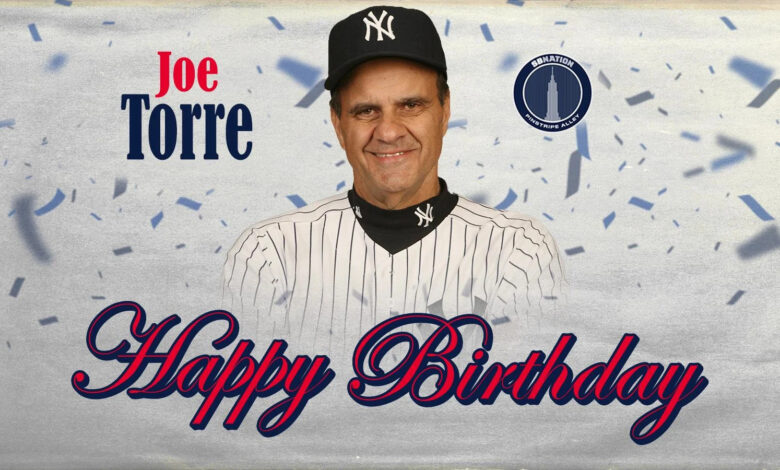
As one of the most influential people in Yankees history, it’s always exciting for fans to see him around the Yankees today whenever he’s able to help as well. Happy birthday, Joe!
See more of the “Yankees Birthday of the Day” series here.