
The World Cup is just hours away! With the countdown edging ever closer to zero, Playmaker steps up to introduce the 48 participating national teams across 12 articles — one for each group in the competition. Find out more about each nation, including their likely starting XI and some of the standout names.
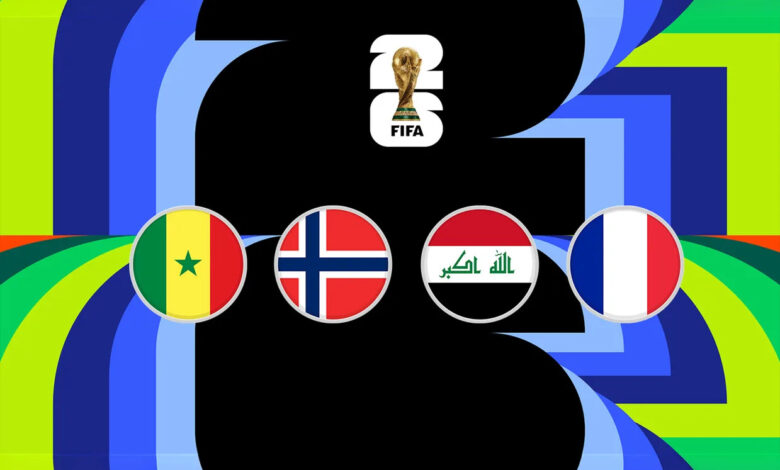
Group I offers an intriguing mix of tradition, individual quality and comeback stories. On paper, the clear favourite is France, two-time world champions and finalists in two of the last three editions. However, this group is far from straightforward.
Senegal continues to establish itself as one of Africa’s leading powers, Norway returns to the World Cup after almost three decades away, driven by a golden generation, and Iraq is back on football’s biggest stage 40 years after its only previous appearance.
There is also a special storyline: France and Senegal meet again at a World Cup for the first time since Senegal’s famous 1-0 victory in the opening match of the 2002 tournament, one of the biggest shocks in the competition’s history.
Senegal
Number of appearances: four
Best performance: quarter-finals in 2002
Since that historic 2002 World Cup, Senegal has established itself as one of the leading powers in African football. The national team has been a regular presence at major international tournaments and continues to offer an interesting blend of experience and talent. Although it is no longer seen as a surprise package, it still has the ability to compete with teams from any continent.
The road to this World Cup once again showed that consistency. The Teranga Lions remain a physically strong, highly competitive side and extremely difficult to beat. The battle for a place in the last 16 is set to be intense, but few doubt Senegal’s ability to fight for that spot until the final round of matches.
The head coach – Pape Thiaw
Replacing Aliou Cissé was never going to be an easy task. The former head coach left an important legacy, including winning the Africa Cup of Nations and several strong campaigns in major tournaments. Pape Thiaw has been entrusted with carrying that responsibility and guiding the team into a new phase.
Although he is still building his story at the helm of the national side, the coach has managed to maintain Senegal’s competitive edge. This World Cup will be the biggest test of his career so far, and also a chance to establish his own identity within a side accustomed to competing at the top end of African football.
The star man – Sadio Mané
Even without the same physical explosiveness he once had, Sadio Mané remains the face of Senegalese football.
The forward has built a remarkable career at the highest level in Europe and remains the team’s main technical and emotional reference.
The experience he has gained in major competitions could prove decisive. Beyond his individual quality, Mané plays a leadership role on and off the pitch, serving as an example for a younger generation looking to follow in his footsteps. In a balanced group, Senegal will need its captain at his very best.
One to watch – Ibrahim Mbaye
He is one of the most promising names to emerge in recent Senegalese football. The young winger has stood out for his unpredictability and dribbling ability, attracting attention both at Paris SG and in the youth national teams.
Although he is still at an early stage of his career, he already shows clear signs that he could become an important part of the senior team in the future. This World Cup could be his first major international showcase, where his pace and creativity may offer Senegal’s attack a different kind of threat.
Other key players: Kalidou Koulibaly (Al-Hilal), Nicolas Jackson (Bayern Munchen), Iliman Ndiaye (Everton), Ismaila Sarr (Crystal Palace)
Norway
Number of appearances: four
Best performance: two last-16 finishes
For many years, Norway was seen as a side with enough talent to return to the major tournaments, but unable to turn that potential into results. That wait is finally over.
After almost three decades away, the Scandinavians are back at the World Cup and arrive with very high expectations.
The reason is simple: few teams outside the outright favourites have so many quality options in attack. The combination of individual talent, collective stability and confidence built during qualification makes Norway one of the most interesting teams to follow in this competition.
The head coach – Stale Solbakken
A respected figure in Norwegian football, Stale Solbakken was the man who managed to bring the country back to the World Cup.
The work carried out over recent years has transformed a talented generation into a genuinely competitive team.
The coach has found the right balance between individual quality and the collective, something Norway seemed to lack for a long time. Qualification for the World Cup ultimately validated a project that had been built patiently and is now looking to take another step forward.
The star man – Erling Haaland
There are very few strikers as feared in world football as Erling Haaland. The centre-forward arrives at his first World Cup after several years of scoring goals almost relentlessly on Europe’s biggest stages.
Expectation around his performance is immense. For the first time, he will have the chance to showcase all his quality at a World Cup, and much of Norway’s ambition depends on his ability to decide matches. If he is at his usual level, any opponent will struggle to contain him.
One to watch – Antonio Nusa
Among the many Norwegian prospects, Antonio Nusa stands out as one of the most exciting. The winger combines pace, creativity and flair, traits that make him particularly dangerous in open spaces.
At 21, he is continuing to develop in important ways and this World Cup is an excellent opportunity to establish himself in front of a global audience. It would not be a surprise to see him play a decisive role in some of Norway’s biggest moments.
Other key players: Martin Odegaard (Arsenal), Alexander Sorloth (Atlético de Madrid), Andreas Schjelderup (Benfica), Jens Petter Hauge (Bodo)
Iraq
Number of appearances: two
Best performance: group stage
Iraq brings one of the most interesting stories in this group. 40 years after its only World Cup appearance, the Asian side returns to football’s biggest stage. Qualification was celebrated with huge emotion and reflected the steady growth the team has shown in recent years.
Although they aren’t touted to go far in the tournament, Iraq believes it can be competitive. The pressure will be lower and that could work to the team’s advantage. In a long and unpredictable tournament, teams with little to lose often spring surprises.
The head coach – Graham Arnold
After several years in charge of Australia, Graham Arnold took over as Iraq’s head coach with the mission of raising the Asian side’s competitiveness.
The Australian coach built a reputation for organised, disciplined teams capable of outperforming expectations, something he now aims to replicate in this new international challenge.
Reaching the World Cup is a demanding test, but also an opportunity to leave his mark on a team that is on the rise.
The star man – Zidane Iqbal
Among the names in the current Iraq squad, few attract as much curiosity as Zidane Iqbal. Developed at Manchester United and possessing a technical profile that is unusual in the national-team context, the midfielder quickly became one of the side’s main references.
His passing quality, positional intelligence and ability to carry the ball make him a differentiating player. In an Iraq side that will often need to sit deep and look for controlled periods of possession, much of the attacking build-up is likely to pass through his feet and his creativity.
One to watch – Youssef Amyn
Youssef Amyn represents one of the faces of Iraq’s new generation trying to establish itself in international football. The winger stands out for his movement and ability to attack space, offering different solutions to the team’s attacking unit.
Still young, he has already shown enough personality to take on a prominent role. This World Cup could be an important platform to consolidate his name and show that Iraq has the talent to compete on a bigger stage.
Other key players: Ahmed Qasem (Nashville), Ali Al-Hamadi (Luton Town), Mohanad Ali (Dibba Al Fujairah), Hussein Ali (Pogon Szczecin)
France
Number of appearances: 18
Best performance: winners in 1998 and 2018
If there is one team that must win this group, it is France. The 2022 runners-up still boast one of the most complete squads on the planet and reached the World Cup unbeaten in qualifying, securing their place comfortably.
The squad depth is impressive. Even with the gradual renewal of some positions, the French continue to combine experience, youth and an enviable amount of attacking talent.
The minimum expectation is a place in the quarter-finals, but anything less than the semi-finals will be seen as a disappointment.
The head coach – Didier Deschamps
Few managers can match that CV. A World Cup winner as both player and coach, Deschamps has led France since 2012 and remains one of the most respected figures in international football. His ability to manage dressing rooms full of stars has been one of the keys to France’s success.
The star man – Ousmane Dembélé
For many years, he was viewed as an extraordinary talent who could never maintain consistency because of injuries. That is now behind him. At 29, Ousmane Dembélé arrives at the World Cup at the peak of his career, after becoming a central figure in the attack of Paris SG and the French national team.
Capable of causing problems in any area of the final third, both with pace and creativity, the winger has become a far more complete and decisive player. In a squad full of stars, he is now one of the names that inspires the most confidence among French fans and one of the candidates to make the difference in the decisive stages of the competition.
One to watch – Rayan Cherki
For years he was tipped as one of the biggest prospects in French academy football. Now, at 22, Rayan Cherki finally looks ready to play a major role in international football.
The creative midfielder stood out at Lyon for his above-average technical quality, vision and ease in creating danger in tight spaces – something he has transplanted to the Premier League since then. His recent rise at the highest level has earned him a more important place in the French national team, and this World Cup could be his true introduction to a global audience.
Other key players:Kylian Mbappé (Real Madrid), Michael Olise (Bayern Munchen), Warren Zaïre-Emery (Paris SG), Marcus Thuram (Inter)