The 2026 FIFA World Cup has featured incredible matches, the world’s biggest stars, and even, throughout the early stages of group play and the knockout phase, several penalty kicks. While penalty kicks have been a hot topic amongst fans, with some disliking that they can ultimately decide games in the knockout round, another emerging conversation has been about the stutter-step approach to penalty kicks. With some penalty kicks taken using the stutter-step approach resulting in a miss, either wide, high or being saved, many wonder why stars are going with this method.
The first big question is simple: why are players opting for the stutter-step penalty method over taking a normal shot? Let’s start there.
The good and bad sides of stutter-step penalty kicks
I’ll start by saying that I’ve played soccer for much of my life. I’ll add to that by clearly highlighting that I’ve never been even within striking distance of being as talented as any player who’s even had a CHANCE to play for any national team. However, one thing I can tell you is that the stutter-step penalty kick requires an incredible level of talent to pull off successfully.
An example of how things go ideally for a penalty taker comes from Neymar during Brazil’s 2-1 loss to Norway. Neymar uses the stutter-step to get the keeper to lean one direction, and he then buries the kick into the opposite corner.
NEYMAR GOAL 🇧🇷
He converts the pen and has words for Norway keeper Ørjan Nyland. pic.twitter.com/OeVhyD9oDt
— FOX Sports (@FOXSports) July 5, 2026
You’re effectively stopping your run-up and momentum, and then taking a smaller stride before taking your shot. Players have to be at an elite level to be able to do this at the highest level, on the biggest stage and against the best keepers in the world. But if they can, it’s a method that can pay dividends because the player taking the penalty kick can gain an advantage.
Why stutter-step penalty kicks have become common at the 2026 World Cup
Penalty kicks are essentially a game between the shooter and the goalie. The player attempting the kick is attempting to convince the keeper they’re going one way, while the goalie wants to read the player’s body/feet/etc. to guess where the shot is going.
So, why the stutter-step?
If it’s effective, a stutter-step gives the player a chance to see if the goalie can give anything away. A slight lean one way or an early jump can help the player know where to shoot the ball successfully. If it works, and the goalie does give anything away, less power is required behind a player’s shot, and they can instead place the ball in the opposite corner/side.
The problem that can emerge is if the goalie doesn’t flinch. At that point, the player has to add power to their shot and in many cases, the advantage could go to the keeper, unless the player shooting is just an elite talent (which many World Cup stars obviously are). As we’ve seen, even the world’s most talented players can be on the wrong side of a stutter-step penalty.
Mbappé can’t convert the penalty 🤯 pic.twitter.com/Jf9S4Js5rk
— FOX Sports (@FOXSports) July 9, 2026
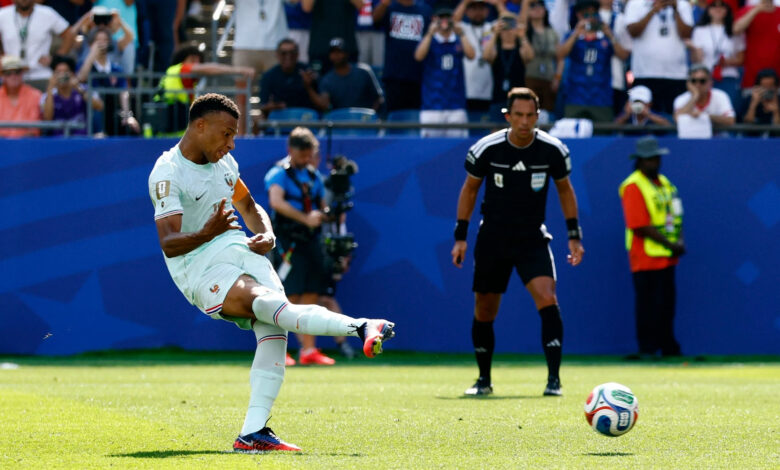
One example is the penalty kick from Kylian Mbappe of France against Morocco during the quarterfinals. Mbappe did a stutter-step, but in this instance, the keeper actually led him to believe he was going one way, then immediately went the other, gaining an advantage in a split second.
This article originally appeared on For The Win: Why are stutter-step penalty kicks so popular at the 2026 World Cup?