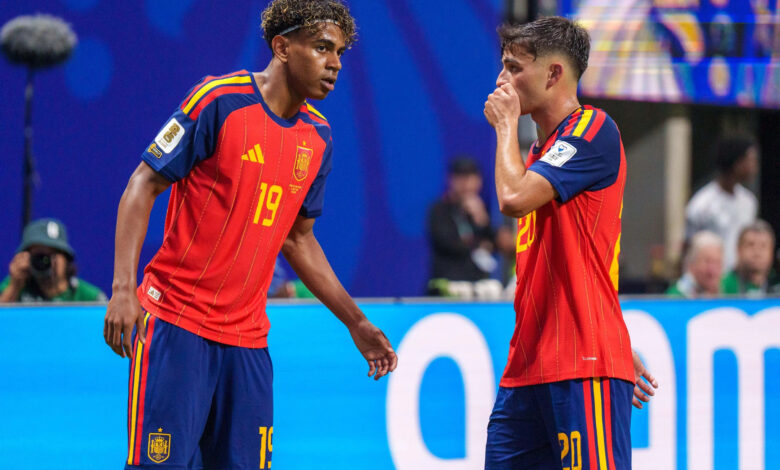

Spain and Barcelona have a lot in common.
For one, there are eight Blaugrana players (nine if you include Fermín López) on the national team roster.
Historically, Barcelona has been a team with strong midfield talent, and you can see that reflected in the way Spain has played under multiple managers since their World Cup in South Africa in 2010.
In hindsight, you could see the struggles against Verde coming from a mile away the moment Luis de la Fuente’s starting eleven was released.

With four midfielders on the field, which was coach’s solution to not having Lamine Yamal and Nico Williams fully fit, and your two strikers being Ferran Torres and Mikel Oyarzabal, parking the bus was always going to be a viable tactic.
What we saw was nothing new, especially if you’re a Barcelona fan. Spain finished with 75% possession, and zero goals.
Eric Garcia said it well in his analysis of the game.
“Against teams that sit back like that, the ball movement has to be very quick,” he told Mundo Deportivo.
“You have to try to occupy spaces inside, even if they try to close them down, because that creates space for you, and then it opens up on the wings.
“It’s something we generally experience all the time with the national team because we’re a team that likes to play attacking football. Opponents sit back and you have to try to find that space. So I don’t think it caught anyone by surprise.”

The problem is, even if you create time and space for the wingers, you still have to have players out wide who can play in a dangerous ball, or run past a defender on the dribble.
Even if you have those players, like Lamine and Nico, it won’t be easy to break down a parked bus. You need tactics for that, so the speed of play is everything, but specifically it’s not the side to side passing game that will unlock the defense, but rather the Hansi Flick approach of not being afraid to be direct.
Barcelona should watch that game and realize that’s what Barcelona will turn into if they get the tactics and the player selection wrong. La Liga have teams like Cape Verde who will line up the same way. If they drop points in those type of games, winning the league will be all the more difficult.

That’s why I’m optimistic about the signing of Anthony Gordon. Even if he had a quiet game for England, he is a system player who was brought in specifically for Flick’s system.
Marcus Rashford scored a fine goal against Croatia, and I still think Barcelona may regret not negotiating his signing, but a defense first approach that emphasizes high-energy pressing is mandatory for Flick’s team to be successful.
Frankly, I think Spain needs the same thing.
They are already a Barcelona copy cat in many ways. Maybe Luis de la Fuente should have been studying Flick over the past year instead of fighting him in the media.

What’s most important is to take care of Lamine Yamal.
Spain is clearly dependent on him, but it’s not worth risking injury to over-rely on him in the group stage.
If Spain can’t get past Saudi Arabia and Cape Verde without him, then maybe it’s just not their year.
On Sunday, they’ll have a chance to redeem themselves, and I would expect changes to the starting lineup, and hopefully some tactical tweaks too.
Football needs Spain and Barcelona to be successful. They are the standard bearers of everything that is beautiful and right with the game.
That being said, they won’t be given anything for free.
Cape Verde was a great reminder of that.