Spain’s newest golden generation poetically nullified Lionel Messi in his final World Cup game

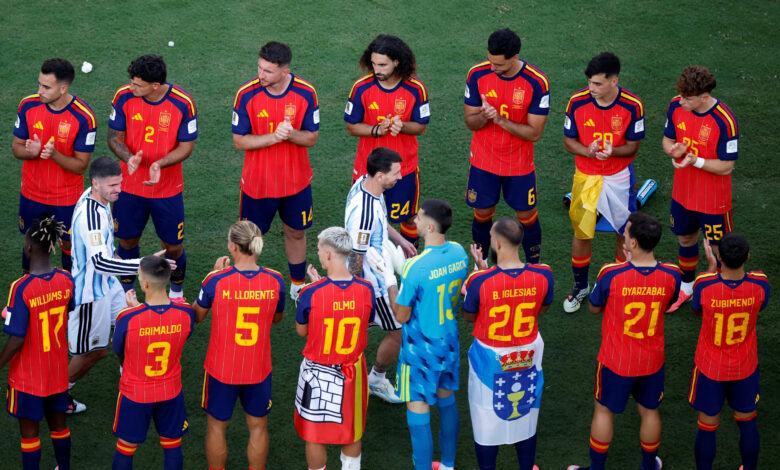
Sunday was not a goodbye to Lionel Messi.
As hard as it was to slowly bid adieu to the greatest player soccer has ever seen over the last five weeks at the men’s World Cup, we have not seen the last of the legendary Argentine. While he will likely never play for Argentina again, icons like Messi do not simply fade into obscurity. Certainly not without making another peep. (Well, “obscurity” depending on whatever you think of Major League Soccer). One way or another, Messi’s image will continue on, whether it’s intentional or passive, and particularly whenever we turn our eyes to soccer. Sports figures like him do not “go away.” They are omnipresent; a reminder of the best version of the silly games we love. Messi, even at 39 (maybe especially at 39), is timeless. It is unfathomable ever to think he could be forgettable, that he could ever be forgotten.
As much as it pains me to admit, I would sooner forget the name of an important password or a delicious dinner item for a family member’s birthday than I would forget someone like Messi. Sorry, Mom.
And yet, for one hot and muggy late July afternoon in New Jersey, that’s exactly what Spain did to the finest soccer player who has ever lived. I forgot that Lionel Messi, the athlete who has defined almost two generations of the sport, who could pull a real rabbit out of a hat with no secret compartment on a whim, was actually playing in the biggest sporting event of modern human civilization. It is, ironically, the one lasting memory I will take from Spain’s 1-0 victory in Sunday’s World Cup Final.
Lionel Messi heads off the pitch, perhaps for the final time at a FIFA World Cup. pic.twitter.com/6xXvvlH4Qu
— FOX Sports (@FOXSports) July 19, 2026
That’s how technical, how efficient Spain’s latest golden generation was in the game of its life. Messi had zero shots on goal. No touches that were in any way threatening to the Spanish machine. A completely anonymous and normal game in the career of a man who has made a reputation for making the abnormal look routine. It is perhaps no coincidence that if Messi was rendered mute, so was a juiceless Argentine side. Is it any wonder that some Argentine players were so frustrated after losing? For all intents and purposes, Spain made Messi invisible. He was just another guy wearing the classic Argentina powder-blue-and-white striped uniform, struggling to make any sort of positive play. He was another mass-produced pawn on the chessboard, not a living legend who oozes eminence with his mere presence.
To be sure, none of what transpired in this anticlimactic final was surprising. Yes, Messi led Argentina to its third World Cup Final in the last six tournaments. Yes, Messi remains an incredible player for whom we have run out of appropriate adjectives. And absolutely, it sure seemed like the Argentines resembled a team of destiny, so to speak. Never mind that the soccer gods tend to laugh at those who they think have it all figured out. That’s why you don’t tempt fate. This was still a lesser, older, and slower version of Messi. Despite an obvious heart of a champion, this was still an inferior Argentina team that, quite frankly, did not belong on the same field with a team as polished as Spain.
Spain did what it was supposed to. That is, nullify a past-his-prime legend in what will likely be the last truly big game he’ll ever play in. They cut off the head of the snake without blinking. With ruthless efficiency, at that. Even though their winning goal didn’t come until extra time, it never felt like the Spanish really broke a sweat. That is eye-opening, staggering, honestly, considering who was playing for the other team.
It is critical to note that it would be foolish to say this game will, in any way, define Messi’s incredible legacy. His place in soccer, hell, all of sports, is so secure. There has never been a player like Messi before. There will never be another, only cheap imitations, at best. This World Cup final was a last-gasp attempt at a storybook ending, a cherry on top, not the pressure cooker that the 2022 iteration was, with the proverbial “monkey” of having never won the World Cup still desperately clinging to Messi’s back four years ago before he finally ripped it off like Velcro. Nothing more.
You just watched what is, in all probability, the final international chapter in the best and most unique athlete’s career of our lifetime. Maybe someone different will come along down the road, but it certainly won’t be someone who even resembles Messi.
🐐—Second-most goals in history (21)
🐐—Most wins in history (23)
🐐—Longest scoring streak (9)
🐐—Oldest hat trick scorer (38)
🐐—Joint-most tournament appearances (6)
🐐—Argentina’s top scorer at World Cup
🐐—Most goals from outside the area (7)
🐐—Most World Cup appearances… pic.twitter.com/7hze9eFYxy— B/R Football (@brfootball) July 19, 2026
Perhaps that is the ultimate note to unpack here. Messi’s possible final game for Argentina was not a king maintaining his throne. It was an old man, in sporting terms, unofficially paving the way for the coronation of a new phenom, Lamine Yamal, poised to lead a young and proficient Spanish side into an extended reign atop soccer for the foreseeable future. And Messi could only simulate meaningful resistance to being usurped.
Messi has been soccer’s golden boy for almost a quarter-century. He had his moment. Many moments, in fact. So, it’s fitting that his last World Cup game for Argentina was a convincing defeat at the hands of a generational Spanish side that made him irrelevant. In a tragic but poetic turn, Messi, in effect, took us into one era of soccer this millennium at his beginning and ushered us into another at his end. One transition was intentional, the machinations of a magician who always had another trick up his sleeve in response to adversity. The other was decidedly not, the quiet but expected thud that all of us, even icons like Messi, inevitably experience.
This article originally appeared on For The Win: Spain’s newest golden generation poetically nullified Lionel Messi in his final World Cup game