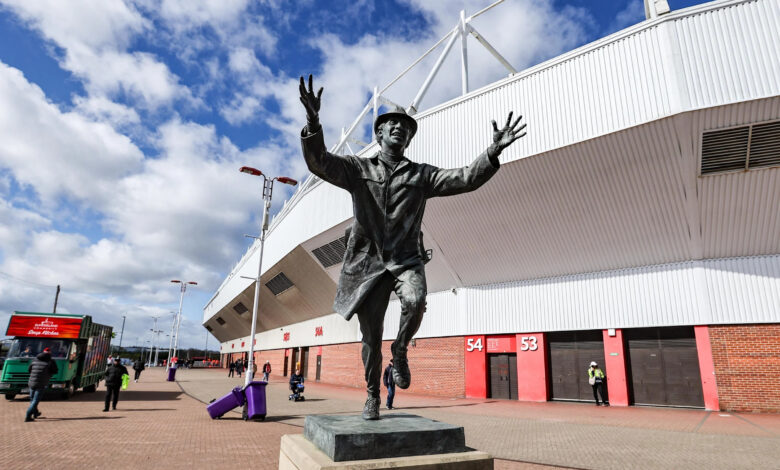

The Bob Stokoe statue was officially unveiled on this day in 2006.
It was sculpted by Sean Hedges-Quinn, a bronze monument to one of our most loved and idolised managers — nicknamed The Messiah.
The enormous grin and Stokoe’s attempts to keep that trademark trilby hat on his head even in the heat of such a triumphant moment marked him out as a special man and a gentleman, with his mackintosh raincoat wafting behind him as he raced onto the pitch at the full time whistle to wrap his arms around Jim Montgomery and hold him aloft.
It’s now a well known and well-loved feature outside The Stadium of Light; a favoured meeting place for many fans but on a busy match day (just like the Bobby Moore statue at Wembley), perhaps it’s not the best idea!
But what about the story behind it, and how did it eventually come about?

Everyone was already indebted to Stokoe even well after his retirement, but following his death on 1 February 2004 at University Hospital Hartlepool, there was a wave of support to create a lasting memorial and a drive was started to raise £73,000 for the creation of a statue in his honour.
It seems that ‘73 is a recurring figure in Stokoe’s story — the 1973 famous FA Cup win over the-then mighty Leeds United, the figure of £73,000 needed to produce the statue, and his age of seventy three when he passed away.
There was a huge local — and indeed global — effort to raise the funds. We may take it for granted now, but over twenty years ago, you couldn’t have avoided stunts and promotions to raise the cash by fans and the wider public.
There were, of course, the usual bucket collections outside the ground. Over eighty volunteers would be around the stadium on match days and at the famous Sunderland Air Show, there were folk galore raising awareness and money for the cause. Limited edition t-shirts were on sale, capturing Sunderland’s FA Cup-winning manager running onto the pitch, and plays were put on to raise money.
Various beer companies got in on the act. “A rich and malty 3.8% beer” was sold, with 15p per bottle from every sale of Stokoe’s Trophy going towards the statue appeal, whilst the Double Maxim Beer Company sold Stokoe’s Best Bottled Ale with a similarly generous offer.

Art exhibitions of Sunderland memorabilia could be found, as well as some well-known local bands putting ticket sales towards the appeal.
Such a band at the time was one of my favourite local bands for many years: The Junco Partners. Elsewhere, Ronnie Barker (not that one) and John Anderson (not that one!) were doing their stuff at The Exchange Building at Wylam Wharf.
TV agony aunt and famous Sunderland fan Denise Robertson advertised the appeal and encouraged people to donate. Hotlines were set up — the first by a Jarrow law firm — and ex-players helped to spread the word and promote the appeal.
As 1973 cup-winning captain Bobby Kerr said: “It’s not just Sunderland fans who appreciate what Bobby did for football. Part of his career was spent at Newcastle, as well as other clubs. Although the ‘73 win was most poignant, it wasn’t the whole story.”

Kerr was right.
Newcastle United’s former players association donated £10,000 and Freddy Shepherd put his hands into his large pockets.
A report in the West Lancashire Gazette ran a feature to appeal to Blackpool fans, where Bob enjoyed two separate spells as manager, to dig deep, whereas other ex-players used their platforms to keep the money rolling in.
In the Sunderland Echo, Gary Rowell in The Rowell Report stated: “It’s something I want to see achieved, because I’m a big believer that clubs are about more than just the present day — they’re about standards and traditions.”
So very true.
After speaking to Jim Montgomery (himself a leading figure in helping to launch the campaign), local poet Sally Lawson penned a poem titled An Appeal For Bobby that was published. So it continued — through The Wearside Roar, city councillors and Tom Cowie (£5,000) — the money kept coming in and less than nine months from the launch of the appeal, the money was raised.
But where would it be placed, which Bob would be on show, and who would do it?
Of course, all these questions were part of the procedure. And it wasn’t without controversy. Some complained that they’d contributed to a separate appeal for a statue three years earlier, so where had that money gone? Others argued that the fans shouldn’t have to raise the money at all and that it should be the club’s responsibility.
Ipswich Town had paid for their statue of Bobby Robson and Newcastle had paid for Jackie Milburn’s, but why had Sunderland AFC not funded Stokoe’s? I’m sure those arguments would be the same today. But it is the people’s statue. For the people’s hero. That feels right.
The eventual short list of sculptors was drawn up and Sean Hedges-Quinn won the honour.
It was unveiled by Stokoe’s daughter Karen Craven, who was very moved and impressed by the statue and all the efforts to bring it into being. Hedges-Quinn had spent hundreds of hours working from video footage and photographs, and incorporated tiny details in order to enhance the artwork.
Did you know that Stokoe’s watch has its hands set at exactly 4:50 pm, the time the final whistle blew that day? It came in at £5,000 under budget, which was donated to the Alzheimer’s Society at the request of the Stokoe family.

And as we move towards the present, how absolutely fitting it is that the man who enthused Stokoe so much to run onto the pitch — goalkeeper Jim Montgomery — is also going to be immortalised with his own statue, facing Stokoe and reenacting that glorious scene from that iconic day.
The story lives on. The history continues to grow.
I didn’t bring the magic. It’s always been here. I just came back to find it.