NWSL returns with the Challenge Cup, but the question remains: What is its purpose?

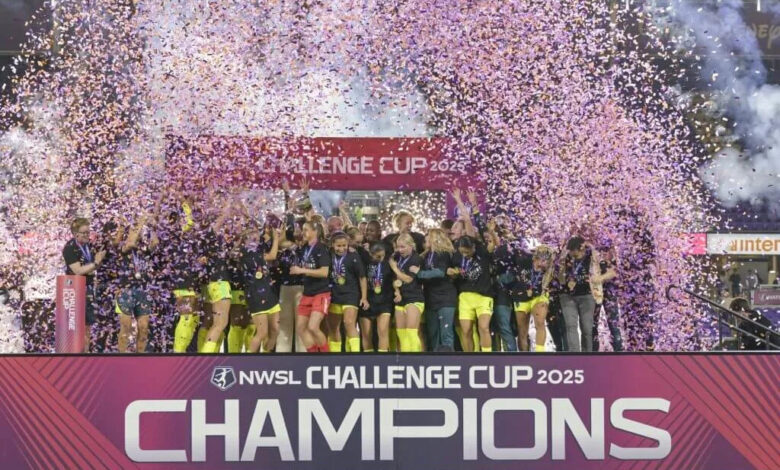

What was created as the NWSL’s month-long return to play tournament during the summer of the COVID-19 pandemic, the Challenge Cup has been a one-off match since 2024 between the league’s championship winners and regular season winners — assuming they are two different teams. (In 2025, Orlando Pride won both titles, so NWSL Championship runners-up Washington Spirit were their opponents.)
For 2026, the 2025 title-holders Gotham FC face off against the 2025 Shield-winning Kansas City Current in Columbus, Ohio, on Friday at 8 p.m. ET, streaming on Prime Video.
The history of the Challenge Cup will linger in ScottsMiracle-Gro Field, even as the NWSL itself barely resembles the league that existed in the summer of 2020. Looking back at our own coverage of the inaugural tournament, held in a bubble in Utah, The Athletic — and most fans — considered the tournament a success, despite plenty of concern over player health and safety before the return to play.
The NWSL was the first professional league in the United States to resume games that summer after the sports world had come to a halt that March, forcing most people to settle for historical replays on YouTube or watch competitive marble racing. The month-long tournament format benefitted the league, providing March Madness-like narratives and an easy entry point for new viewers. (It also gave us one of the best moments of NWSL lore when the Houston Dash won and Kristie Mewis celebrated appropriately.)
By the next year, the Challenge Cup had become a preseason tournament, already relegated to a competition without a clear purpose within the NWSL hierarchy. In 2022, the cup final between the Washington Spirit and North Carolina Courage turned ugly with increased physicality (and Spirit players sprinting for a stretcher for one of their own) after an entertaining first half. “The plot was lost in the second,” we wrote, “with the league’s problems concerning scheduling, officiating and player safety on display on big CBS.”
The NWSL tried shifting the Challenge Cup to the regular season for a single year in 2023, forcing clubs to balance multiple competitions. The next year, it was down to a single-game “super cup” format. It has bounced around the calendar a few times, landing as a summer event this season.
There’s still no obvious solution to creating weight or importance for clubs to win the Challenge Cup for its prestige, especially if it remains a single-game format. Teams will always want to win every available trophy, but given the option, the Challenge Cup will always be a distant third behind the Shield and the Championship.
It’s also hard to argue that by the time the Challenge Cup rolls around, it’s settling any debate on which team is better. The 2026 edition, for instance, features two teams that are fifth and sixth in the standings as of the summer break. Roster turnover from year to year is also a factor.
Players at least have some incentive, thanks to the $3,500 prize money each earns if they win. (Runners-up get $2,200; the Challenge Cup MVP gets an extra $2,000.)
Despite all the questions about the product itself, the 2026 edition provides a new argument from the NWSL front office that the Challenge Cup can actually have a purpose.
Thanks to the NWSL’s choice to set it in Columbus, this one-off event can finally reach event status.
While it doesn’t have the week-long build-up of the NWSL Championship, by hosting it in an expansion market and offering it as counter-programming to the men’s World Cup, the NWSL has made an honest attempt to capture a moment in this summer of soccer in the U.S.
It has booked its first halftime show, featuring singer Amber Mark. They added a lead-in Pride event that featured storytelling with The Moth. And they’re bringing in three players — Kaleigh Kurtz, Sam Staab and Nichelle Prince — to rep the league at a fan zone before kick-off on Friday.
The league did not provide an update on ticket sales when asked, but clicking through the Ticketmaster page for the event shows that while plenty of options are still available, it has sold better as a neutral venue compared to the league’s ill-fated attempt to put its short-lived Summer Cup final in San Antonio, Texas, last year. Only 3,668 people turned up for that one.
So what is the Challenge Cup’s future?
Could it get left off the yearly programming if another competition — or, perhaps, an all-star game — finally got off the ground? Could the name itself be repurposed for an in-season tournament comparable to the WNBA Commissioner’s Cup, which helps add stakes to the first half of the regular season and has a considerably larger prize pool than the NWSL? Could it simply fade away, like the Summer Cup, kept in a cupboard for another year when the league has a better idea of how to supplement the regular season, especially amid increased regional and global club competitions such as the Champions Cup and Club World Cup?
The game stands as a secondary marketing opportunity that lies outside of the playoffs and championship, but one that at least now gives the NWSL the freedom to explore confirmed or potential expansion markets. This summer, the league has edged closer to figuring out what it wants the Challenge Cup to be, but its true purpose still needs to be found.
This article originally appeared in The Athletic.
Gotham FC, Kansas City Current, NWSL
2026 The Athletic Media Company