Michigan' star forward Yaxel Lendeborg poses an age-old problem for teams in 2026 NBA Draft

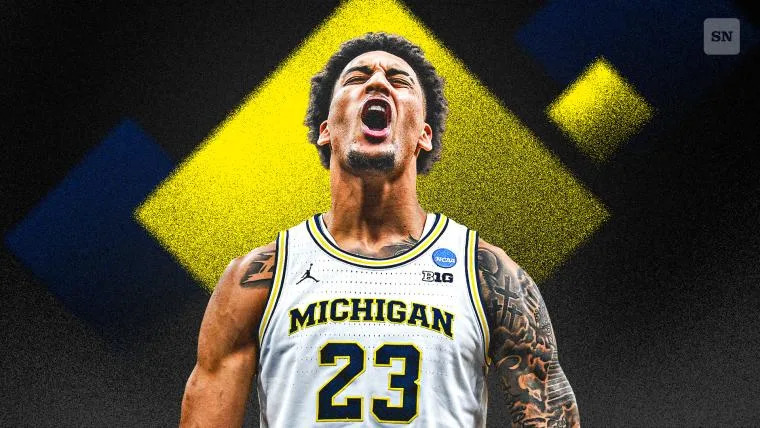

Michigan’ star forward Yaxel Lendeborg poses an age-old problem for teams in 2026 NBA Draft originally appeared on The Sporting News.
Add The Sporting News as a Preferred Source by clicking here.
His birthday is September 30. We tell you this not so you can send a present or card to Yaxel Lendeborg when that day arrives, although either would be nice — and, if you’re a Michigan Wolverines fan, probably warranted. No, we bring this up because on that day, which will arrive before he ever appears in a regulation NBA game, he will turn 24 years old.
Which quantifies him as different than any prospect in the modern history of the draft, really.
The draft was reborn with the introduction in 1995 of the league’s rookie salary scale, which prevents players from negotiating contracts based on their individual worth and instead assigns a value to the slot where he is selected. That diminished the incentive to arrive as a more developed player and led to more players entering the draft at younger ages.
Lendeborg’s story would be unique even if he weren’t standing on the eve of his rookie NBA season a few months older than Orlando’s Paolo Banchero, who already has played four years and appeared in the playoffs in three of them.
MORE: SN’s Latest NBA Mock Draft
Despite obvious physical gifts, Lendeborg didn’t take the game seriously – or much of anything else – while a high school student, until his mother challenged him not to waste his life and potential. He spent three years in junior college learning the game. He spent two seasons at UAB in the American Conference, gaining an understanding of how to be a significant player at a high level. He spent one year at Michigan competing against an intensely competitive schedule and an extremely challenging league and ended as the best player for an NCAA championship team.
And so he stands in direct contrast to most of the top prospects, with Steph Noh of the Sporting News projecting the first seven players selected still to be short of their 20th birthdays on draft night. So what would the team that selects Lendeborg receive in exchange for those four spent years of youth and potential?
“They get a guy that’s ready to play and help on a winning team now,” Dusty May told Sporting News while still coach at Michigan. “You can plug him into any situation … he has the physicality, the tools, the bandwidth mentally to play in meaningful games in the NBA now.
“I go to a lot of Pistons games. They’re right down the road, and I left most of them thinking: Yax is an NBA starter. I think if you can draft an NBA starter from day one, then you’re ahead of the game.
“He is a smart player who processes information really well and quickly … He’s a 6-9, 6-10 guy who makes the right basketball plays.”
MORE: Dusty May’s decision to head to NBA not a shocker
How Yaxel Lendeborg became a not-so-small forward
Lendeborg measured at 6-8¾ and 244 pounds at the NBA combine in May. His wingspan measured at 7-3¼, which exceeded that of many centers in the camp and pretty much every high-end forward, including North Carolina’s 6-9¼ Caleb Wilson (7-0¼).
When he arrived at Michigan slightly more than a year ago, he had been a center or power forward throughout his extended college career. Arriving slightly before 6-9 Morez Johnson came in from Illinois, inside is where Lendeborg figured to play when the Wolverines landed him as one of the most highly regarded prospects in the 2025 transfer portal.
After May and his staff added 7-3 Aday Mara from UCLA a few weeks later, however, they realized Lendeborg would need to make a transition to the perimeter. May admitted during the NCAA Tournament he entered the season still unconvinced such a lineup would work at a championship level. Within a month, UM had beaten Gonzaga by 40 points. By the end of the regular season, Lendeborg was on The Sporting News All-America first team. By the end of the NCAAs, Lendeborg and his teammates were champions.
Lendeborg was the most obvious reason for this, even though he was injured late in the first half of the team’s semifinal victory against Arizona and played the last three quarters of the Final Four limited by knee and ankle pain.
“I really don’t even talk to our players about that, because I don’t want them to feel pressured,” May told SN. “Once his MRI and everything came back completely clean, I felt like he would play just because I know how much he loves his teammates.
“It just shows that he’s a real teammate and a real competitor. Obviously, if there was a tear, if there was risk of further injury because of what he did, I would have encouraged him not to play. Because these guys need to be able to play for the next 10, 15, 20 years. Their careers are long.
“But it’s like an old-school mindset: If you’re able to play, you’re going to play because it means that much to you, as opposed to just thinking about your own individual career.”
There are players in this draft who were questioned – doubted, even – in that respect through the 2025-26 season. Against Connecticut in the final, Lendeborg still went 36 minutes, which was more than any other Wolverine, and scored 13 points, which was the second-most on the team.
Although he did not perform at his customary level, Lendeborg’s forceful play at the small forward position, particularly in transition, was something the majority of opponents simply could not managed. When the Wolverines were able to play at pace, it became overwhelming.

Imagn Images
It was true in the first half against Arizona, before his injury, when the Wolverines built a double-digit lead the Wildcats were not equipped to overcome. It never was more so than against Tennessee in the Midwest Region final against Tennessee, when Lendeborg obliterated teenaged lottery prospect Nate Ament. Yaxel rang up 27 points, 7 rebounds, 4 assists and 2 blocks in a 95-62 victory. Ament shot 2-of-12.
Although Ament is projected higher in a number of mock drafts because of his age, Lendeborg might have just as much room for growth because he hasn’t been playing his current position all that long. In his first year as a wing, Lendeborg made 67 threes and shot 37.2 percent. That was up from 25 makes and 35.7 percent a year earlier.
“With the new CBA, a player of his age is more valuable, especially for a contending team,” NBA and college basketball analyst Robbie Hummel told Sporting News. “Finding talent that is on their rookie contracts and ready to compete right away, I think is as valuable as ever.”
Hummel also sees a comparison for Lendeborg on the reigning league champions, the Knicks.
“Look at a guy like OG Anunoby. I think that would be a great person for him to look at and say, alright, I have the defensive tools to guard at that level. I have the body, the physicality and the wingspan. Now, I’ve just got to make some threes,” Hummel said.
“Obviously, Anunoby has turned himself into a really good 3-point shooter. But I think Yaxel has all those skills except for the percentage from the 3-point line. I think him being new to playing the perimeter, that would probably give some front offices some hope there’s growth to be had there.”
MORE: SN’s 2026 Big Board
How good an “athlete” is Yaxel Lendeborg?
If you watched him steamroll Tennessee on the break, you might have expected Lendeborg to destroy every NBA combine testing record for dynamism: quickness, agility, leaping ability.
He showed the ability to defend opponents at all five positions with the Wolverines.
In Chicago in early May, however, he tested … OK.
His standing vertical leap was one of the poorest in the camp, at 25½ inches, only 69th out of 71 players. He was much better in the lane agility test, ranking 20th, and he climbed to 10th in the shuttle run.
“The problem with Yaxel, they get these numbers, and they say: Well, he’s not as much of an athlete as we thought,” NBA Draft historian Matthew Maurer told SN. “One guy I can remember laughing about is Chase Budinger. He was a freak athlete, but in a game, he was just a shooter and a guy who did his job. You didn’t get the chance to see that dynamic athleticism, because it wasn’t a part of his game.
“I’m one of the people who thinks there’s such a thing as testing athleticism and game athleticism. That’s one thing about Yaxel. I don’t think he’s going to be Amare Stoudemire, but there’s a weird idea that he’s grounded as a player. I’ve just never seen that in Yaxel. He’s always been a guy that if he’s around the basket, he’s going to finish it.”
Lendeborg didn’t win any defensive player of the year awards while at Michigan, because he played with Mara and his 2.6 blocks per game. But Lendeborg’s ability to defend big men (because of his size and length) and point guards (because of his length and quickness) made him one of the best in that aspect of the game. Duke’s Dame Sarr went 2-of-4 against the Wolverines. Jake Davis and Andrej Stojakovic of Illinois combined to shoot 2-of-6. UCLA’s Eric Dailey Jr. shot 1-of-5. In the NCAA title game, Braylon Mullins was 4-of-17.
“To me, this isn’t a typical 24-year-old player. This is a young 24, if that makes sense,” Maurer said. “He did not have a profile in high school. He went to a juco. He transferred to a mid-major from there and was still finding himself. And then he goes to Michigan, and I think he puts together one of the best seasons you can. He answers all the questions you can answer.
“If I’m a team and I want to win now, and I want a dynamic, multi-talented forward, I’m taking him and I’m not even going to think about his age. I’m really looking at him from a standpoint of he’s just starting to understand his role and what he can do and what he can do well. It’s something he had to learn a little later.
“I really think he’ll be a lottery-bound guy.”