LSU v. SEC? Lane Kiffin's brazen approach to eligibility mess raises question of whether league would sue its own school

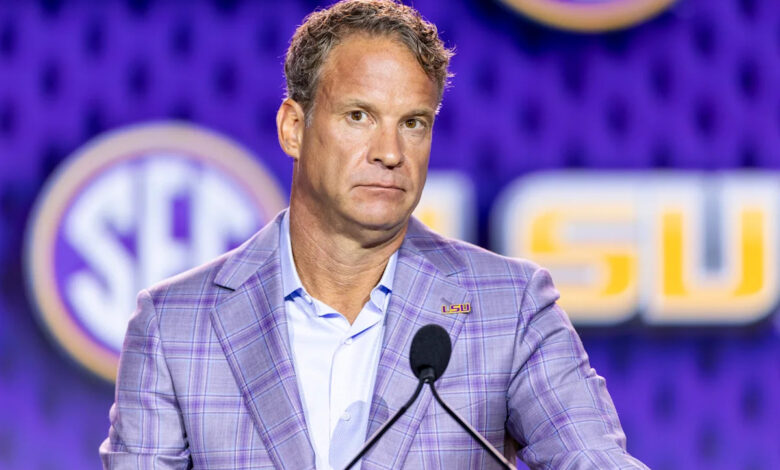
Within a skywalk connecting two high rises in downtown Tampa, Lane Kiffin strode toward the main ballroom of SEC football media days on a sun-splashed Thursday in July.
As Kiffin approached the stage, SEC commissioner Greg Sankey, as is customary with his introduction of each of the league’s football coaches, offered to the hundreds of reporters before him a humorous anecdote.
Sankey had learned of the big news that day: Kiffin revealed to reporters that he’d sworn off social media, pushing aside an addiction that, at times, got himself and his league in trouble. He made the decision after his son Knox challenged him to go social media free. By the time media days rolled around, Kiffin’s streak had reached more than two months.
Sankey told the story, looked up at the crowd and deadpanned, “Thank you, Knox.”
A month later, the head coach at LSU and the commissioner of the SEC seem at odds, not over a post on X or a soundbite from a news conference.
Kiffin is exploiting a loophole that, on Tuesday, Sankey and his band of presidents closed (at least in theory).
But this fight does not appear to be over.
Perhaps it is only getting started.
If you don’t know the backstory of this sordid affair, pull up a chair. Tuck that napkin into your collar, pop open an Abita beer and grab a spoonful of this rich, dark bowl of eligibility gumbo that only Louisiana can cook up.
Within a Baton Rouge courthouse, a Louisiana judge granted an additional year of eligibility to a group of athletes, some of whom had signed NFL contracts and played in NFL preseason games. The lawsuit originated from LSU’s campus (you already knew this if you read our story last week).
In no coincidence, the suit included three former Ole Miss players who played for Kiffin last year, two of whom are returning to college and agreed to contracts with Kiffin and LSU: tight end Dae’Quan Wright and defensive tackle Zxavian Harris.
In fact, Wright is believed to already be in Baton Rouge and was poised to sign with the program on Wednesday. As of Tuesday evening, LSU intends to still sign him, according to one of his representatives, Darren Heitner, a sports lawyer based in Florida.
But on Tuesday, during Day 1 of a two-day joint meeting with athletic directors in Birmingham, Alabama, SEC presidents voted to prohibit football and basketball players who signed or were members of NFL or NBA teams from competing in the league. The move was unanimous. LSU president Wade Rousse voted for it, apparently, despite the decision making ineligible the two aforementioned players as well as one of the most important pieces of Will Wade’s basketball roster, RJ Luis, who played in three NBA games and was in the league long enough to be traded.
Let’s be clear: LSU isn’t alone. Texas has a player who participated in minicamp with two NFL teams. Kentucky signed a former Missouri player who played in the summer league.
But no single team has been as aggressive as LSU.
Let’s stop there for a quick minute.
Have you ever been to Baton Rouge? Walked among the stately oaks, jogged along the muddy Mississippi, slurped oysters in Phil’s backroom, caught beads at the annual Spanish Town Mardi Gras parade, sipped an ice-luge shot at a tailgate party after consuming jambalaya from a cauldron?
I’ve done all that.
The people match its unique environment.
Well, this past year, LSU as a university and athletic department experienced a historic administrative and leadership upheaval. With the governor of the state playing a hearty role, the school fired Brian Kelly, athletic director Scott Woodward and, finally, basketball coach Mike McMahon.
Before all of that, Bill Tate, a respected leader in higher-education circles, left Baton Rouge for Rutgers — a move that those on the bayou describe as a “chased outta here” situation.
The governor, Jeff Landry, an outspoken figure and a man whose involvement in college sports is steadily increasing, hand-picked Tate’s successor, Rousse, a Louisiana-born and bred leader with an accomplished past as a financial guru. The governor’s involvement, though not new for Louisiana (see here), is unusual for outsiders. In fact, he demanded last year that Woodward fire McMahon and hire Wade, the basketball coach who Woodward himself fired years earlier amid NCAA scandal. He also welcomed donors to the governor’s mansion just a few weeks back to unveil a donor-equity inspired financial plan to save the athletic department from bankruptcy.
No, this is not a normal place.
To borrow a line from Kiffin himself, it is just different — for good and bad reasons.
No one should be surprised at what is unfolding here: A coach and university orchestrating a legal challenge to exploit a loophole to improve a football roster in a state where Saturday nights in Tiger Stadium are more important than Sunday’s Catholic Eucharist.
On Monday, Kiffin acknowledged his recruitment of NFL players as a “relentless pursuit of excellence.”
“That’s how I live,” he said. “It’s how I run the team. And that we’re always going to look at every avenue to give you the best team, to give you the best players, so that you have the best chance to win.”
Let’s now return to that legal fight.
A battle brews.
The players in the Louisiana suit are prepared, it appears, to file legal challenges against the SEC over its new ban preventing them from playing.
Ryan Downton, one of the attorneys representing players in the Louisiana case, says attorneys are considering “the appropriate legal response to hold the Big Ten and SEC accountable for their cartel-like coordination with the NCAA.”
There’s more.
Downtown says he plans to file a motion with the court that the NCAA should be held in contempt “for permitting conferences under its purview to blatantly violate court orders.”
Heitner, representing Wright, believes that the language in the Louisiana injunction provides a “colorable argument” to cover conference-wide policies as well. Wright’s reps are “figuring out” next steps in real time.
It’s a complicated mess of a situation — all of it born from the NCAA’s decision not to make an exception for players to be grandfathered into the new five-year eligibility rule (these players played four years, exhausted their eligibility under the previous rule this spring and now believe they have earned an additional year).
And so now what?
Many within the SEC believe that any resistance from LSU or others to the new policy will trigger legal avenues to be explored.
Will a conference file suit against its own school?
We’ve seen it already once this summer, when the Big 12 legally challenged Texas Tech to prevent the school from playing quarterback Brendan Sorsby, who acknowledged gambling on his own team.
Sports gambling on your own team brought the entire college sports ecosystem together — a cross-the-Rubicon moment that will live in the annals of the sport’s history books.
Perhaps we’ve found another: Pro players returning to college (the Big Ten passed a similar rule as the SEC, and the Big 12 and ACC aren’t far behind).
The first Rubicon moment came out of Lubbock.
This next one resides in Baton Rouge.
A month ago, well before Kiffin arrived on that main stage to shake Sankey’s hand, he turned toward a reporter and agreed that LSU had, indeed, become the villain of college football.
He is the central figure — the brash man who signed a $90 million contract, one that unabashedly exploits loopholes, who left his former program for an archrival amid a postseason run, who spent gobs on his roster, and who, one day, believes he’ll be a hero.
Why?
Kiffin smiled. “You’ll be a hero if you win.”