
The story of the first lacrosse game features the four-legged animals of the forest — such as the bear, the wolf and the deer — against the two-legged animals that fly, such as the hawk and the eagle.
During warmups, the rat and the squirrel walked up to the two-legged animals and asked to play. The birds pointed out that those animals have four legs and should be on the other team, but the rat and squirrel were told they were too small and would get in the way; all they wanted to do, however, was please The Creator with how they played.
The birds took the leather off a drum and stretched it across the rat, turning it into a bat. They then stretched the squirrel’s fur to turn it into a flying squirrel.
Toward the end of the back-and-forth contest between the two teams, the falcon received the ball and passed it to the bat, who passed it to the flying squirrel, who shot and scored the game-winning goal.
The theme is that no matter who you are or how big or small you are, there is a place for anyone and everyone to succeed in lacrosse.
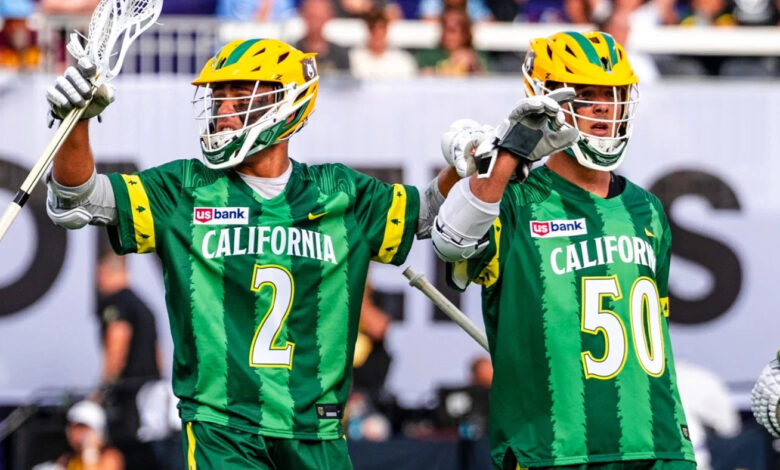
It’s a story that several members of the California Redwoods took to heart over the years.
“There was a bunch of different animals playing very, very different roles because they had very, very different strengths,” Ryder Garnsey said. “I’ve grown to know people are going to have very, very different strengths, and they can all be successful pushing toward a common goal.”
Garnsey was always a small kid growing up in Wolfeboro, N.H. It was hard to field a full team in such a small town, so Garnsey remembered being 5 years old playing 10U lacrosse. His parents joked that he was “just a helmet with legs out there running around, getting the snot knocked out of [him].”
He also played ice hockey and was the team’s goalie. He loved both sports, but he knew there weren’t many successful 5-foot-9 ice hockey goalies. In lacrosse, however, even though he wasn’t super fast or super strong, there were other ways he could have an impact on the game.
“You can have super good stick skills,” Garnsey said. “You can shoot the ball really accurately. You can space the field properly.”
“For me, that was always going to be my ticket,” he added. “I’m going to have the best stick skills on the field. At least, I try to do that.”
The 5-foot-8 Andrew McAdorey heard the story of the first lacrosse game many times in his youth lacrosse career. He took part in the Warriors Foundation, an initiative where players from the United States competed in tournaments on the Onondaga and Seneca reservations so players from different cultures could interact and learn from each other.
He learned a lot about the day-to-day lives of the people on those reservations and how much lacrosse meant to them.
McAdorey saw early on that he was one of the shorter players, but it never was a detriment to his game. He just needed to figure out a different advantage he could carve out for himself. He worked at getting faster and getting stronger, and while that helped, he found creativity was the best way to set himself apart.
He and his dad, Michael, would go to the backyard and spend time just tossing the ball around and trying different things.
“The game doesn’t limit players based on how big, how fast, or how short you are,” McAdorey said. “It’s a game that’s really founded and based off creativity. It’s not like other sports like basketball where you kind of need to be tall because that’s part of the game to have an advantage. There’s so many different ways [in lacrosse] to have an impact. It really just stems from just being creative and having fun.”
In 2025, Dr. Thomas James Reed – a member of the Oneida Nation and assistant professor of American Indian Studies at California State University, Long Beach – visited the Redwoods and spoke with them. He mentioned faithkeeper Oren Lyons, who is also the namesake of the PLL’s Goalie of the Year award; Lyons said there were over a thousand ways to do just one thing in the game of lacrosse.
The Redwoods exemplify that theory. Even the smaller players on the team don’t play the same style.

“If you look at Ryder, he’s super creative,” McAdorey said. “He’s not as fast, but he figures out a way to get the goal and get to those hard spots in the field.”
“You look at a guy like [Josh Balcarcel], like he’s such a great first step and change of direction,” he added. “He tried to avoid the contact at first and then get the contact as he’s getting closer to the net.”
Balcarcel is listed at 5-foot-7, making him one of the shortest players currently on a PLL roster. (Only 5-foot-6 Boston Cannons attackman Michael Lampert is shorter.)
“Guys of my same build are able to be successful and find success in their own ways,” Balcarcel said. “It’s not a carbon copy of what I do, and what [5-foot-8 long-stick midfielder BJ Farrare] does and what McAdorey does.”
Garnsey has battled tall, physical defenders in the PLL over the years, like Mike Manley and Jarrod Neumann. He said there’s a ”game within the game” element in matchups like those and that sometimes, being a smaller offensive player can actually be an advantage against larger opponents.
“If a bigger guy struggles to get down to the point of contact he needs to, he struggles to get on your hip, you can use that leverage game to your advantage,” Garnsey said.
When Balcarcel played travel lacrosse against bigger defenders with long strides, he knew he had to be that much quicker and faster in order to beat people to spots. He found professional players who were similar in size to him in order to learn how to use his smaller stature to his advantage.
He watched Jordan Wolf and Joey Sankey, studying how they moved and how they used their speed to their advantage. He wanted to see what worked for them in order to implement it into his own game.
When he became a pro himself and teamed up with large, physical players like Dylan Molloy, he started to pick their brains, as well. He worked with Molloy on how to back into a defender and use leverage and his shoulders to create separation and shoot off someone’s hip.
He also developed a knack for setting strong picks, a skill not typically associated with shorter players, but one that Balcarcel said his height actually gives him an advantage in.
“The reason I’m good at picks is they don’t see me coming,” Balcarcel jokes with his teammates. “I’m on the shorter side, so it’s easy to sneak my way into it and be in that blind-eye view and just set it.
“In terms of the pick play, I think my size benefits just because I can sneak into certain spots where defenders can’t see me or can’t spot me at that time, and then, quickly, just get into place and allow guys like Chris [Kavanagh] and Ryder, McAdorey, Molloy to get their hands free.”
Recently, Balcarcel has coached younger players. He advises them to find a similar-sized player, try to emulate what he does on the field and utilize the traits they have in common.
What is surreal to him is that he is that player to some, like Wolf and Sankey were to him.
“It’s humbling for me, but at the same time, it’s awesome,” Balcarcel said. “I get a lot of DMs here and there of younger kids reaching out saying, ‘Hey, you’re one of my favorite guys because you’re undersized, and so am I.’ They’re like, ‘What can I do to help with X, Y, and Z?’ And I love when kids DM me because I wish I had someone at that age to reach out to and talk to. I love giving back a little bit and talking them through stuff that helped me and stuff they could do.”
The story of the first game of lacrosse will once again be present in the minds of players — especially ones like Garnsey, McAdorey and Balcarcel — this week as the PLL celebrates its annual Indigenous Heritage Weekend. The Redwoods will open the weekend with a Friday night matchup against the Maryland Whipsnakes in Fairfield (6 p.m. ET; ESPN+).
Much like the rat and the squirrel, California’s smaller players are instrumental to the team’s success.
“If you’re a guy who’s maybe a little bit smaller, it means that you’ve probably worked really hard on your game to be good,” Garnsey said. “So that means you probably really, really like to play.”