On an Island.
It was the “Final Jeopardy!” category Jeremy Schaap had to navigate.
It’s also the way Schaap, who has been with ESPN for 32 years, felt as a participant of “ESPN Jeopardy!”
“I attach way too much self-esteem, self-regard to knowing pointless trivia,” the investigative reporter says. “So for me, this was kind of high stakes because if I didn’t win, I would never forgive myself.”
The line was said with humor, as much of the friendly banter of competition was over three rounds filmed last spring that debuted in the summer. It was hosted by Joe Buck in the announcer’s buddy-buddy style that also jabbed at those he knew.
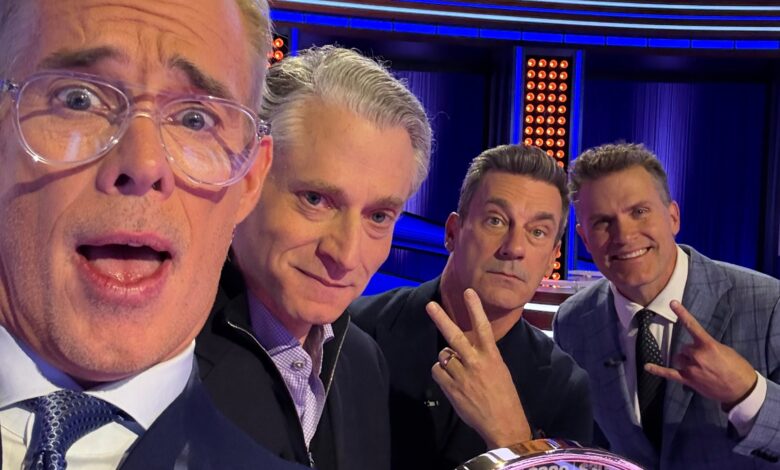
It had ESPN anchors and hosts as well as actor John Hamm and NFL commentator Kyle Brandt, both of whom faced off with Schaap in the final. Brandt joshed with Schaap about how he elevated his arm out in front of him holding a buzzer when he knew an answer.
“It’s intimidating as hell,” Brandt said.

In the quarterfinal round, when Schaap faced ESPN’s Christine Williamson and Kimberley A. Martin, Martin looked at him and said: “Watched this man my entire life, and I’m determined to take him down because he’s one of my idols.”
“I’m not that old!” Schaap said.
And so it went, as Schaap buzzed and grimaced his way to the inaugural title, but also earned a $500,000 gift for his charity of choice: The International Sports and Music Project (ISMP). The ISMP is a nonprofit that uses music to create supportive spaces for kids in underserved communities around the world.
“It’s easy to take for granted access to sports,” Schaap says. “In America it’s an issue here as well. We see that sports are becoming more expensive (for) what participation requires now in terms of the efforts from parents and resources and all of that. And it’s even less accessible in some of these very poor places around the world where there aren’t resources to build fields, to buy equipment, to get the right kind of coaching and mentorship.
“It’s absolutely fundamental to development and to physical and emotional well being to have the opportunity to participate in sports.”
Schaap, 57, spoke with us about the “Jeopardy!” experience, his career, his views on the youth sports landscape and what his win means for the work of ISMP.
What is ‘ESPN Jeopardy’?
What is ‘ESPN Jeopardy’?
ESPN debuted its version of the timeless game show at the Alex Trebek Stage at Sony Pictures Studios in Culver City, California. Longtime narrator Johnny Gilbert announced the contestants. The shows were taped in May and started streaming on the ESPN App, Disney+ and Hulu on July 31.
There were a wide range of contestants across the ESPN landscape and beyond. When Schaap was contacted to participate, he thought he would be on traditional “Jeopardy!” He only realized it was sports-geared on a production call.
“I started studying Shakespeare and Constitutional amendments,” he told Buck on he show. “So I prepared for the wrong show.”
But when he got on air, he seemed to be a natural at this version.
“I love trivia, so I’ve been waiting all my life to show off my useless sports knowledge,” Schaap told USA TODAY Sports.
The categories ran from traditional (“Mascot Mania” and “Basketball Coaches”) to more arcane (“Hey Darnold!” “Nerdy For 30 for 30” and “It’s An Antonym…”). The last one was as confusing as it sounded.
“Sammy, the Mascot of UC-Santa Cruz, is this type of slimy creature with a certain amount of appeal,” Buck said for the mascot category.
“What is a Banana Slug,” Schaap said.
“Uhh, that’s so good that you know that,” Buck replied with a grin.
Subjects leaned more contemporary in nature – think answers of “Who is Randy Moss?” or “Who is Ja’Marr Chase?” – although Schaap grit his teeth for not being fast enough to answer an Ice Bowl question.
“I was hoping there would be more older stuff, you know pre-1980,” Schaap says. “There are a lot of people who are very up on everything that’s going on every day now, and certainly a lot of my competitors, but I think I kind of have a good grasp of sports history.
“They asked everybody in the production call what would be your dream category? And I told them, ‘Pre-20th century heavyweight champions.’ ”
Who is Jeremy Schaap and what is his sports history?
Schaap is the son of the late Dick Schaap, a famous sports broadcaster and writer. He wrote books with, among others, Joe Namath, Muhammad Ali and Bo Jackson.
One of Schaap’s best friends was Jerry Kramer, the Green Bay offensive lineman and Hall of Famer who is Jeremy’s namesake. Kramer made a famous block that secured victory in the Ice Bowl for the Packers over the Dallas Cowboys on Dec. 31,1967.
Jeremy Schaap, who was born in 1969, says he knew “from the very beginning” he wanted to be a sports journalist. He met Ali at a golf tournament and Reggie Jackson in the Schaap Manhattan apartment.
“All those guys, they were part of my childhood in a personal way,” he says. “My dad was in it and it looked like he was having more fun than anybody else. They had more fun than anybody else’s dad as far as I could tell. He loved it and it was exciting and he was around the biggest stars in sports all the time. They were presences in my life, whether he was writing a book with them or just covering them.
“I was like, why would you want to work for a living if you could do this?”
What is Jeremy Schaap’s connection to youth sports?
Schaap followed the path of many of us in that his passion for games drove him into adulthood.
“It was such a big part of my childhood, being a sports fan, getting to play, playing in the back alley of where I lived in New York,” he says.
He didn’t play high school sports but found the contest with colleagues on “Jeopardy!” brought out his competitive side.
“It’s nice to have a chance to talk to you because my wife is enforcing a strict no ‘Jeopardy!’ talk rule,” he says.
He says he felt pressure because the folks at ISMP, for whom he serves on the board, were counting on him to win.
“I know that it can go a long way,” he says of the $500,000 he won. “That’s what I have been told.”

According to its website, ISMP has generated more than 1 million individual impact hours through sports, music, mentorship and community programming.
During our interview, Schaap brought up the E:60 episode he did in 2010 about the aftermath of the 1984 gas leak from the Union Carbide India Limited (UCIL) pesticide plant in Bhopal, India. It exposed thousands to toxic chemicals.
“There was nowhere for kids there to play, there were still so many places that had been contaminated by the disaster,” Schaap says. “(ISMP) kind of naturally aligns with my interest, and it’s not just around the world but also here in the U.S. sports and access to sports is important. And it’s important um that we find ways to make it possible for kids to take part and that’s a big part of ISMP’s mission.”
What are Jeremy Schaap’s feelings about youth sports? (And what’s the deal with the buzzer on ‘Jeopardy!’?)
Schaap, who lives in suburban Connecticut, has three kids (16, 14 and 11) who have been involved in sports.
“Most kids, they’re competitive about it or it’s about just being healthy,” he says. “It’s such a great thing and there’s so many studies that tie self-esteem, confidence, academic performance to sports participation as well. It’s essential, and I think the right to play, it really should be a right rather than a privilege.”
Schaap admits he wasn’t very good at sports as a kid, but he found himself dueling with Hamm and Brandt in the final.
“The hard thing is kind of just getting your heart rate down,” he says. “I was like, ‘I drank a bunch of caffeine,’ and I was thinking, ‘Do I need the energy for the buzzer or should I be at a more even keel?’ I couldn’t figure it out. I still don’t know the answer.”
He also credits a chat with ESPN’s Mina Kimes, who won “Celebrity Jeopardy!”. Her words of wisdom: It’s different on your couch. Trust me.
He also realized contestants can’t buzz until after the host finishes asking a question. If you buzz in too soon, you are locked out. He was too eager in earlier rounds and, in the final, he tried a different method with the buzzer.
“Kyle Brandt was upset because he said as soon as he’s reading the question, and I felt I knew the answer, I would stick my arm out,” he says. “The other guys could see that, and it might have been a little distracting to them. So be it.”
Brandt and Hamm, however, were stumped by the “Final Jeopardy!” question that clinched the win for Schaap: “In the past year, this small island became the smallest country to qualify for a FIFA World Cup & got its first MLB Hall of Famer.”
Schaap answered: “What is Curacao?”
He was finally off the island.
“In the moment I wouldn’t say it was fun because it felt like a lot of pressure,” he says. “But it was fun winning.”
Steve Borelli, aka Coach Steve, has been an editor and writer with USA TODAY since 1999. He played baseball in high school, rowed in college and spent 10 years coaching his two sons’ baseball and basketball teams. He and his wife, Colleen, are now sports parents to a college and high school baseball player.For his past columns, click here.
Order his “Youth Sports Survival Guide” for athletes and parents in time for the holidays
Got a question for Coach Steve you want answered in a column? Email him atsborelli@usatoday.com.
This article originally appeared on USA TODAY: How longtime ESPN reporter beat buzzer for youth sports on ‘Jeopardy!’