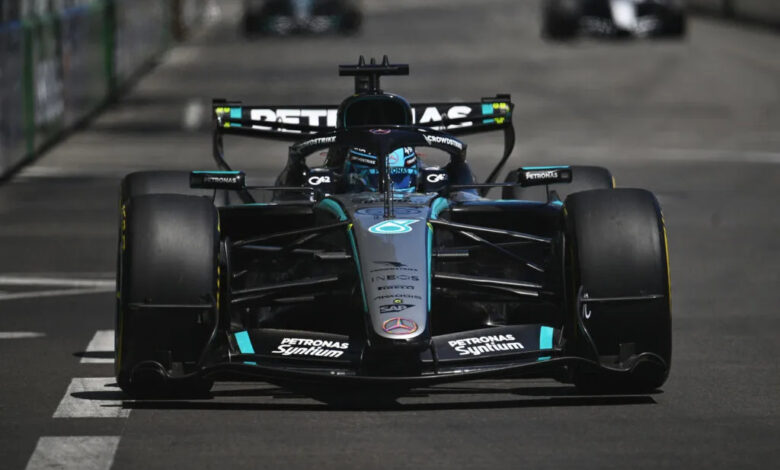
Formula 1 is a sport defined by microscopic margins, where millions of dollars are spent perfecting aerodynamic balance. But sometimes, all that cutting-edge engineering can be completely undone by a single power tool.
According to a recent report from Auto Motor und Sport (AMuS) highlighted by the @MercedesAMGPCF1 X account, a pre-programmed pit lane tool directly compromised George Russell’s car.
As detailed in the post on X, Mercedes utilizes a highly specific front wing adjustment system that ultimately backfired in the worst possible way.
The Pre-Programmed Pit Stop
At Mercedes, the front wing flap angle isn’t adjusted by a mechanic manually cranking a standard allen key on the outer endplates. Instead, the team utilizes a central adjustment mechanism entirely hidden within the nose cone of the car.
To alter the aerodynamic load during a frantic pit stop, a mechanic inserts a specialized cordless screwdriver with an extended attachment directly into the center of the nose.
The incredible part of this proprietary system is that the exact direction and number of turns are digitally pre-programmed into the tool before the car even enters the pit box. This automated setup is designed to be lightning-fast and theoretically eliminate human error in the heat of the moment.
Aerodynamic Nightmare For Russell
Unfortunately for Russell, relying on a pre-programmed smart tool requires the initial programming to be absolutely flawless. According to the breakdown via AMuS, the tool did the exact opposite of what the driver actually needed.
Russell requested the front wing flap to be adjusted flatter to reduce downforce on the front axle and balance the car’s handling. Instead, the tool actually pitched the flap significantly steeper. This technological error immediately shifted the aerodynamic balance of the car heavily toward the front axle. With too much front downforce and not enough rear downforce to match, the rear end of Russell’s Mercedes became incredibly loose and began aggressively sliding through the high-speed corners.

An imbalanced, oversteering car is incredibly difficult to drive under normal circumstances, but it becomes an absolute disaster on scorching asphalt.
The track temperatures during this specific stint were soaring above 50 degrees Celsius. Because the rear end was constantly sliding and shearing across the boiling tarmac, the rear tires immediately overheated.
This compounding error not only robbed Russell of vital mechanical grip but also caused severe, accelerated tire wear, completely destroying his stint. It serves as a brutal reminder that even in the most technologically advanced sport on the planet, a single wrong input on a drill can ruin a multi-million-dollar race weekend.