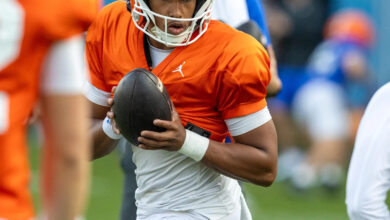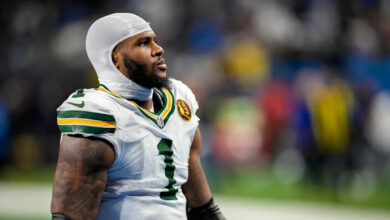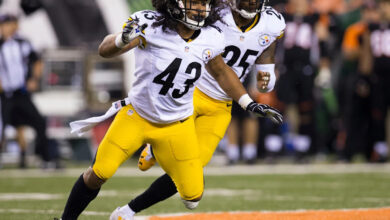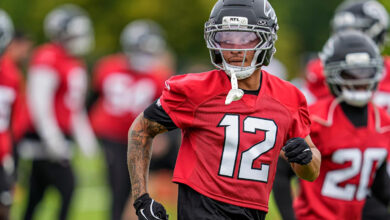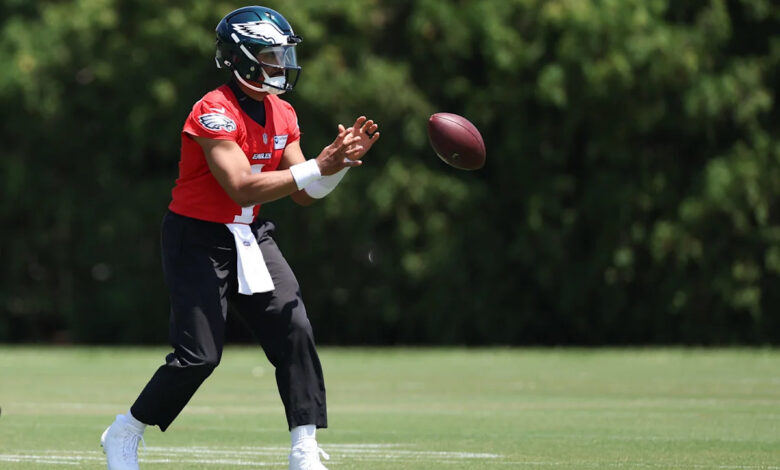
After months of waiting, the Philadelphia Eagles are ready and have returned to work.
Philadelphia reported to the Jefferson Health Training Complex on Tuesday, July 28, opening a training camp featuring a new offensive system, a rebuilt wide receiver room, and several consequential competitions on defense. The Eagles possess enough established talent to enter the season as legitimate contenders, but their roster also looks considerably different from the group that finished the 2025 season.
Jalen Hurts, Saquon Barkley, DeVonta Smith, Jordan Mailata, Lane Johnson, Jalen Carter, Zack Baun, Quinyon Mitchell, and Cooper DeJean give Philadelphia an impressive foundation. Training camp will be about determining how the pieces around those stars fit together and whether the organization adequately replaced several departed starters.
Here is everything Eagles fans need to know before training camp opens.
When does Eagles training camp begin?
The Eagles will officially report for training camp on Tuesday, July 28. Most practices will be held at the Jefferson Health Training Complex and will not be open to the general public.
Philadelphia will hold its public practice at Lincoln Financial Field on Tuesday, Aug. 25, at 6 p.m. General-admission tickets are available for $15.40, including fees, and proceeds will benefit the Eagles Autism Foundation.
The late public practice date will allow fans to see a team that should have a more settled depth chart by then. It will also arrive near the end of the evaluation process, when younger players and roster-bubble candidates are fighting for the final spots on the initial 53-man roster.
What is the Eagles’ preseason schedule?
Philadelphia will begin its preseason on the road against the Baltimore Ravens at 7 p.m. on Saturday, Aug. 15. The Eagles will then travel to face the New England Patriots at 7 p.m. on Saturday, Aug. 22.
The preseason results will matter far less than the individual performances. Hurts, Barkley, and other established starters may receive limited work, leaving extended opportunities for younger receivers, reserve offensive linemen, backup quarterbacks, and defensive backs.
Preseason games will be especially important for players competing for special-teams jobs. The final receiver, cornerback, safety, and linebacker spots may be decided as much by coverage and return-unit responsibilities as by offensive or defensive production.
Sean Mannion is installing a new offense.
The most important development of the summer will be the installation of Sean Mannion’s offense.
Philadelphia still has elite personnel at quarterback and running back. Along the offensive line, but another coordinator change means Hurts and the rest of the offense must learn new terminology, new sequencing, and potentially different answers against pressure.
Mannion has inherited an offense capable of leaning on Barkley and one of the NFL’s premier offensive lines, but the passing game will look different following A.J. Brown’s departure. The Eagles must replace Brown’s physicality, target volume, and ability to punish single coverage without asking one newcomer to reproduce his entire role.
Training camp should reveal how frequently Mannion uses pre-snap motion, play-action concepts, and multiple-tight end formations. It should also provide clues about how he plans to distribute targets between Smith, Dallas Goedert, rookie tight end Eli Stowers, and Philadelphia’s rebuilt group of wide receivers.
DeVonta Smith becomes the unquestioned No. 1 receiver
Smith enters camp as the centerpiece of Philadelphia’s passing game.
He has already demonstrated that he can produce at a high level in playoff games, win from multiple alignments, and handle difficult coverage assignments. The difference in 2026 is that defenses will build more of their plans around limiting him.
Philadelphia must find ways to create favorable releases for Smith and prevent opponents from consistently bracketing him on important downs. Mannion can accomplish that by moving Smith around the formation, using motion, and developing credible threats elsewhere.
Smith’s ability is not in question. The greater concern is whether the Eagles can generate enough production behind him to keep the passing game from becoming predictable.
The wide receiver competition will command attention
No position group underwent a more significant offseason transformation.
Philadelphia added Hollywood Brown, Dontayvion Wicks, and Elijah Moore while trading up in the first round to select USC receiver Makai Lemon. Those four players join Smith in a room that also includes Johnny Wilson, Darius Cooper, Quez Watkins, Britain Covey, Samori Toure, Danny Gray, and Erik Ezukanma.
The Eagles’ official position preview identifies Smith as the returning starter and frames the central question around how all of the new pieces will fit into the offense.
Hollywood Brown offers vertical speed and veteran experience. Wicks brings size and route-running ability, while Moore can line up outside or in the slot. Lemon has the highest long-term ceiling among the newcomers but must make up for practice time lost during the spring because of a hamstring issue.
The competition is not simply about identifying a No. 2 receiver. Philadelphia must determine which players complement Smith, contribute on special teams, and offer enough versatility to remain active on game days.
Makai Lemon will be one of the most-watched rookies
The Eagles did not trade up for Lemon only to keep him a developmental player indefinitely.
The former USC standout enters camp with an opportunity to earn an immediate offensive role. His route-running, ball skills, and ability to create yards after the catch could make him a natural fit alongside Smith.
Lemon’s spring injury makes his early camp availability important. Every missed repetition delays his ability to build timing with Hurts and demonstrate that he understands the offense’s full route tree.
Philadelphia has enough veteran options to avoid rushing Lemon, but a strong camp could quickly elevate him into the starting lineup. His progress will be one of the clearest indicators of the passing game’s ceiling.
Cooper DeJean could play several positions.
DeJean is listed as a defensive back because Philadelphia has no reason to limit him to one role.
He has already developed into an elite nickel defender, but the Eagles expect to explore additional work at safety and outside cornerback. That flexibility could allow Vic Fangio to change coverages without changing personnel and create more difficult pre-snap pictures for opposing quarterbacks.
The Eagles must determine how much movement is beneficial. DeJean’s slot play is already a major strength, and Philadelphia should not weaken that area merely to demonstrate his versatility.
Camp will reveal whether DeJean remains primarily a nickel corner or becomes a true multipositional defender who moves according to opponent and game situation. The Eagles have publicly discussed increased safety usage for DeJean entering his third season in Fangio’s defense.
Andrew Mukuba needs a new running mate at safe.ty.
Mukuba enters his second season as an established starter after earning an important role as a rookie.
The departure of Reed Blankenship created an opening beside him. Marcus Epps brings experience and familiarity with Philadelphia, while the Eagles could also use DeJean at safety in certain packages.
The official position preview notes that the Eagles will have a new starting combination in 2026.
Philadelphia must identify a safety who can communicate, tackle consistently, and avoid giving up explosive plays. The winner does not necessarily have to produce highlight-reel interceptions, but he must earn Fangio’s trust and complement Mukuba’s athleticism.
This competition could remain fluid. The Eagles may use different safety combinations depending on whether DeJean is aligned in the slot, outside, or in the back end.
Jalyx Hunt enters camp with higher expectations
Hunt is no longer an anonymous developmental prospect.
He played 62% of Philadelphia’s defensive snaps in 2025, the highest percentage among the edge rushers currently on the roster. His length, athleticism, and ability to drop into coverage make him one of Fangio’s most flexible front-seven pieces.
Hunt also led the Eagles in sacks and interceptions last season, creating expectations that he can become an even more disruptive player in 2026.
Philadelphia has added Jonathan Greenard, Arnold Ebiketie, and A.J. Epenesa to a room that also includes Nolan Smith. That depth should allow the Eagles to keep their rushers fresh, but it also means every player will have to earn their share of the rotation.
The next step for Hunt is consistency. He must prove that his production can hold up against increased attention and a larger weekly role.
Nolan Smith faces an important season.
Smith enters camp with his fifth-year option secured through the 2027 season, giving Philadelphia additional time to evaluate his long-term place in the defense.
The former first-round pick has shown speed, effort, and the ability to make disruptive plays, but the Eagles need him to become a more consistent edge presence. He will be competing for snaps in a deeper room that includes Hunt, Greenard, Ebiketie, and Epenesa.
Smith’s camp will be evaluated in areas beyond sacks. Fangio needs edge defenders who can maintain run responsibilities, execute coverage assignments, and prevent quarterbacks from escaping the pocket.
A strong summer could position Smith for the most complete season of his career.
Byron Young could earn a major defensive line role
Jalen Carter, Jordan Davis, and Moro Ojomo provide the foundation of Philadelphia’s defensive tackle rotation.
The opportunity behind them belongs to Byron Young, who received first-team work during the spring. Young has a chance to become an important rotational lineman capable of keeping Carter and Davis fresh while providing dependable early-down snaps.
The Eagles’ official defensive tackle preview centers the group around Carter and Davis, who are entering their fourth season together.
Young’s ability to carry his spring momentum into padded practices will be important. Philadelphia has traditionally invested heavily in defensive line depth, and a strong camp could secure Young a meaningful role rather than a spot at the bottom of the rotation.
Tyler Steen is an established starter.
Steen should not be viewed as a roster-bubble player or a temporary placeholder at guard.
He played 1,008 offensive snaps in 2025 and earned a 71.6 overall grade from Pro Football Focus, ranking 17th among 81 qualified guards. His 74.0 pass-blocking grade ranked 11th, while his 71.8 run-blocking grade ranked 17th.
Steen enters camp as part of a starting offensive line that also includes Mailata, Landon Dickerson, Cam Jurgens, and Johnson.
The primary offensive line questions involve depth and adjustment to the new position coach,h Chris Kuper. The official position preview notes that the starting lineup is filled with familiar players but will experience its first camp under Kuper.
Philadelphia must identify backup tackles and interior linemen capable of surviving meaningful snaps. Johnson is entering his 14th season, and the Eagles must be prepared to manage the inevitable injuries that occur during a 17-game schedule.
Eli Stowers adds a new dimension at tight end.
The Eagles selected Stowers in the second round because of his exceptional receiving potential.
The former Vanderbilt standout measured 6-foot-4 and 239 pounds at the NFL scouting combine, ran the 40-yard dash in 4.51 seconds, and recorded a 45.5-inch vertical jump, the highest ever by a tight end at the combine.
Goedert remains the established starter, but Stowers gives Mannion another weapon who can align in the slot, move across the formation, and threaten defenses after the catch.
Training camp will show whether Stowers is ready for an immediate offensive package or needs more time to improve as a blocker. Even if he is not ready for a full-time role, his athleticism could earn him touches in specific passing situations.
The backup quarterback roles appear defined.
Hurts enters camp as the unquestioned starter.
Veteran Andy Dalton was added to provide experience and stability behind him. Dalton has completed 3,539 career passes, ranking 22nd in NFL history when the Eagles published their position preview.
Tanner McKee and Kyle McCord Payton will have opportunities to secure their places in the quarterback room and handle most of the preseason workload. Philadelphia must decide how many quarterbacks it will carry and whether one of the younger options has enough developmental value to protect on the initial roster.
There is no quarterback controversy, but the backup hierarchy still matters. Dalton’s experience gives Philadelphia a dependable No. 2, while McKee and Payton will be evaluated as potential longer-term options.
Special teams will decide the final roster spot.s
The final receiver, defensive back, linebacker, and running back jobs will not be won exclusively on offense or defense.
Reserve players must demonstrate that they can cover kicks, block on returns, and contribute in multiple phases. A player who wins a close positional battle but offers little special-teams value may have difficulty being active on game day.
That reality makes August particularly important for players such as Wilson, Cooper, Covey, Ringo, Bennett, and the younger linebackers. Philadelphia will be looking for players who can fill emergency roles without creating weaknesses elsewhere on the game-day roster.
The Eagles still have a championship-level core.
Philadelphia’s offseason produced significant change, but the Eagles are not rebuilding.
Hurts has already led the franchise to two Super Bowl appearances and won a Super Bowl MVP award. Barkley remains one of the league’s premier running backs, Smith is prepared to assume a larger role, and the offensive line remains a defining strength of the organization.
On defense, Carter anchors the line, Baun leads the second level, and Mitchell and DeJean give the Eagles two elite young defensive backs. The roster has enough high-end talent to compete with any team in the NFC.
Training camp will determine whether Philadelphia has successfully rebuilt the areas surrounding that core. The Eagles must establish a receiving hierarchy, settle the second outside cornerback job, identify Mukuba’s partner at safety, and determine how their new additions fit into Mannion’s offense and Fangio’s defense.
Those answers will begin arriving on July 28.
This article originally appeared on Eagles Wire: Everything Eagles fans need to know before training camp opens