The 2026 NFL season is nearly upon us. In a league where parity rules, the only thing we know for certain is that this fall will look very different than the last one.
While a handful of powerhouses will retain their place in the postseason, new contenders will rise from the muck. 2025’s top teams stand at perpetual risk of falling apart, whether from a handful of bad bounces, injury luck or straight-up mismanagement.
Today, we’re gonna start taking a look at the latter piece of the puzzle. The offseason is where Super Bowl dreams begin for all 32 franchises. It’s when coaches are hired, the salary cap is navigated and difficult roster building decisions set the stage for the season to come.
Let’s take a look at the most notable additions for each team, ranging from new coaches to completely overhauled units. We’ll run down the list in alphabetical order — then take a look at each franchise’s biggest loss next time around.
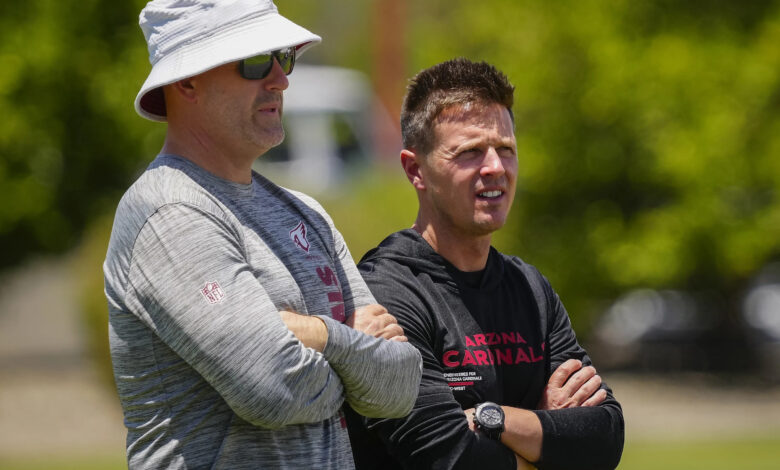
Arizona Cardinals: HC Mike LaFleur

The Cardinals had a low-key run through free agency as they set the table for LaFleur. Bringing in guys like Elijah Wilkinson and Isaac Seumalo will stabilize things a bit, but are ultimately underwhelming additions to a three-win team.
LaFleur will be tasked with using his offensive scheming to lift up an offense that needs to restore Marvin Harrison Jr., keep Michael Wilson and Trey McBride thriving and justify Jeremiyah Love’s lofty draft position… all with either Jacoby Brissett, Gardner Minshew II or Carson Beck at quarterback. Hooooo buddy, good luck.
Atlanta Falcons: QB Tua Tagovailoa
Oh, boy. OK. The Falcons’ quarterback battle will be an all-southpaw battle between the tarnished former Dolphin and an injured Michael Penix Jr. Penix can throw a football through the side of a barn but was only on target for about two-thirds of his throws last season. Tagovailoa can thrive in an environment loaded with playmakers, but has seen his average target distance drop significantly as his deep ball waned in recent years.
How much can Drake London, Bijan Robinson and Kyle Pitts fix their flawed passers? That group wasn’t able to revive a hobbled Kirk Cousins, who is now a Las Vegas Raider. Last year’s Atlanta offense had a negative expected points added (EPA), which feels borderline criminal given the playmakers at the skill positions.
Baltimore Ravens: EDGE Trey Hendrickson
Maxx Crosby would have been a wonderful piece of the puzzle, but getting Hendrickson without having to give up two first round picks is a healthy contingency plan for a team that drafts well. Baltimore’s pass rush ranked 29th in pressure rate and 31st in sack rate last season. For $60 million guaranteed, here comes a player who was a perennial defensive player of the year threat as recently as 2024.
Hendrickson turns 32 in December and saw his production drop significantly in 2025 after a contract standoff and subsequent injury. But he’s also the guy who had 35 sacks across the 2023 and 2024 seasons. If he can be even 85 percent as effective as he was at his peak, he’ll be a much-needed boost in Baltimore.
Buffalo Bills: WR D.J. Moore
Moore underwhelmed his last two seasons as a Chicago Bear. He’s 29 years old and will have the opportunity to settle back into a WR1 role despite signs of decline, leading a group that includes Khalil Shakir, Joshua Palmer and a still-on-the-roster-despite-getting-scapegoated Keon Coleman.
After 60.8 expected points added at wideout for the Bears in 2023, he hit 14.7… his last two years combined. Can he be the huckleberry Josh Allen needs to lead Buffalo to something better than January disappointment? Or will he fade into the mélange of inconsistent receivers who’ve haunted the Bills since Stefon Diggs’ departure?
Carolina Panthers: EDGE Jaelan Phillips
The Panthers invested wisely in their offensive line, adding Rasheed Walker on a bargain one-year deal and drafting Monroe Freeling in the first round. But Carolina was 2-6 when Bryce Young had a pressure rate under 38 percent and 6-2 when it was higher, which suggests the most impactful change in the season that could determine head coach Dave Canales’ future will come on defense.
Phillips is a risky acquisition; a $120 million deal with $60 million guaranteed for a player who missed 22 games between 2023 and 2024. But his 2025 saw him play a full season and record a pressure rate just under 16 percent. It won’t take much to coax double-digit sacks from him… if he can stay healthy.
Chicago Bears: S Coby Bryant and S Dillon Thieneman
Ben Johnson’s offense should continue to soar. His defense will rely heavily on a rebuilt secondary. Flipping Jaquan Brisker and Kevin Byard into a reigning Super Bowl champion and a first round pick is a viable strategy.
Bryant allowed just a 51.9 passer rating in coverage as a free safety for the Seahawks last season. Thieneman is a jack of all trades who thrived at both Purdue and, upon realizing he was still at Purdue, Oregon.
Cincinnati Bengals: Most of the starting defensive line
Cincinnati has reconciled with the idea it cannot win enough 41-40 shootouts to make the playoffs. Thus, expensive upgrades arrived to bolster the trenches.
Jonathan Allen was signed away for $14 million annually despite underwhelming returns as a Minnesota Viking; his pressure rate has decreased each of the last four seasons, giving him more name value than on-field production. Boye Mafe was enlisted to punch up the pass rush at three years and $60 million and may be the opposite of Allen, but Cincinnati is paying a premium to find out.
Dexter Lawrence and his $28 million annual salary came at the expense of the 10th overall pick in this year’s draft. The Bengals scoring defense has cracked the top 16 only once in Zac Taylor’s six years at the helm. If it fails again this year, that could mean the end of his run in Ohio.
Cleveland Browns: WRs KC Concepcion and Denzel Boston
A rookie lifted Cleveland’s passing game in 2025. Now two dynamic top 40 draft picks will join Harold Fannin Jr. and try to do the same in a receiving corps where no wideout recorded a catch rate over expected (CROE) last fall.
Concepcion is a shifty run-after-catch stud. Boston is a beefy downfield savant with great ball tracking, contested catch and adjustment skills. They’ll try to lighten the load for whomever is throwing passes this fall (and limit Browns’ fans frustrations with Jerry Jeudy. Additionally, the offensive line rebuild is important, if weirdly executed).
Dallas Cowboys: S Caleb Downs

Rashan Gary brings name value after being acquired for a fourth round pick. While his sack numbers have remained solid his pressure rate has dropped each of the last three seasons. Instead, the more impactful addition may be Downs — a player with top five traits who slid to the 11th overall pick due to his role at safety.
Dallas fielded the league’s 30th-ranked passing defense last fall. Its 109.6 passer rating allowed meant opposing QBs were the equivalent of Matthew Stafford, on average, each week. Downs has elite recognition and can thrive in pretty much any coverage situation coordinator Christian Parker can throw his way, giving the Cowboys a vital insurance policy downfield.
Denver Broncos: WR Jaylen Waddle
Denver’s WR2-by-committee behind Courtland Sutton was occasionally electric but often inconsistent. Now Troy Franklin, Pat Bryant and Marvin Mims will fight to be Bo Nix’s third target in an offense that continues to add ways to beat you.
Waddle’s average target distance rose as he emerged as the Dolphins’ top receiver last fall, filling some of the role Tyreek Hill left behind (albeit with mixed results. Bringing some extra deep ball credibility for a quarterback who has polished his bomb-lobbing skills after being criticized for a low-impact passing game at Oregon. It should also set the stage for a player like Franklin, Bryant or Mims to shine in the space created, even if snaps in the Broncos offense suddenly became harder to find.
Detroit Lions: OT Blake Miller
Attrition carved down one of the league’s best offensive lines. Taylor Decker’s release means an opening up front, and Miller — one of 2025’s fastest rising college tackles — has been tasked with following in Penei Sewell’s footsteps as the All-Pro moves to the left side.
As it stands, Sewell is the only returning starter from the Lions’ breakthrough 2024 campaign, leaving plenty of work to be done for a franchise that went from NFC top seed to NFC North basement dweller last winter. Miller has the athleticism and size to be a proper bookend for Sewell. Will his relative lack of college experience create a significant learning curve on Sundays?
Green Bay Packers: K Trey Smack
Several new additions will have larger roles for the Packers, including linebacker Zaire Franklin and second round rookie cornerback Brandon Cisse. None may be able to provide more peace of mind than Smack if he can live up to his draft status.
The only kicker selected in 2026, Smack will attempt to bring stability to a volatile position that saw Mason Crosby crumble late in his career and replacements like Brandon McManus, Brayden Narveson and Anders Carlson struggle in his stead. Early training camp returns have been, uh, pessimistic.
Houston Texans: A revamped offensive line
The defense is not the problem in Houston. An offense that slid from 15th in expected points added (EPA) per play in CJ Stroud’s rookie year to 21st, then 22nd last fall, is. Stroud has yet to be flanked by a run game capable of cracking even the top 20 when it comes to efficiency.
Now, in place of Nick Chubb and Dameon Pierce, comes David Montgomery and second-year back Woody Marks. Montgomery is 29 years old and has more than 1,500 NFL carries under his belt. He still averaged 0.8 rush yards over expected (RYOE) per carry in 2025 behind an uneven Detroit Lions line — 11th-best among qualified running backs last season.
They’ll run behind a line with three prospective new starters. Braden Smith is a useful veteran likely to miss a handful of games at right tackle. Wyatt Teller is getting old, but guards tend to age well. Keylan Rutledge is young, and Houston will have to hope he works out better than the last first round interior lineman it selected (Kenyon Green, woof).
Indianapolis Colts: LBs Akeem Davis-Gaither and C.J. Allen
The Colts turned over the middle of their defense, trading Zaire Franklin to the Green Bay Packers and opting against re-signing an aging Germaine Pratt. Allen, a second-round pick who had first round buzz, brings youth and athleticism to the position.
Davis-Gaither, however, is nearing his 29th birthday and was brutal in coverage last season (a 133.8 passer rating allowed while lined up at linebacker). There’s a way to make these puzzle pieces fit together. Can defensive coordinator Lou Anarumo find it?
Jacksonville Jaguars: DT Ruke Orhorhoro
Jacksonville was quiet in free agency. With its first round pick owned by the Cleveland Browns thanks to last year’s Travis Hunter trade, the team’s first pick in the 2026 NFL Draft was a blocking tight end. This is a team that ascended in 2025 and opted to largely run it back.
Orhorhoro was a buy-low pickup, acquired in a deal for similarly disappointing young prospect Maason Smith. The 35th overall selection in the 2024 NFL Draft, the 295-pound tackle has shown promise as an interior pass rusher. His 32 pressures were second-most for the Atlanta Falcons last season, but he was a mess against the run and may be limited to a rotational role even if he fulfills his pocket-shrinking promise. The Jaguars’ 32.5 percent pressure rate ranked 23rd last season, creating an opportunity for the frustrating Day 2 pick to prove his worth.
Kansas City Chiefs: RB Kenneth Walker
Mansoor Delane’s arrival will boost a needy secondary, but the Chiefs were roughly as efficient against the pass in 2025 as they were in 2024… when they went to the Super Bowl. But as Patrick Mahomes’ playmakers have waned, so has the offense.
Kansas City fielded the league’s most efficient offense in 2022 even without Tyreek Hill thanks to Mahomes and a top 10-ish run game. They still ranked eighth in 2025 with a healthy Mahomes, but the run game was a mess outside of quarterback scrambles and gadget plays. No tailback averaged better than 3.9 yards per carry.
Enter the reigning Super Bowl MVP. Walker is a bit of a gamble; a player with negative rush yards over expected (RYOE) in half his seasons in the NFL. He’s also been part of a high profile platoon his last three seasons, averaging about 13 carries per game… and now his primary running mates in Missouri are Emari Demercado and Brashard Smith.
But he’s also a home run hitter whose 67 runs topping at least 15 miles per hour ranked second only to De’Von Achane last fall. His ability to flip a game with one touch should create openings for Kansas City’s underwhelming band of targets to thrive.
Las Vegas Raiders: QB Fernando Mendoza

The living LinkedIn post authored one of the greatest stories in college football history, piloting one of the losingest teams in the sport’s history to a 16-0 season and national title. He arrives for a Raiders offense that ranked dead last in offensive efficiency and fourth from the bottom in terms of dropback EPA last fall. Expectations are minimal for a rebuilding team. Kirk Cousins’ presence will provide plenty of runway for a player who made the jump from Cal to Indiana with aplomb last fall.
Las Vegas boosted the personnel around him to ease this transition. Tyler Linderbaum will clear space for Ashton Jeanty after a trying rookie campaign. A rebuilt linebacker corps should help limit the amount of shootouts Vegas has to win. But an underwhelming receiving corps could dent Mendoza’s impact in a similar way the Titans left Cam Ward hanging last year.
Los Angeles Chargers: OLs Tyler Biadasz, Cole Strange, Jake Slaughter and TE Charlie Kolar
Jim Harbaugh had a very Jim Harbaugh offseason, showcasing his intention to ram the ball down your throat by replacing all three interior offensive line spots and bringing in one of the league’s best blocking tight ends. This is balm to a Omarion Hampton/Keaton Mitchell/Kimani Vidal tailback platoon and an offense whose -0.08 EPA per carry ranked only 22nd in the NFL.
It’s also an acquisition with risk involved. Strange has generally underwhelmed in the NFL. Slaughter is a second round rookie who’ll likely move from center to guard. Kolar has never had more than 10 receptions in an NFL season. But it’s an overhaul that makes sense for a team looking to establish its culture up front.
Los Angeles Rams: EDGE Myles Garrett
A) Holy crap, and B) we’re still waiting to see if the idea of fewer double teams can coax a 35-year-old Aaron Donald out of retirement. Though losing Jared Verse stings, the Rams had a top five pressure rate last season with a bottom four blitz rate.
That was, in part, balm for a burned secondary… that added Jaylen Watson and Trent McDuffie this offseason as well. So the Rams have turned one weakness into a strength, and one strength into Mark Henry in his prime. Got it. Cool. Have fun, rest of the NFC West.
Miami Dolphins: QB Malik Willis
Was Willis’ revival as a Green Bay Packer the symptom of a small sample size and unprepared defenses? Or was it a sign he’s capable of being a franchise quarterback? It will be tough to tell with a Miami roster whose top receivers are Malik Washington, Tutu Atwell, Jalen Tolbert, Chris Bell and Caleb Douglas.
We’ll have to grade Willis’ first season in orange and aqua on a curve. If he thrives in RPO situations and finds openings with the quick processing he showed as an understudy in Green Bay, the Dolphins will be in good shape. If he succumbs to frustration, holds the ball too long and can’t establish a rapport with his young wideouts… well, nothing really counts for this team until 2027, anyway.
Minnesota Vikings: QB Kyler Murray
There’s still time for JJ McCarthy to embody the potential the Vikings saw in him when they made him the 12th overall pick of the 2024 NFL Draft. But, uh, hoooo buddy, it doesn’t look good. His 66.5 percent on-target throw rate ranked 33rd of 33 qualified quarterbacks, nearly three full points below No. 32 Caleb Williams. Since Pro Football Reference began charting that stat in 2019, only one player has been worse: Anthony Richardson in 2019. Ooooof.
That leaves Murray with a path to redemption after his Arizona Cardinals career flamed out. He’s been a nest made of vacated promise after his Pro Bowl 2021 season. His 0.097 EPA per dropback since then ranks 20th out of 33 quarterbacks to play at least 1,000 snaps, just behind a diminished Kirk Cousins. But this is his age 29 season. But he was a useful dual-threat presence as recently as 2024 (where, admittedly, Arizona went 8-9) and now gets the most talented supporting cast of his career.
New England Patriots: WRs AJ Brown and Romeo Doubs
Stefon Diggs was key in Drake Maye’s rise from “possible franchise quarterback?” to MVP runner-up last fall. New England decided it no longer wanted his services despite a solid year (possibly due to off-field drama) and instead made two major offseason moves to bring in Brown and Doubs to top the team’s wideout depth chart.
Brown is post-mushroom Super Mario to Kayshon Boutte’s smaller version when it comes to winning routes downfield. Doubs is a solid sideline presence who can also slide into the slot as needed, where he’s roughly league average. Pair that with Mack Hollins’ toolsy presence and whatever the team can wring from Boutte, Kyle Williams and Demario Douglas and a former weak spot has the potential to be an above-average unit for the Patriots.
New Orleans Saints: WR Jordyn Tyson
The Saints spent big to ensure Tyler Shough’s impressive rookie campaign won’t be an outlier. They made Travis Etienne one of the league’s highest-paid running backs to solve their ground game woes (which, given he’s had a negative rush yards over expected in half his seasons as a pro, is… risky) and invested a top 10 pick on Tyson in hopes he’ll serve as Batman to Chris Olave’s Also Batman.
Tyson’s strength is his versatility. He can line up anywhere head coach Kellen Moore needs, with the size (6-foot-2, 205 pounds) and straight line speed to thrive on the sideline and the route crispness to outmaneuver corners and safeties in the slot.
Ideally, he’ll be able to free Olave up to run more intermediate and deep routes, as the veteran did the bulk of his work near the line of scrimmage (83 of his 156 targets came fewer than 10 yards downfield) and wasn’t especially efficient there (-4.0 EPA and -37 yards after catch over expected vs. 30.6 EPA and -12 YACOE when targeted deeper). If Tyson can stay healthy and Bryce Lance can emerge as a viable deep threat as a rookie jumping up from the FCS (big ifs!), Shough could have a diverse, occasionally devastating group of receivers.
New York Giants: EDGE/LB Arvell Reese
Reese has some Micah Parsons qualities to him, in that he can line up across multiple positions and attack the pocket. When you’ve got Brian Burns and Abdul Carter ready to go on the edge, that makes him a devastating wild card who can generate pressure as a blitzer or drop into coverage and use his size and 4.4-second 40 speed to shut down tight ends. Head coach John Harbaugh can deploy him in a multitude of ways, keeping opposing quarterbacks and centers from diagnosing his defense with confidence.
That also creates a learning curve. Reese has the traits to do a little bit of everything. He fulfilled that potential at Ohio State under a former NFL head coach (defensive coordinator Matt Patricia, who has somehow restored his value there). But he needs to prove he can thrive in NFL coverage schemes and avoid taking the bait veteran quarterbacks will throw his way. Still, his ceiling is as high as anyone’s on the roster — and anyone from the 2026 NFL Draft class.
New York Jets: About two-thirds of the starting defense

New York sold off stars last season (not you, Breece Hall) and opted to give head coach Aaron Glenn a mulligan. Now he’ll have to show proof of concept with a defense that could have as many as eight new starters following the departures of Sauce Gardner, Quinnen Williams, Quincy Williams and more. The two most interesting veteran additions?
Let’s start with Nahshon Wright, who has a bit of Trevon Diggs’ boom/bust DNA after allowing five touchdowns and nearly eight yards per target last season but bolstering that with five interceptions and 11 passes defensed. That led to Pro Bowl honors, but he has plenty to prove moving to a defense that was, by far, the league’s worst against the pass last season.
The other intriguing piece is T’Vondre Sweat, a hotel-sized anchor in the middle of the line who had a 13 percent run stop rate despite consistent double-teams. He can line up over center or as a three-technique, using an impressive burst and long arms to shuck blockers aside. It may never result in impressive counting stats, but it will make life easier for his teammates.
Philadelphia Eagles: OC Sean Mannion
Firing Kevin Patullo served not only to revive a moribund offense but protect Patullo from the hordes of Philly fans who were forced to watch said offense. His lone year calling plays saw the Eagles fall from seventh to 19th in scoring offense, eighth to 24th in total yards and sixth to 17th in expected points added (EPA).
Mannion will be a litmus test of how much head coach Nick Sirianni was to blame for Patullo’s uninspired architecture. Patullo and Sirianni had worked together for seven years before he was promoted to OC in the wake of Kellen Moore’s hiring in New Orleans. Mannion is a breath of fresh air but is only in his third year of coaching after spending nine seasons as a backup quarterback. He helped Jordan Love find open targets in Matt LaFleur’s system with the Packers. Doing the same could boost a deep group of young wideouts tasked with replacing A.J. Brown. Will it be enough to restore Philly’s Super Bowl aspirations?
Pittsburgh Steelers: WR Michael Pittman Jr.
What do you get a quarterback who needs to get the ball out as quickly as possible to avoid getting his 42-year-old bones crushed into dust? How about a high volume safety valve who excels at creating space in the short range? Aaron Rodgers hit career lows in both time to throw (2.59 seconds, lowest in the NFL among starters) and average target distance (5.9 yards, ditto). Mike McCarthy’s arrival won’t fix that; Rodgers’ mobility is a shell of what it once was and he, understandably, has no interest in taking big hits and risking drive-stalling sacks.
Enter Pittman, whose 3.0 yards of separation per target last season led all Colts wideouts. Some of that was thanks to the space Alec Pierce created downfield, but Pittsburgh has its own deep ball burner in DK Metcalf, who had an uncharacteristically unproductive season last year. Pittman had a +5.7 percent catch rate over expected and hauled in more than 81 percent of his targets that came fewer than 10 yards downfield. His above average run-after-catch skills should further bolster the final (?) year of the Rodgers experiment.
San Francisco 49ers: WR Mike Evans
The Niners are in desperate need for stability in their wideout corps. Who better than the guy who started his career with 11 straight 1,000-yard seasons? While Evans will be 33 before the season starts and played only 22 games the last two seasons due to injury, he remains a daunting physical presence who can haul in passes through traffic and had 24 touchdown catches in 31 games between 2023 and 2024 leading into 2025’s fall-off.
If San Francisco gets him at even 80 percent of his prime, it’s a win — a counterbalance to Davante Adams’ late-career wizardry in Los Angeles. There’s reason to believe he may not get to those levels. His average separation per target last fall was a career low 1.9 yards. He had only 12 deep targets in eight games and caught just two of them. He recorded a negative yards after catch over expected (YACOE) for the first time in his career, and it’s unlikely another season of wear and tear on his legs will fix that. Evans can be a stable presence for the 49ers, but we’ll see if he can be a productive one.
Seattle Seahawks: RB Jadarian Price
Seattle lost more veteran talent than it gained, including the reigning Super Bowl MVP. Fortunately, a low-cost replacement arrived at the end of the first round, making Price the second running back (and second Notre Dame running back) selected.
Price will join a platoon with Zach Charbonnet for an offense that had a roughly 50/50 run/pass split under former coordinator Klint Kubiak (now head coach of the Las Vegas Raiders). Kubiak utilized a wide zone blocking scheme, which is where Price excelled with the Fighting Irish. He’s a patient back who understands how and when his holes develop, but he has enough quickness to improvise and find space and the power/balance combination to explode through contact for tough yards (or to break out for a big gain once he gets behind the linebackers).
Tampa Bay Buccaneers: EDGE Rueben Bain Jr.
Tampa Bay’s 39.1 percent pressure rate was third-best in the NFL, but it came in large part due to a 33 percent blitz rate (fourth-best). Even more concerning, the Bucs generated a ton of pressure but their 5.8 percent sack rate ranked just 23rd. Yaya Diaby had 68 pressures and seven sacks, but he was largely fighting a battle on his own. Only two other players had more than 30 pressures last year; tackle Vita Vea and unsigned free agent Haason Reddick.
That made Bain’s first round selection an obvious choice. While he earned criticism for a small wingspan, Bain was a monster at Miami. He had 9.5 sacks and 15.5 tackles for loss in an All-American season and showed his ability to win with strength and violence or finesse and quickness.
Tennessee Titans: WRs Wan’Dale Robinson and Carnell Tate
We’re hitting wideouts a bit hard in this breakdown, but that’s because a) they’re important and b) several of them were on the move this offseason. Tennessee, understanding the obvious, knew there was no chance Cam Ward could grow into a franchise quarterback when his wideouts were Chimere Dike, Elic Ayomanor and the ghost of Calvin Ridley. They also knew they had little to sell free agents on, so they overpaid for a young wideout with one year of production ($17.5 million annually for Robinson) and spent a top five draft pick on another.
Tate is everything you’d expect from the latest link in a chain of high profile Ohio State wide receivers. He isn’t a burner, but he has outstanding body control that makes him a menace on the sideline. His ability to create separation will be an asset for Ward, as his the ball tracking that dramatically increases his catch radius. Robinson broke through for 1,000-plus yards last season a bit by necessity, as Malik Nabers’ injury forced him to expand his role. He responded and proved he can be an intermediate and deep threat, giving the Titans an intriguing wideout room this fall.
Washington Commanders: The linebackers (all)
Washington and its bottom two defense underwent significant changes this offseason in hopes of providing Jayden Daniels with some badly needed cover. The Commanders were a bottom five unit against the run and the pass, so in came an athletic, thumping duo of Leo Chenal (27.5 percent run stop rate the last two seasons) and Sonny Styles (possibly the most athletic player in the 2026 draft class). They ranked 24th in pressure rate but 15th in blitz rate, so Odafe Oweh and K’Lavon Chaisson signed as free agents.
In all, we could see as many as eight new defensive starters for Washington this fall. Given how last year turned out, that’s not a bad thing.
This article originally appeared on For The Win: Every NFL team’s biggest 2026 addition, from Fernando Mendoza to Myles Garrett