Did the Celtics give away Jaylen Brown? Why 'analytics' don’t see Philly's new star as elite of elite

Weeks after firing former president of basketball operations Daryl Morey, the face of the NBA analytics movement, the Philadelphia 76ers did the funniest thing possible: the team traded for the anti-analytics star Jaylen Brown.
On Wednesday night, ESPN reported a stunning blockbuster that saw the Sixers — now led by new top exec Mike Gansey — trade away Paul George, two first-round picks (2028 and 2031) and two second-round picks (2028 and 2030) for Brown, a former Finals MVP who reportedly was floated by Boston in a failed Giannis Antetokounmpo deal. Instead, the Celtics landed a 36-year-old George and draft capital.
For those who believe the Celtics should have gotten more in the trade, it’s a mind-blowing turn of events, lending credence to the notion that Brown’s value around the league had declined. This postseason, the 76ers finally beat the rival Celtics in the playoffs for the first time since 1982 and then traded for Boston’s top scorer in that series, Brown.
In recent days, Brown was embroiled in a social media war against the analytics community, sparking widespread debate about his value on the open market. Now, Brown will try to prove the doubters wrong, and what better place to do that than a franchise that hasn’t made it to the conference finals in 25 years? But before we dig deeper into the trade, let’s take a step back.
The Jaylen Brown debate
Pop quiz: Who was the best player in the NBA from 2011-12 to 2020-21?
For a mental landmark, this is the decade that spanned Kyrie Irving’s first 10 years in the league. Beginning with LeBron James’ first title in Miami and ending with Giannis Antetokounmpo’s title in Milwaukee.
OK, done thinking? You’re probably going with LeBron. He won three MVPs and four titles in this span. I’d probably go with that, too. I’d also accept Stephen Curry, whose 3-point shot revolutionized the league and helped the Golden State Warriors win three championships in that decade of hoops.
I’d be fine with either of those two answers. They did a whole lot of winning. And isn’t winning what it’s all about?
But here’s the thing: the guy who did the most winning in that decade was not LeBron or Steph. It wasn’t Kevin Durant, James Harden or Draymond Green or Klay Thompson either.
So who won more games than anybody from 2011-12 to 2020-21?
You’re going to want to sit down for this.
It was Danny Green.
That’s right. Nobody won more combined regular season and playoff games from 2011-12 to 2020-21. In games that Green played, his teams went 622-256 (.708), which meant he won 31 more games than LeBron James did in that span, making Green the decade’s winningest player, not LeBron who finished with the second-most wins.
Would you accept Danny Green as the greatest player in that decade?
Of course not. Far from it. We are reasonable adults, and reasonable adults can readily understand that a player who won a ton of games does not make him the best player. Or as the Green example shows us, not even one of the league’s best players.
Which brings us to Jaylen Brown and his viral tweet on Saturday.
Nobody has won more combined regular season and playoff games since I entered the league 10 years ago
— Jaylen Brown (@FCHWPO) June 27, 2026
Brown’s stat was posted to social media after an aggregated tweet swept the Internet that quoted ESPN’s Bobby Marks who said — and don’t shoot Marks, the messenger, here — that an analytics person told him that Brown was the seventh-best player on a team.
Brown understandably felt disrespected and used that won-more-games-than-anybody stat to defend his honor. But team win-loss records for individual players can be misleading. The Danny Green example has taught us that.
Now, Brown isn’t Green. He’s also not LeBron or Steph. So, what is he?
The debate shouldn’t be whether Brown is the seventh-best player on a team. The real discussion is whether he’s the seventh-best player in the league — because he’s being paid like that. The Celtics had to decide whether he was worth taking up that much of the cap.
After the Celtics traded him to Philadelphia to pair up with Tyrese Maxey, VJ Edgecombe and Joel Embiid, we’re about to find out what Brown looks like outside of Boston.
Brown’s concerning on/off splits
Jaylen Brown switching teams is a fascinating case study in the value of analytics. When taking a closer look, an NBA observer would be hard-pressed to find a player whose all-league accolades disagree more with his impact on the scoreboard.
On one hand, he’s a former Finals MVP at the apex of his career. Last season he lit up the box score, averaging a career-high 28.7 points, 6.9 rebounds and 5.1 assists per game for a team that won 56 games. After years of sharing the spotlight with Jayson Tatum, he was the unquestioned face of the team, taking over for Tatum as he rehabbed from his Achilles tear.
Playing for a team that was pegged for 41.5 wins by Vegas preseason projections, Brown understandably received considerable MVP buzz last season when the Celtics stayed near the top of the East while he posted career-best numbers. Brown generated the sixth-most MVP votes and earned All-NBA Second Team, ranking a few votes shy of taking Cade Cunningham’s spot on the first team.
But advanced analytics, which are highly attuned to the scoreboard, turned a skeptical eye to his impact. You don’t need a Ph. D. in Pure Mathematics to see that the Celtics were just fine without him last season, going 9-2 when he didn’t suit up. In those games, the defense held opponents to a minuscule 96.7 points per game, which sure didn’t coalesce with Brown’s reputation as a defensive stopper who took on the assignment of guarding the opponent’s best player.
But even in those games that Brown did play, a funny thing occurred: good stuff tended to happen when he hit the bench. We don’t have to look too far to see that trend. In Game 7 against Philly, with Tatum sidelined, Brown scored 33 points, but the team was minus-16 in the 40 minutes that he played and the C’s went on a 21-14 run when he was on the bench.
The Sixers Game 7 followed a season-long phenomenon of the Celtics performing extraordinarily well when the face of the team was resting. In games during which Brown suited up, the Celtics outscored opponents by 9.4 points every 100 possessions with Brown on the bench, scoring a blistering 121.3 points per 100 possessions per pbpstats.com.
Without Brown dominating the ball, the Celtics saw Derrick White and Payton Pritchard flourishing in the offensive attack, seemingly not missing the gravity of Brown’s presence. But when Brown checked onto the floor, the team’s scoring rate dipped from 121.3 points to 119.9 per 100 possessions, with the defense also suffering by a few ticks. The Celtics’ rate of outscoring opponents tumbled from 9.4 points to 5.7 with Brown on the court.
This is not suggesting that Brown was the seventh-best player on the Celtics, but it does raise some important questions. Maybe the loudest one of all: Why did teams have a harder time stopping the Celtics when Brown wasn’t there?
As for the in-game lopsided results, maybe it’s because the Celtics had superior second-units that skewed the results. After all, the Celtics’ bench players did well last season.
But the problem with the second-unit theory is that it doesn’t explain the Celtics 9-2 record last season in games in which Brown didn’t play at all.
Or last season, when the Celtics went 15-4 when Brown didn’t play.
Or the season before that, when the Celtics went a perfect 12-0 when Brown sat.
The truth is that in the last four seasons, the Brown-less Celtics went a sizzling 47-10 (.825), which is the equivalent of being a 68-win team, enough to earn the No. 1 seed in almost every season on record. That’s not analytics. That’s just counting wins and losses for a team without a certain player. Drilling down to within the game, the Celtics’ average score margin every 100 possessions fell in each of the last four seasons with Brown on vs. when he was off, which is why, on his Basketball Reference page, you see his recent marks in the On-Off column colored red.
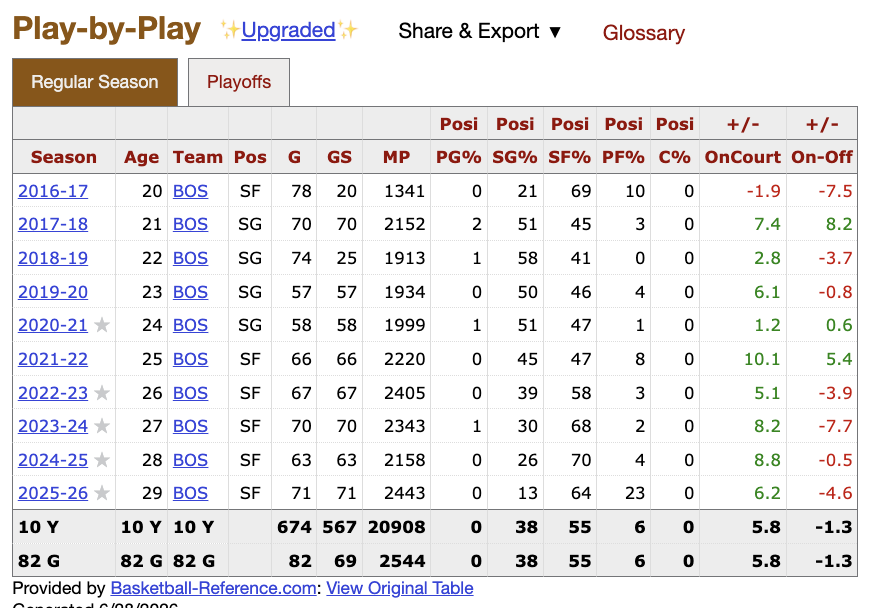
What do we make of this? How do we reconcile a Finals MVP who fills up the box score who also seems to consistently drag down his team’s overall effectiveness?
This is the wheelhouse of analytics: to disentangle team success from individual skill. And the numbers don’t agree on Brown, showing why he’s such a fascinating player.
The analytical consensus on Brown
As I showed above, the Celtics’ performance with and without Brown is the biggest reason why he’s an analytical riddle. I can’t speak to Marks’ source who says Brown would be the seventh-best player on a team, but the consensus of highly regarded analytical measures in the public domain don’t view him that lowly. If you’re the seventh-best player on a team, that places you somewhere in the neighborhood of the 200th-best player in the NBA. That’s a bold statement.
All-in-one metrics that primarily use box-score figures think he’s rightfully in the All-NBA discussion, like Player Efficiency Rating (PER), which saw him as the 11th-best player last season.
But that’s the top end. Box plus-minus and VORP both peg Brown at 21st based on last season’s production – basically a certified All-Star. But not every metric is convinced of that lofty status. Daily Plus-Minus, Kostya Medvedovsky’s metric found on databallr.com, registers Brown at 39th in the league — a good starter nibbling on the fringes of All-Star notoriety. Win shares per 48 minutes, an old standby that can be found at Basketball Reference, has him at 51st. Somewhere between 11th and 51st, we can ballpark Brown’s value as something like a fringe All-Star player this season.
Once you bring in the scoreboard element, Brown’s standing falls dramatically. Estimated Plus-Minus, which blends box-score numbers with a strong dose of on-court/off-court data, pegs him as 87th-best in the league going forward. That’s not seventh-best on a team, but it certainly does not view him as an All-Star caliber player.
The biggest Brown skeptic, among publicly available analytical models that I could find, belongs to Jeremias Engelmann’s xRAPM metric. An analytics guru who used to work for the Phoenix Suns and Dallas Mavericks, and now writes at Royce Webb’s 5×5 Substack, Engelmann hasn’t been shy about his Brown takes. He argued last year that Boston should have traded Brown and more recently explained why Boston may be having so much trouble finding a taker for his services.
Engelmann’s value metric xRAPM, which uses on-off data as a key signifier, places Brown in the 62nd percentile in the league, above average still, but ranking 180th among players with at least 1,000 minutes played last season. His negative on-off data over the last four seasons is what made Engelmann write the following: “ Brown, to whom Boston owes more than $180 million over the next three seasons, easily one of the most overpaid players in the NBA.”
On Sunday, Engelmann posted another contributing factor to Brown’s low standing in his data. With a scatter plot attached depicting scoring rates, Engelmann concluded “no player in the NBA lowers the points that his teammates score, while on the court with him, more than Jaylen Brown.”
No player in the NBA lowers the points that his teammates score, while on the court with him, more than Jaylen Brown
He lops off 4 points, per 100, from each of the 4 teammates that share the court with him pic.twitter.com/ZgVlCppSHE
— Jeremias Engelmann (@JerryEngelmann) June 28, 2026
In Engelmann’s view, dealing Brown and his massive contract would be an “addition by subtraction” situation. A player may be waiting to break out. And I’m not talking about Tatum.
Is Pritchard a mini Jalen Brunson?
For much of last season with Tatum rehabbing, Celtics coach Joe Mazzulla let Brown cook in a spaced-out offense. He placed fourth in scoring and first in 2-point attempts per game (16.0) with an old-school shot profile. Brown was the most high-volume isolation scorer in the NBA behind Shai Gilgeous-Alexander and James Harden, scoring more points on that action, according to Sportradar tracking, than everybody except those two names. On those plays, Brown posted an effective field goal percentage of 50% (field goal percentage weighted for 3-pointers) but turned the ball over quite a bit, with iffy handle and a ton of offensive fouls.
Brown worked well as an innings-eater for the Celtics offense, but the issue for Brown’s impact was that he wasn’t the best isolation scorer on his own team.
That would be Pritchard.
Standing at just 6-1, Pritchard has developed into one of the premier scoring guards in the league. After winning the Sixth Man of the Year award in 2024-25, Pritchard took another step forward and recorded career-highs in both points (17.0), assists (5.2) and rebounds (3.9). Simply put, he was a monster in isolation actions. On those one-on-one plays last season, Pritchard posted a 57.7% effective field goal percentage, which ranked second among 63 players with at least 100 isolation plays last season.
Brown and Pritchard operated in different ways. A physical attacker, Brown often utilized a push-off arm to gain space on his drives, which resulted in the third-most offensive fouls called in the league and fifth-most charges. Pritchard didn’t leverage brute force like Brown, choosing to overcome his size disadvantage with elite quickness and footwork to get to his spots.
The Celtics trading Brown is a bet that Pritchard is their in-house version of New York Knicks guard Jalen Brunson, a diminutive player who didn’t fully show his talents until Luka Dončić was out of the picture. The splits on Pritchard without Brown are intriguing to say the least.
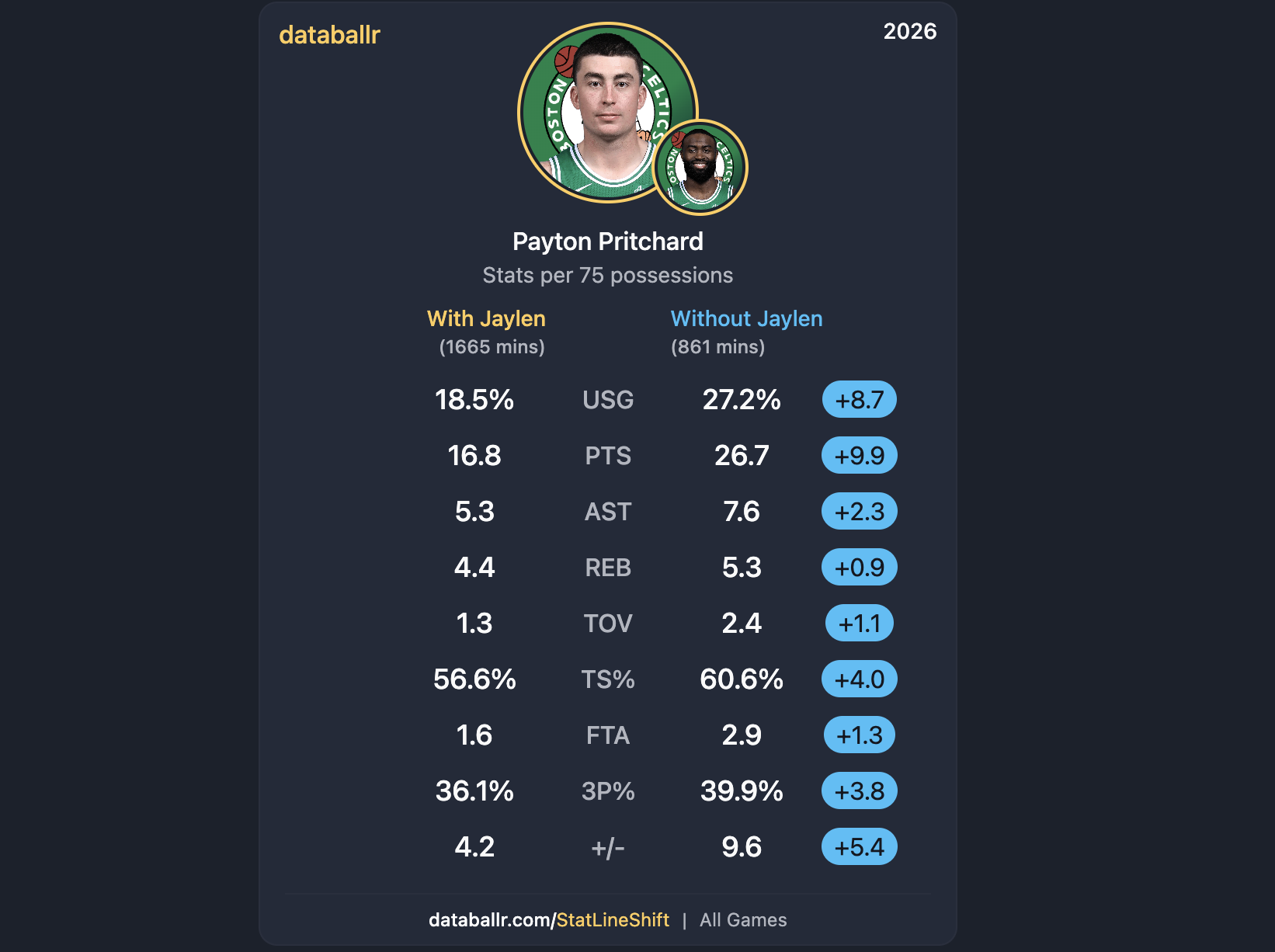
In 10 games this season without Brown in uniform, Pritchard elevated his game to all-league levels. The 28-year-old averaged 25.2 points, seven assists and 4.8 rebounds while shooting 51.3% on 2s and 44.4% on 3s. Notably, the Celtics went 8-2 in those games.
By moving off of Brown, the Celtics aren’t saying they think Pritchard is the better player. They’re making the presumption that Pritchard is the better player relative to his contract.
In a league with a salary cap, the Celtics have to maximize their talent under the constraints of the collective bargaining agreement. Brown is set to eat up about 35% of the cap in each of the next three seasons, earning $57.1 million next season, $61 million in 2027-28 and $65 million in 2028-29.
Meanwhile, Pritchard is signed at a bargain rate at $7.8 million for 2026-27 and $8.3 in 2027-28. It may be the single-best contract from a value standpoint in the entire league. In 2026-27, Brown will make more in one month than Pritchard will make during the entire season.
For a team that hopes to win another championship in the new apron world, the Celtics have to make some tough decisions. Brown, not Tatum, was the one to go.
Why not deal Tatum?
We haven’t talked much about Tatum in this breakdown, but as big as Brown’s contract is going forward, it can’t be ignored that Tatum is owed more money (about $5 million more annually). So if Boston had to pick one of the two stars to deal, why wasn’t Tatum being shopped more?
One objective of any front office is to go to market and see if another team values your player more than you do. In Tatum’s case, it’s possible that another team feels more strongly about Tatum going forward than Boston does. But given Tatum is coming off an Achilles tear, it’s less likely that teams will be willing to part with cherished assets for him.
Brown doesn’t have a medical red flag like Tatum and it makes sense why the Celtics might determine the Cal product as having more trade value around the league. Opposing teams also may see Brown’s controversial comments about last season being his favorite of his career as an indication he’s eager to be the leader of a team. Not only would they be getting an alpha, the underwhelming on/off splits are probably easier to explain away than “the longest tendon in his body is stitched together.”
There’s another thing. Tatum’s impact on the Celtics has been far more positive than Brown. Playing for the same franchise, Brown has a minus-1.6 on-off split in his career, indicating that the Celtics have been worse on a per-100-possession basis with Brown on the floor than off. Tatum, on the other hand, is a plus-5.9 for his career, showing Boston improvement when he’s on the floor. Tatum has been positive in eight of his nine seasons in the league, while Brown can claim only three such seasons in a 10-year span.
I’ve long defined analytics as the study of what wins. It is not dogmatic. It does not say you have to shoot lots of 3s or play a certain type of player. It is not one metric and not one voice. Importantly, it changes with the times. What won yesterday is not necessarily what wins tomorrow.
It is certainly possible that Brown will win a ton of games in Philadelphia. That has been the case in Boston. It is also the case that the Celtics, with Brown a DNP, have posted a 90-36 (.714) record in his 10 seasons.
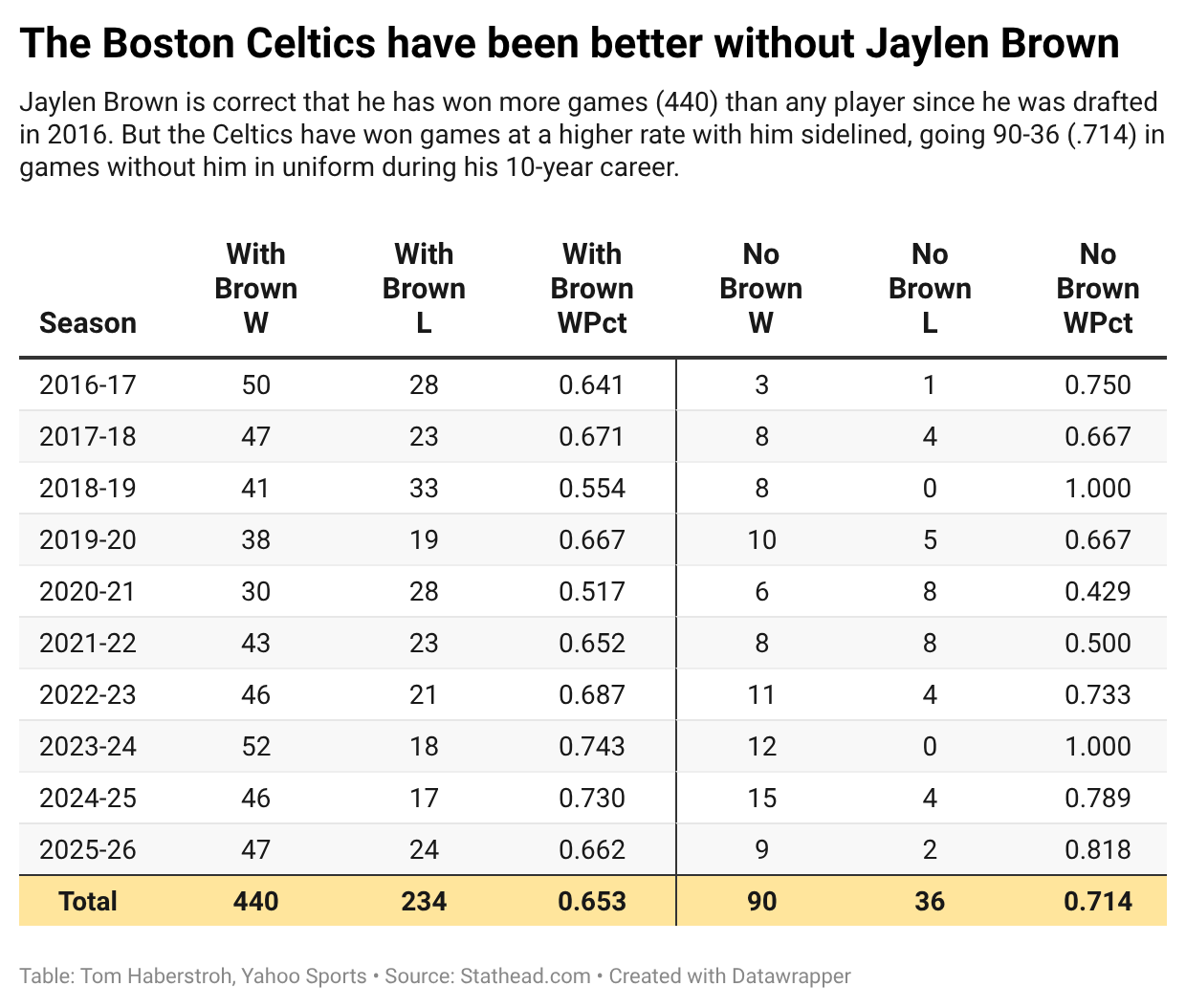
Evidently, the Sixers believe Brown’s talent is worth the risk and that Boston’s non-Brown win-loss record understates his value. To take on the three years, $183 million remaining on Brown’s contract and a possible extension, the Sixers offloaded George’s $54 million coming next season and his $56.5 million player option in 2027-28. The expectation should be that Brown’s career-high usage rate will fall back down now that he’s sharing the ball with Maxey, Edgecombe and Embiid, and perhaps his middling efficiency will get a boost. He has won a Finals MVP after all.
So, yes, it is true that Brown has won more games than any other player since he was drafted in 2016. Brown has every reason to defend himself and every right to hold the belief that he is the main reason for all those wins, not the coach and his supporting cast.
But it’s also true that the Celtics have won at a higher rate without him. We’ll see which stat wins out in the end.