College World Series packed with parity. What makes baseball tournament so unpredictable?

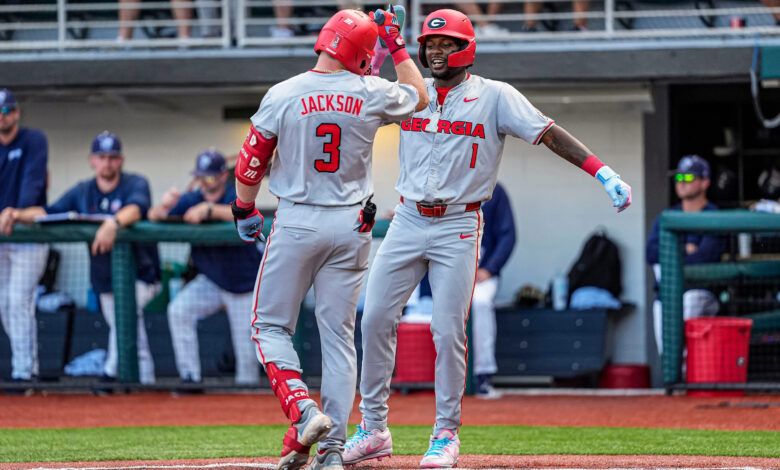
Football and basketball have nothing on college baseball’s postseason.
Defending college football national champion Indiana climbed from the bottom of the Big Ten to the top of the Bowl Subdivision in a two-year span, showcasing how the transfer portal and increased spending on personnel has transformed the top level of the sport.
But last season’s College Football Playoff was still largely a murderer’s row of high-profile programs from the Big Ten and SEC, two leagues that have combined to capture the past seven and 18 of the past 21 national championships.
In men’s basketball, Florida Atlantic and San Diego State, both in 2023, are the only two mid-major programs to have made the Final Four in the past five years. There’s even less disparity on the women’s side, where the same four teams have reached the Final Four in each of the past two seasons.
Baseball is just different. Driven by factors such as increased talent distribution and the postseason’s double-elimination format, college baseball stands alone among the major NCAA-sponsored sports in terms of pure unpredictability and parity.
The proof is in the lineup of participants in the past three College World Series, where just one team, No. 5 North Carolina, has made repeat trips to Omaha. Put another way, 23 unique teams make up the 24 possible CWS spots during this three-year span. That includes 11 different programs from the SEC, the nation’s top conference.
“I think that’s what makes baseball so awesome,” said North Carolina coach Steve Forbes.

College baseball is less predictable overall
Baseball’s inherent randomness is nurtured by the dozens of roll-of-the-dice individual matchups that comprise what is ostensibly a team sport. There are a set number of innings and outs; baseball teams in the lead can’t run out the clock or milk possessions in the second half.
But the sport’s volatility stems from the fact that baseball, unlike football and basketball, is a skill-driven sport where size and physicality are secondary assets — helpful, for sure, but size and strength alone won’t help you hit a curveball.
“The sport in and of itself lends itself to unpredictability, more upsets,” said ESPN college baseball analyst Chris Burke.
“College baseball is a sport where you don’t get to put your hands on your opponent, like you do in football or basketball. So it becomes almost entirely a skill sport. And as we know in baseball, that skill can come in a lot of different shapes and sizes.”
That helps explain how this year’s College World Series field includes two first-time participants in No. 16 seed West Virginia and unseeded Troy, a Mississippi team that finished ninth in the loaded SEC and an Oklahoma team that finished below .500 in SEC play.
Troy finished fourth in the Sun Belt standings and was a controversial at-large pick for the tournament. Fourteen years ago, West Virginia’s program was nearly disbanded due to lackluster facilities and support.
“It’s just really tough in baseball,” said Troy coach Skylar Meade. “You can have so much depth and so much talent, but unlike football, where you can just out-strong somebody, or basketball, where you can just have a guy that’s like, ‘Hey, I’m giving the ball to MJ.’ It’s just different in our sport. But beautiful things do happen where unpredictability prevails.”
Not a one-and-done postseason
While the football and basketball postseasons follow a one-and-done format, baseball’s double-elimination tournament creates more instability by granting room for error and the chance for a team to build momentum.
Case in point: As the No. 3 seed in the Gainesville regional, Troy dropped the opener to No. 2 Miami (Fla.) and was against the wall heading into the loser’s game against No. 4 Rider.
The Trojans pounded out a 15-7 win and haven’t looked back, taking the rematch against the Hurricanes, taking two in a row against host Florida and then sweeping Arkansas-Little Rock to make the CWS.
Likewise, Oklahoma faced elimination after losing to No. 2 Georgia Tech on May 30 but hasn’t lost since, topping the favored Yellow Jackets on a walk-off home run in the regional elimination game before taking two in a row from No. 15 Kansas in the Lawrence super regional.
“I do think the double-elimination format allows teams to kind of get hot, so to speak,” Burke said. “You can build this sort off short-term momentum.”
Transfer portal increases talent distribution, parity
There may be “20 or 30 programs with major NIL funding,” Burke estimated, but every program in Division I leans heavily on the transfer portal to build their rosters. In that sense, baseball is no different than football and basketball.
But the fact there has been just one repeat CWS team in the past three years shows how the portal has had a more transformative effect on baseball than on other major NCAA sports.
One factor behind this impact is the pure number of college baseball teams and players. Beyond the 301 Division I teams carrying a maximum of 34 players apiece, there is much more upward mobility for Division II, Division III and even junior college prospects to reach the highest level of competition.
“That’s a lot of players for coaches to try and evaluate and fill their rosters for,” Burke said.
“It’s totally a spread. I just think it allows for coaching staffs to be way more creative with the way they build their rosters than the traditional ‘sign high schools kids and hope they grow up quickly’ model.”
By using the transfer portal, programs “can stay older and you can stay more physical,” Forbes said, meaning coaches can consistently replenish depth with seasoned, battled-tested veterans and upperclassmen to supplement their traditional high school recruiting.
And that edge isn’t solely for major-conference teams. The same advantage exists for the mid-major programs such as Troy, which has more than three times as many seniors, 16, as freshmen, five.
“So just because you’re a Power Four team doesn’t mean that you can’t lose to a mid-major. They’re also active on the transfer portal, they’re also active in the high schools,” said Forbes.
“I think it’s going to remain like that. I don’t think the gap is going to be gigantic just because of ‘money.’ I think a lot of people think that’s going to be the case, but we saw that this year, that’s not the case.”
This article originally appeared on USA TODAY: College Word Series showcases parity, in college baseball