
It’s Tuesday night here at BCB After Dark: the hopping hot spot for night owls, early risers, new parents and Cubs fans abroad. Come on in out of the heat. The vibe in here is cool. There’s no cover charge. The dress code is casual. We’ve still got a few tables available. Bring your own beverage.
BCB After Dark is the place for you to talk baseball, music, movies, or anything else you need to get off your chest, as long as it is within the rules of the site. The late-nighters are encouraged to get the party started, but everyone else is invited to join in as you wake up the next morning and into the afternoon.
Last night I asked you for your opinion of the best Cubs trade of the 21st Century. (Some of you missed the “21st Century” part and made a plea for the Sandberg trade.) Among the trades actually made this century, you went with the deal that brought Jake Arrieta and Pedro Strop to Chicago with 53 percent of the vote. The trade for Anthony Rizzo came in second with 22 percent.
I think it’s possible in 25 years that we’ll say the Pete Crow-Armstrong deal was the best, but we still have to wait to see that play out.
On Tuesday nights, I don’t write about movies. But I always have time for jazz, so let’s start the music now. You can skip ahead if you want.
We’ve got one final performance from saxophonist Sonny Rollins, who left us last month to go on to the next gig. This is “If Ever I Would Leave You” from Camelot in 1962. Jim Hall is on guitar, Bob Cranshaw plays bass and Ben Riley is on drums.
Welcome back to everyone who skips the music.
Yesterday’s topic of what was the best Cubs trade of the 21st century got a lot of reaction, so I’m going to have to go on and ask you what was the Cubs’ worst trade of the 21st Century.
I really hate to ask these kinds of negative questions because being a fan is supposed to be fun and it’s no fun to be going over the Cubs’ failures. But I think we need to be objective and acknowledge that every team in baseball has made good trades and bad ones. These are the bad ones.
Here are the candidates for the Cubs’ worst trades of the 21st Century and some explanation as to why the Cubs made them.
July 7, 2008. Josh Donaldson, Sean Gallagher, Matt Murton and Eric Patterson to the Athletics for Rich Harden and Chad Gaudin.
The thinking behind this trade was clear. The Cubs needed a starting pitcher down the stretch in 2008. Rich Harden, who had a reputation as the American League’s Mark Prior for both his talent and his injury issues, was available.
Harden was actually very good for the Cubs down the stretch, going 5-1 with a 1.77 ERA in 12 starts. Gaudin was a good reliever in Oakland, but he was very poor for the Cubs in 2008, posting a 6.26 ERA.
The Cubs won 97 games that year and finished with the best record in the NL. But Harden lost Game 3 of the Division Series as the Dodgers completed the three-game sweep.
Sean Gallagher was the big name going back to Oakland when the deal was announced. Gallagher had an undistinguished four-year MLB career. But the second name in the deal was the Cubs’ first-round supplemental pick from the year before: Donaldson. He had destroyed short-season Boise in his first professional season, but was struggling in low-A Peoria in his second season when the deal happened. There were also many doubts he could stay as a catcher.
Those doubts about him as a catcher were correct, but he turned into a solid third baseman. Donaldson went on to play 13 years in the majors, make three All-Star teams and was the 2015 MVP.
Murton didn’t do much after leaving Chicago. Patterson was a decent utility infielder for a few years, but nothing special. The big loss here was Donaldson.
July 30, 2009. Josh Harrison, José Ascaino and Kevin Hart to the Pirates for Tom Gorzelanny and John Grabow.
The Cubs were a game under .500 in 2009 when this trade was made and they were desperately trying to turn around a bad month of July and make the playoffs for the third-straight year. But they were 5.5 games behind the Giants for the final Wild Card and they would end up finishing far out from a playoff spot. Gorzelanny didn’t help much, posting a 5.63 ERA in seven starts and 13 appearances after the deal. He was better in 2010, but the Cubs were so poor it didn’t matter.
Grabow was a decent reliever in 2009, but he played two more years with the Cubs in 2010 and 2011 and was bad in both seasons. After that, he retired.
Neither Ascaino nor Hart did anything that would make the Cubs miss them. But Josh Harrison was having a great year with Peoria when traded and had just been promoted to High-A Daytona before the trade went down. Harrison went on to be a two-time All-Star with the Pirates and played 13 years in the majors and was a very good second baseman.
December 8, 2011. DJ LeMahieu and Tyler Colvin to the Rockies for Ian Stewart and Casey Weathers.
This was the first trade that Theo Epstein made as President of Baseball Operations for the Cubs and it was the worst trade he ever made. On top of it being a bad deal, there was no real reason for it other than the Cubs wanted a third baseman and thought Ian Stewart could be the guy. It’s not like they were dumping a contract or anything. This was a pure talent-for-talent trade and it was a terrible one.
LeMahieu would go on to a 15-year career in the majors. He’d win two batting titles, make three All-Star Games and win four Gold Gloves. Colvin didn’t do much of anything after the trade, but LeMahieu would go on to be one of those guys whom people would say that “Real fans know how good he is.”
Stewart was not only terrible with the Cubs, but he had a bad attitude and ended up getting released after blasting the front office on social media. Weathers never made the majors.
July 31, 2017. Jeimer Candelario and Isaac Paredes to the Tigers for Alex Avila and Justin Wilson.
The Cubs got off to a bad start to the 2017 season as they tried to defend their title, but by the Trade Deadline they were firing on all cylinders and had crawled back into first place. But the Cubs had a backup catcher problem. Willson Contreras had established himself as the starting catcher in 2017, but David Ross had retired and Miguel Montero was unhappy about being on the bench and got traded after publicly complaining.
So without a real backup catcher, the Cubs made a deal for Avila, with Wilson to shore up the pen. Avila was a decent backup catcher for two months before he left as a free agent. Wilson was bad down the stretch in 2017 with a 5.09 ERA, although he was solid in 2018 with a a 3.46 ERA in 71 games. No matter, the Cubs lost the Championship Series to the Dodgers in five games.
With Kris Bryant firmly ensconced at third, the Cubs felt they could deal away two minor league third basemen: Candelario and Paredes. Candelario was a solid starting third baseman for the Tigers for six year and is still bouncing around the majors and is with the Angels right now. The Tigers would end up dealing Paredes to Tampa Bay, where he turned into a quality third baseman, making the All-Star Game with Tampa in 2024 and with Houston in 2025.
Ironically, the Cubs would end up trading back for both Paredes and Candelario after Bryant left.
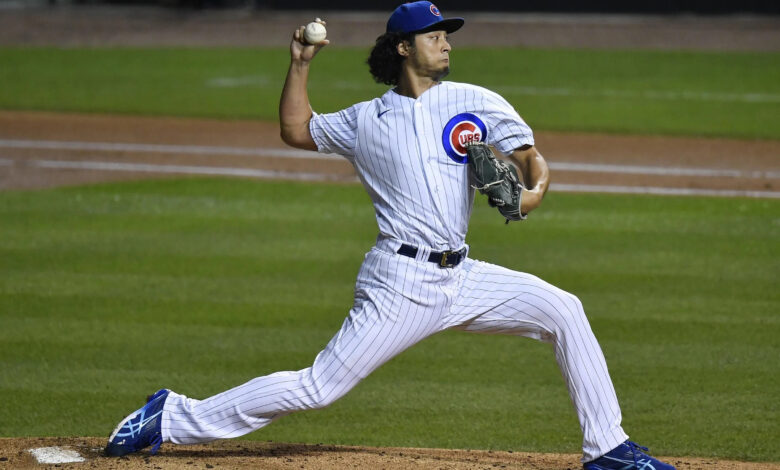
December 29, 2020. Yu Darvish and Victor Caratini to the Padres for Owen Caissie, Zach Davies, Ismael Mena, Reginald Preciado and Yeison Santana.
You all know the reason for this trade. After the cut in revenue that the Cubs suffered after the COVID-19 pandemic kept all fans out of the ballpark in 2020, ownership ordered the front office to cut payroll. The Padres were one of the few teams willing to take on payroll that winter, so the Cubs had little choice but to get whatever they could out of San Diego.
Darvish pitched five seasons for the Padres and signed an extension that covers him through the 2028 season. That extension was probably a mistake by the Padres as it looks like Darvish’s career is over. He’s definitely out for the year this year.
But before age and injuries brought him down, Darvish made one All-Star Game with the Padres and had very good years there in 2021 and 2022. Since then he’s either been ineffective or battling injuries.
Caratini was Darvish’s personal catcher and played one OK season with the Padres.
Zach Davies had one bad year with the Cubs before leaving as a free agent. Of the four prospects, Mena and Santana washed out. Preciado is still with the Cubs in High-A South Bend, although he’s currently on the 60-day injured list. Caissie made the majors with the Cubs are was traded to Miami for Edward Cabrera. So the trade has basically broken down to Darvish for Cabrera.
December 17, 2024. Cody Bellinger to the Yankees for Cody Poteet.
This deal was also a pure salary dump, although it was one that didn’t need to happen if the Cubs hadn’t traded for Kyle Tucker. I considered putting the Tucker trade on this list, but we really don’t know how the players the Cubs traded to Houston are going to work out. Paredes is Paredes. After a strong start for Cam Smith with the Astros, he’s been pretty so-so since. He’s also been a right fielder, which was and is a problem for the Cubs.
But we know Poteet never played for the Cubs and was sold to the Orioles for cash before the 2025 season even started. We also know that Bellinger was about as good for the Yankees last year as Tucker was for the Cubs. Yes, he took advantage of Yankee Stadium and he might not have been as good in Chicago, but the upgrade from Bellinger to Tucker wasn’t huge. And Bellinger has certainly been a better player than Tucker in 2026, although both were free agents after last year so that doesn’t really play a role here.
So the Bellinger trade gets listed here because it was a salary dump, bringing back nothing, to make room for a player who turned out to be not much better than Bellinger was.
So now it’s time to vote.
Thank you for stopping by tonight. We need to see friendly faces around now. Please get home safely. Recycle any cans and bottles. Tip your waitstaff. And join us again tomorrow night for more BCB After Dark.