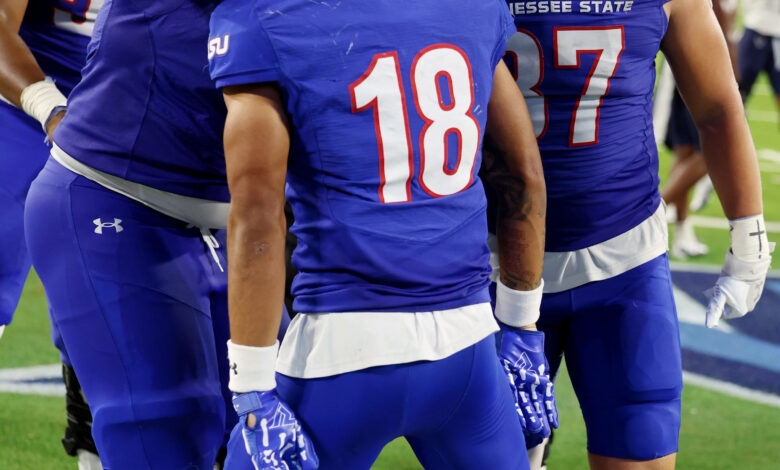
On June 1, news broke that six Tennessee State University athletic coaches submitted a vote of no confidence against athletic director Mikki Allen. Men’s basketball coach Nolan Smith, football coach Reggie Barlow, women’s basketball coach Candice Dupree and three others cited “inconsistent communication and lack of operational transparency,” “lack of clear departmental vision, structure and accountability” and “declining morale and trust within the athletic department” among their complaints.
The timing is fortuitous.
On May 19, the NAACP launched its Out of Bounds campaign in response to widespread congressional redistricting across the South. The dismantling of the Voting Rights Act, courtesy of the Supreme Court decision in Louisiana v. Callais, means elected officials are now free to break up majority Black districts, like Memphis, without fear of running afoul of the once monumental legislation of the modern Civil Rights Movement.
So while acknowledging the inextricable link between state lawmakers and their flagship universities, the NAACP and other Black leaders are asking top football and men’s basketball recruits to forgo schools in states run by gerrymandering Republicans and to, instead, “visit and seriously consider” attending HBCUs.

In a previous column, I expressed my support of the campaign’s spirit, while also noting its limitations. History has proven that elite Black athletes are generally inclined to go where the money and opportunities are – which, post-segregation, has lead them away from Black institutions and toward predominately white ones. I don’t see that immediately changing in the NIL and revenue sharing era, even if it would be the politically prudent thing to do.
Nevertheless, the proposed boycott has sparked a needed and ongoing conversation about Black athletic power and the viability of HBCUs. People are paying attention to what’s happening at schools like TSU, and in an increasingly uneven collegiate sports landscape, they’re asking what it will take to level the field.
Though temporarily disruptive, and perhaps embarrassing, the news out of TSU – and the opportunity for President Dwayne Tucker to reassess the athletic department’s leadership – may provide an answer.

Vanderbilt’s rise offers a blueprint
Over on West End, the radical transformation of Vanderbilt University continues to be one of the biggest stories in college sports.
In football and basketball – the sports that generate the most revenue at the collegiate level and, thus, hold the biggest influence on an athletic department’s fortunes – Vandy was a perennial SEC basement dweller. Then the football team defeated Alabama in a 2024 upset before logging its first 10-win season in program history in 2025. Men’s basketball got in on the action, finishing at 27-9 and scoring a No. 5 seed in the 2026 March Madness tournament. (Women’s basketball had its own charmed season, ending with a 29-5 record and a Sweet Sixteen berth this year.)
Much of the public credit tends to go to the athletes – Diego Pavia, Tyler Tanner, Mikayla Blakes, et al – but excellence across sports is a top-down affair. You need good coaching to attract the best athletes and push them to be their best, but you need a strong athletic director to appoint the right coaches.
Candice Storey Lee, Vandy’s athletic director, has been masterful. She hired Clark Lea, Mark Byington and Shea Ralph, all masterful at their own jobs, all architects of the dramatic turnarounds for their respective programs. Lee’s approach when she was rifling through resumes? Finding people who believed in Vanderbilt athletics just as much as she did.
It’s Lee’s belief that Vandy’s sports performance could match its academic distinction. That has driven her the past six years. It’s why she kept her head down when outsiders questioned her qualifications and capabilities as a Black woman – as the first woman of any race to run an SEC athletic department. And it’s why when the tide started to turn, or roll, in Vandy’s favor, she never lost focus. She never allowed her staff to, either.
“We beat Alabama, and everybody said we shocked the world,” Lee told me in March 2025. “Internally, that’s not how we talked about it. Yes, the world may be shocked. But we weren’t shocked because we had been preparing.”

A resource gap and an imperfect comparison
The parallel between Vandy and TSU isn’t perfect – TSU is still working to overcome the ongoing impact of decades of state underfunding (as well as internal mismanagement), while Vanderbilt boasts an endowment greater than $10 billion.
Still, an underdog story is an underdog story, and Vandy’s trajectory from SEC punching bag to national contender hold valuable lessons for a school struggling to overcome its own negative perceived value. Because the truth is, TSU and other HBCUs aren’t just battling a lack of capital. They’re fighting the idea, particularly among elite athletes, that HBCUs are second-rate, uncompetitive and ill-equipped to get kids to the pros.
But as with Lee’s belief in Vanderbilt athletics, the first, and most crucial step, in facilitating a TSU transformation is an unwavering faith that it’s possible.
I imagine this faith being similar to the conviction Tucker must have held when he agreed to accept the role of TSU’s president – first on an interim basis, and then permanently. The school was in financial disarray, and not just because the Tennessee government had been withholding funds legally due to TSU for decades. The messy departure of former president Glenda Glover left an institutional failure of fiscal checks and balances, threats of a state takeover and a widespread assessment that TSU just can’t handle business.
But Tucker stepped in, rolled up his sleeves and stabilized TSU’s finances, fulfilling the final request made by his late mother: to “take care of those kids in North Nashville.”

What TSU’s president decides could define the future
Proposed SEC boycott aside, taking care of North Nashville kids should include building a strong, competitive sports program. And Tucker can help facilitate that by ensuring his AD of the future shares his commitment to excellence in all areas, including sports – and who has the support of coaches and student-athletes. Only then can the athletic director begin to overcome TSU’s preexisting financial hurdles by creating a winning environment that attracts corporate partners, drives merchandise and ticket sales and, eventually, brings in the most elite recruits.
With the right leadership from Tucker, this moment, however inconvenient and embarrassing, can prove itself the defining one for the modern era of TSU athletics. More importantly, it could be the beginning of TSU’s return to athletic dominance, an ascent that could eventually put the HBCU in position to compete for talent with the likes of the University of Tennessee-Knoxville.
Then, those elite student-athletes wouldn’t need political pressure to consider TSU. They could consider TSU because they want to.

Andrea Williams is an opinion columnist for The Tennessean and curator of the Black Tennessee Voices initiative. She has an extensive background covering country music, sports, race and society. Email her at adwilliams@tennessean.com or follow her on X (formerly known as Twitter) at@AndreaWillWrite and BlueSky at@andreawillwrite.bsky.social.
This article originally appeared on Nashville Tennessean: Vanderbilt rebuilt its brand. TSU can learn from that