Life, death and football: How the Saints kept marching after Hurricane Katrina (SN Archive — 2005)

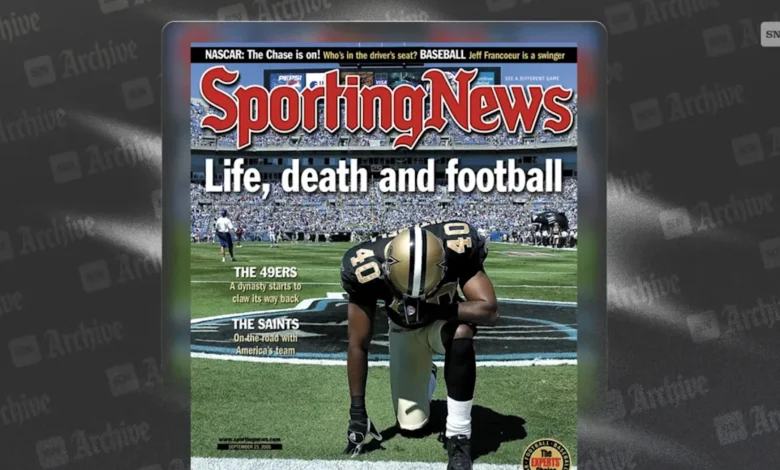

Life, death and football: How the Saints kept marching after Hurricane Katrina (SN Archive — 2005) originally appeared on The Sporting News.
Add The Sporting News as a Preferred Source by clicking here.
This article, ‘The Saints go marching on’ by Dennis Dillon, originally appeared in the Sept. 23, 2005 issue of The Sporting News.
As he looks out the window of his 15th-floor room at the Marriott Rivercenter, Fred McAfee gazes down on San Antonio’s famed River Walk. Men, women and children stroll along the serpentine walkways outside the restaurants and shops. A cruise boat filled with sightseers motors slowly down a ribbon of the lime green Rio San Antonio. Arching limestone bridges and a variety of foliage complete the picturesque scene.
“It’s a great view,” says McAfee, the Saints‘ special teams star, three days before his team’s opening game.
It is easy on the eyes, especially compared with what McAfee has seen moments earlier. Sitting on the end of his bed, TV remote in hand, he stared at some more disturbing video from New Orleans on the evening news shows.
The city known for its Bourbon Street revelry, Mardi Gras parades and Super Bowls now exhibits a
loathsome identity in the devastating wake of Hurricane Katrina. National Guardsmen patrol neighborhoods, looking to evacuate the remaining inhabitants. Water reaches the rooftops of thousands of houses and apartment buildings.
SN ARCHIVES:Access every SN issue since 1886, for free
Several lanes of highway at the 1-10 and 1-610 interchange collapse.
“That’s mind-boggling,” McAfee says. “It’s almost like watching a science fiction movie.”
McAfee and the Saints must feel like they’re living some kind of fantastic journey themselves. They escaped New Orleans several hours before Katrina came knocking. Now, they can’t go back. They aren’t
homeless, but they certainly are orphans, having taken up residence in San Antonio-their likely headquarters for the 2005 season while their long-term fate rests in the hands of NFL commissioner Paul
Tagliabue, team owner Tom Benson and various public officials.
Their city is flooded. Their stadium, the Superdome, might be destroyed. Their training facility, in the New Orleans suburb of Metairie, has been taken over by Federal Emergency Management Agency officials. All of which has turned the Saints into the NFL’s ultimate road warriors.
But they’re winning warriors.
John Carney’s 47-yard field goal with three seconds left gives them a 23-20 victory in their opener at Carolina and extends the team’s winning streak to five games, counting their 4-0 finish in 2004. The triumph over a Panthers team picked by some prognosticators to end the Eagles‘ reign of NFC supremacy pushes aside the memories of Katrina’s devastation-temporarily, at least for both the Saints and their legion of fans, many of whom are displaced, too.
“We went out to give the people of New Orleans a break for three or four hours,” left tackle Wayne Gandy says, “and I think we found we had a break. From hurricane conversations, hotels, bus trips. We
finally got to play football.”
This is only the beginning of a long road show for the Saints. Next up is a game against the Giants,
their “home” opener, which was relocated to Giants Stadium and rescheduled as part of a unique
Monday night doubleheader. Then they will journey to Minnesota.
Their first game without travel could be against the Bills on October 2 in San Antonio, but that was not final at week’s end. At points during their 39-year history, the Saints have been called pathetic. Now they can be called peripatetic. In preparing for the Panthers in San Antonio, they hold team meetings at the convention center, dress at the Alamodome, practice at a high school sports complex and lilt weights at a Gold’s Gym (their own weight-training equipment was in transit). In their free time, they deal with such pressing issues as where they will live — they must vacate the Marriott by October 1 — whether they should move their families to Texas and what to do about insurance, financial matters and clothes.
Most of the players left New Orleans with travel bags containing a couple pairs of shorts, T-shirts, socks and underwear. Among McAfee’s purchases in San Antonio are three pairs of jeans and six baseball caps — “I’m a hat guy,” he says — which sit on the desk in his room. His current wardrobe is contained in a large paper sack and a duffel bag, both of which lie on the floor in his hotel room.
McAfee spends most of the time in his room flipping through news channels and watching the graphic
images of Katrina’s fury on New Orleans and other cities along the Gulf Coast.
“The scope of this tragedy is so huge,” he says. “Every day, you see a different story.”
McAfee is lucky. Four feet of water had flooded the apartment in Metairie he shares with his brother,
Charles, but most everything lost is replaceable. Charles evacuated to their mother’s house in Philadelphia, Miss. And Fred’s two children, ages 6 and 3, are safe in Madison, Miss., just north of Jackson, where they live with their mother.
When the Saints receive a couple days off after their final preseason game, McAlee goes to Jackson to
visit his kids.
“It was a happy feeling to know they were safe and to see their smiling faces,” he says. “There’s a lot of people who won’t see their kids’ smiling faces.”
The Saints spend much of their first week in San Antonio riding buses. They bus to the Alamodome, to the practice field, to the gym and back and forth from the hotel.
“Yesterday, I think I took six or eight bus rides,” tight end Ernie Conwell says as he hurriedly changes out of his practice uniform and into shorts and a T-shirt so he can jump on yet another bus to go lift weights.
“Make do” was the operative slogan. Coaches have to work at the convention center out of makeshift
offices that also serve as meeting rooms. The trainers, video personnel and equipment men have to operate without all of their apparatus. About the only training equipment players can use during
practice are step-over pads, hand shields, cones and a JUGGS machine. Such essentials as blocking sleds and standup dummies aren’t available.
“We’re just trying to get by,” says one member of the equipment staff, who could have been speaking for the entire organization.
It all made for an outrageous disadvantage in preparing for the start of the season. But you would be hard-pressed to hear a disparaging word in the locker room or elsewhere. That’s because coach Jim Haslett isn’t allowing the circumstances to become an excuse.
“He’s just staying positive,” says Conwell, who tied his career high with six receptions for 71 yards
before leaving Sunday’s game with a dislocated jaw and a concussion after a vicious hit that ripped off his helmet. “He’s empathetic to what the players are dealing with, because he’s dealing with the same
things . … Obviously, there’s a built-in excuse for us to fail, but we’re not jumping on that. We didn’t put all that time and energy into the offseason, our OTAs, our minicamp, training camp, all this transition we’ve gone through to now go out and fall down on our faces on Sunday. If anything, it’s made us
more determined.”
Conditions are expected to improve somewhat this week. On Tuesday, all the team’s personnel and computer and video equipment are scheduled to be moved from the convention center to the
Alamodome. And a decision is expected soon on the remaining schedule. According to published
reports, the Saints are negotiating to play four of their home games at the 65,000-seat Alamodome
and three at LSU’s Tiger Stadium in Baton Rouge.
There was some grumbling early in the Saints’ odyssey. When the team evacuated New Orleans, it first
went to San Jose to prepare for its final preseason game against Oakland. Some of the players complained about the inconvenience of leaving New Orleans early — until Gandy’s 6-4, 315-pound frame rose during an offensive meeting and quelled the whining.
“I painted a picture of what was really going on,” Gandy says. “We weren’t victims in the grand scheme of things. I said, ‘Our situation is uncomfortable; the situations of the people in New Orleans are catastrophic.’ When it gets to the point that you have to steal toilet paper, then your life must be at an all-time low.”
Some of the Saints see firsthand how fortunate they are when they visit USA Kelly, a former Air Force base in San Antonio that has been sheltering almost 1,800 evacuees. Gandy is among a group of a half-dozen team representatives to visit the facility a week before the opener. As they wait for a security guard to walk them in, a man in his early 40s recognizes them from across the street. He is crying but comes over and manages to say, “I knew the Saints were coming.”
The scene inside the shelter is disconcerting: Rows and rows of 6-foot by 3-foot cots; people asking
whether anyone has seen their moms, their dads, their wives; wrenching stories of what it was like to live for several days in the Superdome, where three holes were torn in the roof, hallways were flooded and young girls were raped.
Two days later, nine Saints players return to the shelter. On their way, they stop at a Wal-Mart. They load up carts and buy several thousand dollars’ worth of gifts toothpaste, shampoo, underwear, socks, shirts, diapers, candy, toys, footballs and soccer balls. Conwell runs into a man from the shelter who wants to buy an engagement ring “for a gal he wanted to marry,” the tight end says. “They had just had twins.” The man picks out a ring and Conwell pays for it.
During the team meeting at the Saints’ hotel last Saturday night, Haslett calls on Ricky Porter, the team’s director of player development. Porter stands up and reads an inspirational letter from New Orleans mayor Ray Nagin. Not that the Saints need extra incentive.
“If you’ve been watching TV for two weeks or had a chance to visit those (evacuees) in San Antonio, you understood,” Gandy says. “It was time to go out and play with that kind of heart.”
Although the Saints never trail Sunday after a 15-play, 80-yard opening drive that consumes 9:37 and concludes with the first of two Deuce McAllister touchdown runs, they find themselves tied and facing the possibility of overtime when they start at their own 22 with 1:04 left. In years past, such a situation might have been too much to overcome.
This time, the Saints show resilience-a resolve they hope to mirror in the coming weeks.
The Panthers played their home games at Clemson University in 1995, their inaugural season, while
their new stadium was being constructed. The Bears played their home games at the University of Illinois in 2002 while Soldier Field was renovated. But the players on those teams were able to practice close to home and sleep in their own beds. How long can the Saints survive their gypsylike existence?
“It’s a huge distraction,” one NFC pro scout says. “They’re a Jekyll-and-Hyde team. They have talent, but they haven’t always played up to it. You could say this is going to band them together.
They’re playing for the city. They’re like a wild animal backed into a corner, and they’re going to come
out swinging. Or they could just fall apart. History has proven they’re not the most mentally tough team. I don’t know which way they’re going to go.”
This is what awaits the Saints after Sunday’s victory: another bus ride. Another plane trip. Another
night in a strange city.
“Hey, that’s our life,” McAfee says. “We’re nomads now. We’re wanderers. We’re like that song
Papa was a rollin’ stone, wherever he laid his hat was his home. The Saints are rolling stones right now.”
For now, they’re rolling-and-triumphant stones.