Bryce Harper’s First 1,000 Games With the Phillies: Was the $330 Million Contract Worth It?

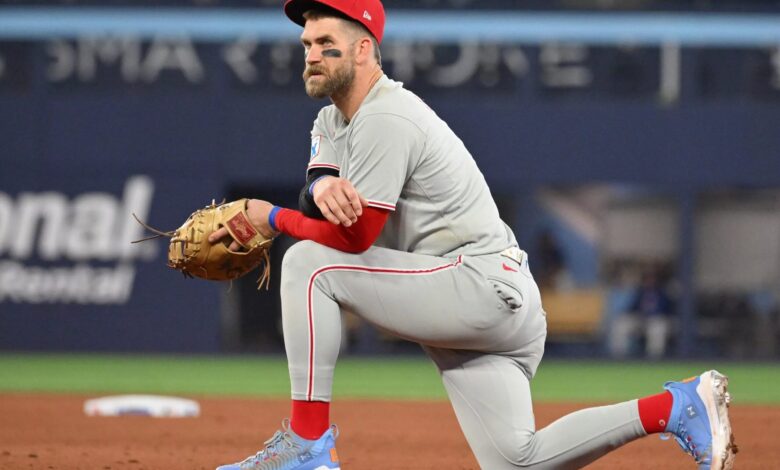

When Bryce Harper signed with the Philadelphia Phillies in March 2019, the number was almost impossible to comprehend.
13 years. $330 million.
At the time, it was the largest guaranteed contract in the history of American professional sports. Philadelphia wasn’t simply signing a superstar. The Phillies were betting that Harper would become the face of their franchise for more than a decade.
Eight seasons later, Harper has now played his 1,000th game as a Phillie.
So the obvious question is:
Was it worth it?
The answer is becoming increasingly difficult to argue against.
The Numbers Tell the Story
Through his first 1,000 games in Philadelphia, Harper has produced at a level that is remarkably consistent with the player the Phillies thought they were buying.
He has:
- 1,016 hits
- 206 home runs
- 610 RBIs
- 629 runs
- .280/.386/.523
- .910 OPS
- 143 OPS+
- 29.9 Baseball-Reference WAR
Those numbers are even more impressive when considering the circumstances.
Harper has dealt with injuries, played through a shortened 2020 season, changed positions and spent a significant portion of his Phillies career transitioning from right field to first base.
And yet, over 1,000 games, he has remained an elite offensive player.
Then There’s the MVP

If Harper had simply been a very good player in Philadelphia, the contract would probably still be defensible.
He has been much more than that.
In 2021, Harper won his second National League MVP Award, hitting .309/.429/.615 with 35 home runs, 84 RBIs and a league-leading 1.044 OPS.
That season alone provided a substantial return on the Phillies’ investment.
But Harper’s most important contribution may have come the following year.
Harper Became a Postseason Star
The Phillies reached the postseason in 2022 for the first time since 2011.
They didn’t just make the playoffs.
They went all the way to the World Series.
Harper was at the center of it.
He hit .349 with a 1.160 OPS during the 2022 postseason and was named NLCS MVP after hitting the go-ahead home run that sent Philadelphia to the World Series.
The Phillies ultimately lost the World Series to Houston in six games.
That’s the biggest hole in Harper’s Philadelphia résumé.
He has everything else.
MVP? Check.
Postseason heroics? Check.
NLCS MVP? Check.
Franchise milestones? Check.
World Series championship?
Not yet.
And that distinction matters.
He Has Helped Change the Phillies
The value of Harper’s contract isn’t limited to his statistics.
When he arrived, Philadelphia was coming off an 80-82 season in 2018.
Harper immediately became the face of a franchise that was trying to build something bigger.
The Phillies eventually did.
Philadelphia returned to the postseason in 2022, 2023, 2024 and 2025, establishing itself as a perennial contender in the National League.
Harper has been at the center of that transformation.
He also hasn’t always insisted on doing things his way.
When the Phillies needed a first baseman, he moved across the diamond.
When the lineup needed flexibility, he accepted the designated-hitter role.
He has become the type of franchise player teams hope they are buying when they hand out a decade-plus contract.
The Contract Looks Better With Every Passing Year

There’s another reason Harper’s deal looks so good today.
The market caught up to it.
Harper’s contract carries an average annual value of approximately $25.4 million.
That was enormous in 2019.
Today, it looks relatively modest for a player of his caliber.
Philadelphia’s own payroll currently includes contracts with higher annual values for Zack Wheeler and Kyle Schwarber, while Harper’s AAV remains below Trea Turner’s $27.27 million.
Even more importantly, Harper’s contract runs through 2031.
The Phillies aren’t paying him $50 million a year in his late 30s.
His annual cash salary drops from $26 million through 2028 to $22 million from 2029-31.
That structure could become increasingly valuable as other teams deal with the enormous salaries attached to newer mega-contracts.
The One Thing Missing
There is one legitimate criticism.
The Phillies haven’t won a World Series with Bryce Harper.
That’s the standard that will ultimately define this era.
Harper has been excellent in October, posting a .311/.431/.659 slash line with 12 home runs and 24 RBIs in 38 postseason games as a Phillie.
But Philadelphia has not finished the job.
For a player who signed one of the biggest contracts in baseball history, winning a championship would be the ultimate validation.
Still, it would be difficult to put that entirely on Harper.
Baseball doesn’t allow one player to win a championship by himself.
So, Was It Worth It?

Absolutely.
Maybe Harper hasn’t delivered the one thing Philadelphia wants most.
But judging the contract strictly on production, he has given the Phillies exactly what they paid for—and arguably more.
An MVP.
An NLCS MVP.
More than 1,000 hits.
More than 200 home runs.
Nearly 30 WAR.
A franchise face.
A postseason icon.
And eight years of elite offensive production.
The Phillies didn’t sign Bryce Harper to be a good player.
They signed him to be Bryce Harper.
Through 1,000 games, that’s exactly what they’ve gotten.
The World Series ring is still missing.
But if the question is whether the 13-year, $330 million contract has been a success, the answer is clear.
It has.
And with five years still remaining on the deal, Philadelphia may not even have reached the best part of the investment yet.