Chauncey Wiggins, Explained: Why Gonzaga Is Betting on Him to Fix Three Years of Bad Shooting


Gonzaga has spent three straight offseasons trying to buy its way out of a shooting problem, and three straight offseasons the fix hasn’t held. Adam Miller arrived off a career-best 42.9% season at Arizona State and shot 30.2% from outside in his one year in Spokane. Before that, Steele Venters was supposed to be “the guy,” but he lost two straight seasons to injury, then played 15 minutes a night, shot it fine but couldn’t stay on the floor due to his defensive limitations. Khalif Battle carried stretches of games by himself and then went ice cold in others, cold enough over one four-game run in February 2025 to shoot 2 for 17. Even Ben Gregg, who made 37.7% as a junior, somehow cratered to 27.1% as a senior. None of that is one guy’s fault. It’s been a three-year slide, and it’s getting worse, not better. Gonzaga shot 35.4% from three in 2024-25, the worst mark of Mark Few’s 26 years at the time. And then the Bulldogs broke that record for worse the very next season, hitting 33.3% and finishing 212th nationally in 2025-26.
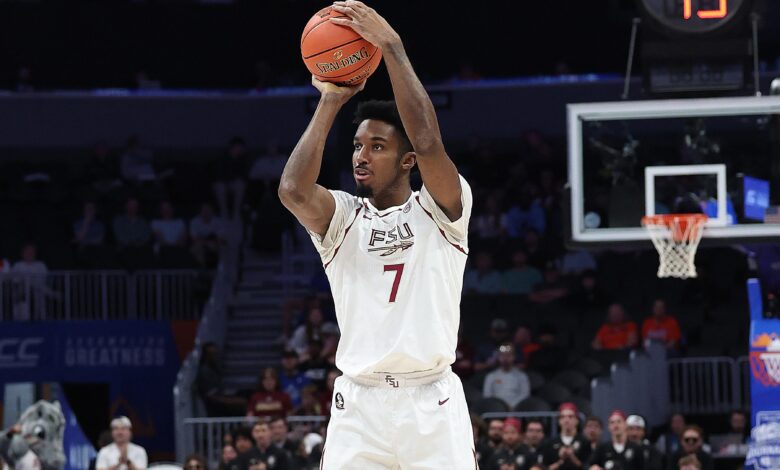
Florida State graduate transfer Chauncey Wiggins is the answer Gonzaga is banking on. He’s 6-foot-10, but he plays like a wing more than a traditional forward, and last season, 60% of his shots came from behind the arc, where he made 38.7% of them on a very high volume. What nobody knows yet is what role he’ll actually end up playing for the Zags: full-time starter carrying real shot volume? A complementary piece deployed the way matchups dictate? Or something in between.
Who is Chauncey Wiggins?
Wiggins hails from Grayson, Georgia, a suburb about 30 miles east of Atlanta, where he played his high school ball. He was a 3-star, top-150-nationally prospect in the 2022 class, ranked as the No. 25 power forward in the country and the No. 4 player in the state of Georgia by 247Sports. He chose Clemson over Georgia, Maryland, NC State and South Florida, and committed early, in September 2021. He spent his first three seasons with the Tigers, where, despite his size and skill set, he never became more than a complementary piece off the bench, playing fewer than 20 minutes per night and averaging around 35% from outside.
Then he transferred to Florida State for his senior year, and the role changed completely. He started 30 of his 32 games, played almost 28 minutes a night, and posted career highs across the board: 13.3 points, 3.9 rebounds, 47.9 percent shooting overall, 38.7% from three on 5.8 attempts a game.
After his four years of competitive eligibility wrapped up, Wiggins entered the transfer portal in April 2026, betting on the courts to grant him an additional year of play. The bet paid off. In early August, a Georgia judge granted him and more than a dozen other plaintiffs a preliminary injunction for a fifth year, part of a wave of similar rulings moving through courts in different states. He committed to Gonzaga days later.
Where Wiggins Fits In
Whatever else this roster figures out, it’s going to be enormous. The wings alone run 6-6 to 6-10: Isiah Harwell and Luca Foster at 6-6, Davis Fogle at 6-7, Wiggins topping out at 6-10. The frontcourt is even bigger, some combination of Braden Huff and Parker Jefferson at 6-10, Izan Almansa (if he’s cleared to play) also at 6-10, Sam Funches at 6-11, and Massamba Diop at 7-0.
But whether Wiggins gets the starting nod is far from settled. If he does, it almost certainly means Fogle slides over to the two-spot for his sophomore season and runs the backcourt alongside Dayton transfer point guard Javon Bennett and/or international import Nathan DeSousa out of France, giving Gonzaga size and shooting at every non-big spot on the floor. That’s an appealing problem to have. If he doesn’t start, he’s either the first or second man off the bench spelling Fogle or Harwell at the wing. In some instances, Wiggins could also be used in short bursts as a small-ball stretch four, spacing the floor from the perimeter to give Diop or Huff space to go to work one-on-one against a defense stupid enough not to double-team them in the low post. That second scenario is probably rare for obvious reasons.
As he showed at FUS, he’s comfortable putting the ball on the floor against mismatches, working inside to score over a defender with no business guarding him. That’s a very valuable secondary tool for the Zags if a possession breaks down or the wrong body ends up guarding him, not just a guy standing in the corner but a dude who can use his height and length to get clean looks over smaller opponents.
The Problem
The part that hasn’t gotten enough attention amid all the excitement of his commitment, though: his defense has a real, specific problem, even if it doesn’t look disastrous on the surface. His composite defensive scores are actually unremarkable, sitting right around the 45th-to-49th percentile nationally across the board. What’s bad is more specific than that: his individual defensive rating sits in the 32nd percentile nationally, his foul rate in the 88th, and his steal rate in the 8th. And his defensive composite has dropped every single season he’s played, from a passable freshman year (0.75) to this past year’s 49th-percentile mark (-0.26). He arrives with a reputation for being slow-footed on the perimeter and soft in the paint, and the specific numbers back that up even where the overall grade doesn’t look alarming.
The clearest evidence is what happened for the ‘Noles when Wiggins sat on the bench. Florida State’s defense was 9.1 points per 100 possessions worse with him on the floor (101.2 defensive rating) than off it (92.1). Their net rating told the same story: plus-1.7 with him in the game, plus-9.0 with him on the bench, a 7.3-point swing, in the best offensive season of his career. Opponents also turned the ball over 2.4 percentage points less often when he was on the floor, and Florida State’s defensive possessions ran nearly two full seconds longer with him in the game than out of it, meaning the Seminoles had to work harder and longer for stops they weren’t getting anyway. That’s the tradeoff that comes with the blistering, high-volume shooting, and it belongs in this conversation before the good numbers do.
Best Case Scenario:
If the shot translates anywhere close to what he did at Florida State, the offensive math is pretty straightforward. Scaled to a 25-minute role, Wiggins’ per-minute rates from last season work out to roughly 12 points, 8.7 field goal attempts, 5.2 three-point attempts, and 2.1 threes made a night. That’s the best-case scenario. Over the course of an average 33-game season, this would roughly come out to about 70 made threes on roughly 170 attempts; It’s still significantly better than Gonzaga’s three-point leaders last year, Mario Saint-Supery (48-for-119) and Adam Miller (39-for-129).
More likely, Wiggins comes off the bench and is used as a pure catch-and-shoot option who can sprint to the short corners in transition and help move the ball inside when he doesn’t get clean looks. At 15 minutes off the bench, that’s closer to 7.2 points on 3.1 attempts a night, or about 40 made 3s on 100-something attempts across a full season, nearly identical to what Steele Venters gave Gonzaga in a limited run this past year (36-for-98). The mismatch post-ups he flashed when he drew a smaller closeout at FSU are a real bonus on top of that shot profile, but not a reason to call him anything other than a pure shooter and not reason enough to suspect he’ll be implemented otherwise.
The honest best case for Wiggins isn’t a full-time starting job that ignores that tradeoff. It’s the 15-minute framework, a situation-specific weapon, with Massamba Diop’s rim protection behind him and Isiah Harwell’s perimeter defense beside him as the only things that could push his role past what the numbers suggest he deserves. If that happens, it’s not because his defense got better. It’s because the talented defenders around him make his limitations less of a liability.
Worst case
The most difficult fact for Zag fans to swallow when it comes to Wiggins is that the 38.7% he shot last season is the best he’s ever shot. He shot 34.9% as a sophomore (solid, not elite) and 36.5% as a junior at Clemson (solid-er, still not elite). A season closer to 35% wouldn’t be any kind of total collapse for Wiggins, but actually a return to his baseline. And if he does regress, there’s nothing else to fall back on. He’s a below-average (at best…) rebounder for his size, a slightly below-average passer, and a legitimate defensive liability in terms of fouls and (lack of) interior protection. Take away the +35% shooting, and there isn’t a second reason to play him over Isiah Harwell, Davis Fogle, Izan Almansa, or even Parker Jefferson for extended stretches.
Best case, he’s a specific tool worth the defensive tradeoff in the right moments. Worst case, he’s another name on the list this piece opened with: a guy who was supposed to fix Gonzaga’s three-point woes, and instead became one more player whose best shooting season was already behind him by the time he stepped on campus.
Final Thoughts
Wiggins isn’t walking in alone, though. There is reason for some optimism in the grim saga of Gonzaga’s three-point shooting slide. Recent signee Javon Bennett (Dayton) shot 90-for-259 from three last season, a legitimate 35% on ridiculous volume, and he arrives as Gonzaga’s presumptive starting point guard until further notice. Davis Fogle also shot it at 35% on low volume as a freshman, and by all accounts has spent the summer building on it.
And the roster still isn’t finished, either. Gonzaga is actively chasing another fifth-year guard, with Donovan Dent and Xaivian Lee still the two names attached to that search, and if Izan Almansa or Nathan De Sousa don’t clear eligibility in the near future, Mark Few has suggested that the staff is willing to go right back into that same ever-expanding “5-in-5” market for depth in the backcourt and rebounding inside. This roster could look meaningfully different (and perhaps better) before November.