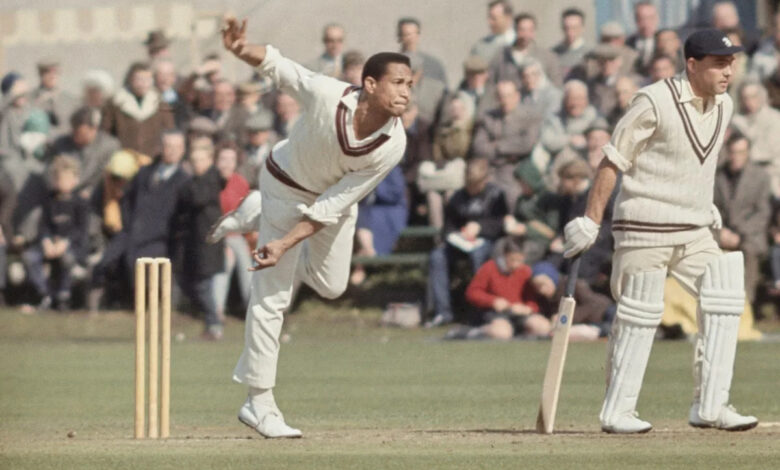

Garry Sobers, who has died aged 89, was one of the two greatest cricketers of all time, the most complete player the sport has ever produced and among the most exciting and charismatic. In his heyday, the former West Indies captain was nicknamed “King Cricket” and when, long after his retirement, Wisden backdated their Leading Cricketer of the Year award to take the game’s history into account, only two players won it more than three times: Sir Donald Bradman, on 10 occasions between 1930 and 1948, and Sir Garfield Sobers, on eight between 1958 and 1970.
Towards the end of his life, Bradman described Sobers as “the greatest all-round cricketer I ever saw” and, while the Australian’s batting feats remain unique, the case for calling the Bajan a still finer player calls upon an extraordinary range of skills. “The bloke could do just about anything on a cricket field except umpire,” said Australia’s Alan Davidson, himself one of the best players Sobers faced in his two decades of international cricket.
If all-rounders can be described as three players in one, Bradman called Sobers a “five in one” cricketer. He was a superb fielder in any position, and when he retired only Colin Cowdrey and Wally Hammond had taken more Test catches, wicketkeepers aside. He debuted for West Indies as a left-arm spinner, later became that rarity of a left-arm leg-spinner, bowling googlies out of the back of his hand, and claimed the majority of his 235 Test wickets as a swing bowler whose quickest balls were delivered at a lively pace. But, had he never bowled a ball in his life, Sobers would still have a status as one of the game’s most brilliant batters, a player with two contrasting achievements that gave him a sporting immortality.

In 1958, aged just 21, he broke the Test record for the highest score with an unbeaten 365 against Pakistan. It contained 38 fours but no sixes whereas, a decade later, he became the first player ever in first-class cricket to hit the maximum six sixes in a six-ball over. When Sobers played his last Test, in 1974, he had the most runs in the format ever, with 8032. That total has been passed by many another since then but, among those with at least 5000 runs, only Bradman, Ken Barrington and Hammond have scored them at a higher average than Sobers’ 57.78, and among those with 8000, none have, even though he was a player who could never be accused of playing for his average. If the vast majority of the outstanding Test all-rounders averaged between 25 and 40 with the bat, only Sobers and Jacques Kallis topped 50. Solid as the South African was, Sobers was a more dynamic cricketer, combining elegance with power. He was both the competitor and the entertainer supreme.
It was fitting Sobers came from Barbados, the island that, per square mile, has produced more world-class cricketers than anywhere else. He was born in 1936 and, when he was only five, his father, Shamont, died as the ship he was on was torpedoed by a German U-boat. There were already signs the young Garry was different: he was born with six fingers on each hand. The boy became a prodigy, making the Barbados team at 16 and the West Indies side at 17. He took four wickets on his debut against England in 1954 while making 14 not out and 26, batting at No 9.
He never went in as low again. His potential was soon recognised and there were glimpses of talent. As a makeshift opener, the teenager dispatched the great Australian all-rounder Keith Miller for a flurry of boundaries in a swift 43. When England’s spinners bowled West Indies out for 89 and 86 at The Oval in 1957, Sobers stood alone with scores of 39 and 42. He began the 1958 series against Pakistan with three half-centuries.
But, after 16 Tests, he had never got past 80. Until, in astonishing fashion, he remedied that. Sobers’ 365 not out at Kingston included a partnership of 446 with Conrad Hunte that is still West Indies’ highest for any wicket and broke Len Hutton’s world record of 364, set against Australia 20 years earlier. Sobers’ score was unsurpassed until Brian Lara made 375 against England in 1994.

The floodgates duly opened for Sobers, one century leading to another 25. Two came in his next match, 125 and a match-winning 109 not out. He finished 1958 with 198 and an undefeated 106 against India and the calendar year with 1299 runs at a Bradman-esque average of 144.
Yet 1959 was to bring further tragedy. Sobers was involved in a car crash in which fellow West Indies all-rounder Collie Smith was killed. From then on, Sobers said, “for most of my international Test career, I was playing for two—myself and my great friend Collie Smith”.
There were times when his efforts exceeded those of two men. In his next series, he made 709 runs against England at 101, including scores of 226, 147 and 145. West Indies still failed to win any of the five Tests. In 1960-61, in the celebrated series between Frank Worrell’s West Indies and Richie Benaud’s Australians, Sobers made a brilliant 132 at Brisbane in the first ever tied Test.

Australia was to figure more in his future. He was to marry an Australian, Prudence Kirby. He spent three seasons playing for South Australia. When they won the Sheffield Shield for the first time in 11 years in 1963-64, Sobers achieved a rare treble: he was the competition’s top run scorer, leading wicket-taker and, among outfielders, took the most catches.
By the mid-sixties, Sobers was at the peak of his powers. He had helped West Indies win 3-1 in England in 1963. They repeated that scoreline under his captaincy in 1966. It is an understatement to say Sobers led by example: he took 20 wickets at 27 and made 722 runs at 103. He saved the Lord’s Test in conjunction with his cousin as he and David Holford both made unbeaten hundreds. He made 161 in the win at Old Trafford, 94, as well as taking five wickets, in victory at Trent Bridge and 174, with eight wickets, when the series was sealed at Headingley.

Sobers was an antidote to much of the unambitious Test cricket played in the 1960s. Yet, as draws dominated, 20 of his 39 Tests in charge finished with no winner and an attempt to inject excitement backfired when England visited West Indies in 1968. Sobers declared at Port of Spain, gambling that England, under the cautious captaincy of Cowdrey and with as defensive an opener as Geoffrey Boycott, would not even attempt to chase a mere 215 for victory. They did, with seven wickets in hand. Sobers still almost rescued the series, making 152 and 95 not out and taking six wickets in the last Test, but it was drawn.
Under his captaincy, and despite two more centuries, they West Indies lost 3-1 to Australia the following season. As a skipper, Sobers ranked below the ambassadorial, diplomatic Worrell, West Indies’ first Black captain, and a successor, Clive Lloyd, who made them the world’s best side.
But as a bowler, he peaked in the 1960s. His overall Test average of 34 was higher, Bradman said, because he had to switch between various disciplines, costing him accuracy. He initially played in West Indies sides with the spinners Sonny Valentine and Alf Ramadhin, later with the off-break bowler Lance Gibbs and the quicks Wes Hall and Charlie Griffith, but they lacked strength in depth in the bowling attack. Sobers often had to be the jack of all trades.

He had played for Radcliffe in the Lancashire League and Norton in the North Staffordshire and Cheshire League in the days before overseas players were permitted in the County Championship. When they were, in 1969, Nottinghamshire signed Sobers and made him captain. He responded with a history-making piece of hitting. Looking for quick runs to declare against Glamorgan in Swansea, he hit the unfortunate bowler Malcolm Nash for six sixes in as many deliveries.
Sobers’ finest feats came in a variety of spheres; in some cases, in games he thought that should have Test status but did not. He twice led Rest of the World sides in series that replaced cancelled matches that were due to have been played against apartheid South Africa. Against England in 1970, he took 21 wickets at 21 and made 588 runs at 73. Against Australia in 1971-72, he produced the innings that Bradman called the greatest he had seen on Australian soil.
In a battle between the generations, Sobers had twice fallen cheaply to the young, very quick Dennis Lillee, including a golden duck at the MCG. He responded by bowling bouncers at the Australian when he came out to bat. The ante duly upped, Lillee still more fired up, Sobers made a magnificent 254.

Include those two series and Sobers’ Test record becomes a still more impressive 265 wickets at 33 and 8,961 runs at 58. He also finished with more than 28,000 first-class runs, featuring 86 hundreds, and 1,043 first-class wickets
He carried on until 1974, runs only deserting him in his last Test series. His final hundred came the previous year, an undefeated 150 against England after Sobers – never one to keep conventional hours – had spent some of the night drinking. In its own way, it was another of his superhuman deeds.
There might have been a coda to his career. He had played a solitary one-day international, making a duck. He was named in the West Indies squad for the first World Cup, in 1975, but withdrew because of injury. It was an anticlimactic end to an astonishing career.
Sobers’ many skills would have equipped him for ODI cricket just as, it is safe to say, many will suggest he would have earned a fortune now in the days of the Indian Premier League and Twenty20 franchise cricket. It is true, but it is probably a more accurate reflection of his virtuosity to say that, in any format, in any era, in any conditions, Garry Sobers could have been cricket’s most valuable player.