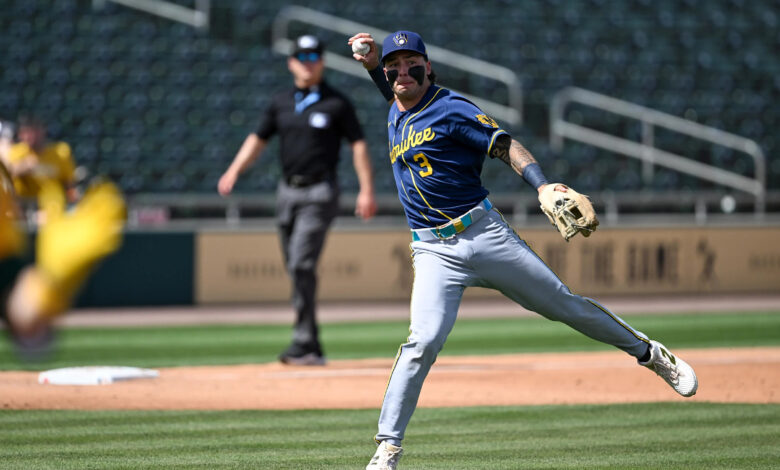

It’s hard to argue with the Brewers’ recent draft results. Jacob Misiorowski is already a two-time All-Star, while Cooper Pratt, Braylon Payne, Blake Burke, and Andrew Fischer have emerged as some of the organization’s brightest young stars. Milwaukee will look to add another name or two to that list this weekend as the 2026 MLB Draft gets underway. Here’s everything you need to know before the Brewers are on the clock Saturday afternoon.
What picks do the Brewers have?
Milwaukee has three picks in the first three rounds. They only have two picks in the top 101, their fewest top-100 picks in the last eight years.
First round:
- No. 25
Second round:
- No. 66
Third round:
- No. 102
After that, the Brewers have one pick in each remaining round. Last year, after selecting infielders Andrew Fischer and Brady Ebel with their first two picks, Milwaukee drafted five straight pitchers. In 2024, every selection they made between the fifth and 13th rounds was a pitcher. Don’t be surprised if the Brewers once again prioritize pitching depth on Day 2.
Milwaukee also had a second-round competitive balance pick (No. 67), but traded it to Boston in the trade that brought Kyle Harrison, David Hamilton, and Shane Drohan to Milwaukee.
What are the Brewers’ organizational strengths and weaknesses?
Most consider the Brewers’ farm system to be the best in baseball. By “most,” I mean Baseball America, MLB Pipeline, ESPN… you get the idea.
Strengths: The Brewers’ biggest strength is the middle infield, led by the consensus No. 1 prospect in baseball, shortstop Jesús Made. Milwaukee also has three other middle infielders ranked among MLB Pipeline’s Top 100 prospects: Luis Peña (No. 2 in the organization, No. 18 overall), Cooper Pratt (No. 3, No. 56 overall), and Jett Williams (No. 5, No. 81 overall). Josh Adamczewski (No. 6), who has hit at least .320 in every season of his professional career, came up as a middle infielder but has shifted to the outfield simply because there’s nowhere else to play him. Last year, Milwaukee also took Brady Ebel (No. 14) with the No. 32 pick.
Honestly, it’s easier to ask what the Brewers don’t have. They have plenty of promising corner infielders, led by Andrew Fischer (.299/.441/.713, 28 home runs between High-A and Double-A), Blake Burke (.885 OPS, 19 home runs in Double-A), and Luke Adams (.942 OPS in 38 Triple-A games). They also have 11 pitchers in MLB Pipeline’s organizational Top 30, led by Logan Henderson (No. 7) and Bishop Letson (No. 10), plus another handful who could realistically crack those rankings in the near future. In last year’s article, I highlighted Coleman Crow, Tyson Hardin, and Ethan Dorchies as unranked pitchers to watch. Sure enough, all three have since appeared in MLB Pipeline’s rankings, and Crow ended up making the big leagues.
Last year, I also listed the outfield as one of the Brewers’ biggest organizational weaknesses. One year later, it’s become one of their strengths. Luis Lara‘s breakout season earned him a seven-year extension worth at least $31 million, while Braylon Payne (.281, .967 OPS, 16 home runs) has taken a huge step forward. Williams can play the outfield, Adamczewski has already made the move there, and younger prospects like Alexander Frias, Josiah Ragsdale, Brailyn Antunez, and Kenny Fenelon have all shown flashes. Add in a major league outfield already headlined by Jackson Chourio, Sal Frelick, Garrett Mitchell, and now Lara, and it’s suddenly become a pretty deep positional group.
Weaknesses: Honestly… maybe catcher?
Jeferson Quero (No. 9) and Marco Dinges (No. 11), both of whom the Brewers are extremely high on, are the only two catching prospects in the organization who project as potential above-average major leaguers. Even then, calling catcher a weakness feels like a bit of a stretch.
Milwaukee already has an All-Star behind the plate in William Contreras, while players like Matthew Wood (.891 OPS in 189 Double-A at-bats) have produced despite flying under the radar. Besides, organizations don’t need nearly as many catching prospects as they do pitchers, infielders, or outfielders.
Either way, I would expect the Brewers to draft a catcher at some point during the draft. In a recent mock draft, Baseball America had the Brewers selecting high school C/SS Cole Prosek, the nephew of Brewers third base coach Matt Erickson, with their first-round pick.
The reality is that the Brewers don’t have many glaring organizational weaknesses. They have impact talent at nearly every position and enough depth throughout the system that they’re in a position to draft the best player available rather than trying to fill a specific need.
Who will the Brewers take?
One player who has been frequently mocked to Milwaukee is Ace Reese, a third baseman from Mississippi State who reminds evaluators of recent Brewers first-round picks Brock Wilken and Andrew Fischer. Reese slashed .336/.432/.721 with 24 home runs in 247 at-bats this season. Both ESPN’s Kiley McDaniel and The Athletic’s Keith Law have him going to the Brewers at No. 25 overall.
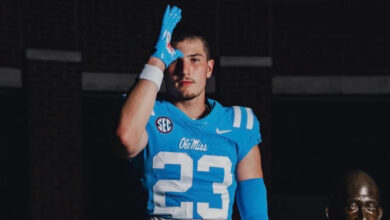
In addition to Reese and Prosek, other players who could be in play at No. 25 include Zion Rose (OF, Louisville), Aidan Ruiz (SS, Stony Brook HS), and Cade Townsend (RHP, Ole Miss).
One thing to keep in mind: the Brewers have frequently gone under slot (spent less than the projected value of the pick) with their first-round pick to free up bonus pool money for later rounds, where they can target high-upside prospects with strong college commitments. Don’t be surprised if their first selection isn’t any of the names listed here. Ultimately, only Matt Arnold and the front office know the answer to this question, and the Brewers usually find a way to surprise.
How much can the Brewers spend?
After trading away its Competitive Balance selection, Milwaukee’s bonus pool is $8,042,900, which ranks 25th in Major League Baseball. Their first-round selection (No. 25) carries a slot value of $3,696,000, although the Brewers can choose to spend less or more on whatever prospect they select.
Day 1:
Round 1 (No. 25): $3,696,000
Round 2 (No. 66): $1,353,100
Round 3 (No. 97): $853,000
Round 4 (No. 127): $614,800
Day 2:
Round 5 (No. 157): $455,900
Round 6 (No. 187): $351,600
Round 7 (No. 217): $275,100
Round 8 (No. 247): $224,400
Round 9 (No. 277): $202,100
Round 10 (No. 307): $191,900
In rounds 11-20, teams are allowed to offer up to $150k in signing bonuses without it counting towards their bonus pool. They are allowed to offer more, but any money spent in excess of that $150k limit is then counted toward the pool.
How do I watch the 2025 MLB Draft?
The 2026 MLB Draft begins at 12:00 p.m. CT on Saturday. Picks 1-10 will be televised on NBC and Peacock, picks 11-40 will air on MLB Network, MLB.com, and MLB.TV, and picks 41-135 will stream on MLB.com and MLB.TV. Day 2 begins at 10:30 a.m. CT on Sunday and will stream live on MLB.com and MLB.TV.