
In part one of this five-part trade deadline primer, I looked at the Brewers’ roster and determined what their primary needs are. While things could certainly shift over the next 25 days (look no further than the injury to David Hamilton, which put the Brewers’ infield in a bit of flux), I identified relief pitching as the roster’s biggest area of need, and the area that I felt the team was most realistically likely to address.
Today, we’ll start doing the work of looking around the league to see which relief pitchers might be available. Remember, the landscape this year is strange; there are a lot of bad teams, which means that there are a lot of teams that feel they might have a real shot with a hot week or two between now and the deadline. So I’m going to break this into two parts: first, which targets are available on teams that definitely look like they’re out of it? Second, which targets could become available if things don’t go well over the next three-and-a-half weeks?
I also mentioned that the Brewers’ need in this area was for a high-leverage reliever, so I’m going to be aiming high here. Matt Arnold and David Stearns before him have shown a proclivity for acquiring less splashy relievers at the deadline, but I’m specifically looking for players who could push Aaron Ashby for the number-three role in the bullpen behind Trevor Megill and Abner Uribe.
Targets from teams who look out of it
As I mentioned, there are a bunch of teams where it’s hard to say with certainty whether they are or are not out of it at this point. But I’ll do my best to first identify some targets from teams who are far enough back that, at this point, they should probably sell.
The problem is that these teams are bad, so it’s harder to find good players on them. Honestly, I had trouble identifying targets worth acquiring from the six teams that should be declared, with certainty, out of it: the Reds, Mets, Giants, Rockies, Royals, and Angels.
There are a few interesting names, though, and let’s start in New York. Luke Weaver is having an excellent season — at the start of play Wednesday, he has a 1.89 ERA and 2.54 FIP in 38 innings pitched — and has a track record of success in the postseason. The question here is money. While the Brewers could probably afford the prorated bit of his 2026 salary, they probably don’t want to be on the hook for the $12.5 million he’s owed in 2027.
Money is also a barrier to a Devin Williams reunion. Williams has had a rough go since leaving the Brewers, and that reflects in his 4.85 ERA this season. But Williams’ FIP this year is way lower, at 3.25, and he’s striking out 13 batters per nine innings, so there are some reasons for optimism. However, his walks — which were always a bit of an issue, even when he was unhittable — are higher than they’ve ever been, and that’s an issue. But bringing it back around: Williams is owed $12 million in 2027 and 2028, plus there is $15 million in deferred money in his contract. That’s way too much for the Brewers to pay a reliever who might not even be good, and even if the Mets covered some of it, I think it’d still be too much. I’d cross this one off the list.
Sticking with the Mets for a moment, some lower-profile trade candidates include a couple of old guys in 38-year-old Brooks Raley and 36-year-old Huascar Brazobán. I’m skeptical of Raley’s numbers — they seem flukey — and while Brazobán’s feel a little less flukey, he’s not striking a ton of guys out, and he’s walking a lot. I’d stay away from both.
Another high-profile trade target this deadline could be Royals reliever Daniel Lynch IV. The Royals’ bullpen has been a major disappointment, but Lynch has been good. He holds a 2.41 ERA and 3.23 FIP, and while he isn’t a big strikeout guy, he’s done a good job keeping the ball in the ballpark, and he hasn’t been giving up many hits. The scary thing here is that Lynch is having a way better season in this, his sixth year, than he ever has before, so I don’t have a lot of confidence.
If you were looking for a reclamation project on the Royals — and the Brewers shouldn’t really be looking for reclamation projects right now, to be clear — you could check in on Lucas Erceg and Matt Strahm. Erceg, who was drafted as a position player by the Brewers in 2016, was really good the past couple of years, throws hard, and gets a lot of ground balls, but this season has been a disaster; he hasn’t been able to strike anyone out, he’s been walking everyone, and he was stripped of the closer job. Strahm has been one of the league’s more reliable relievers over the past three years, but he’s been terrible in 2026, and there’s not a lot in the data to give much confidence that he’ll get better.
Lastly, there are a couple of Rockies relievers who are having good seasons. Antonio Senzatela has essentially been a starter for his whole career, but after back-to-back rocky (get it) seasons in 2024 and 2025, he’s been moved to the bullpen. It’s worked out quite well: Senzatela has a 2.93 ERA (169 ERA+) and 3.36 FIP in 46 innings, and with his background as a starter, he’s capable of pitching multiple innings (46 innings across 27 relief appearances). He’s never been a strikeout pitcher whatsoever, but he’s seen a slight uptick in his numbers with the move to the ‘pen.
The other guy is Jimmy Herget, who has put together back-to-back good seasons in the Rockies’ bullpen — not an easy task. Last season, Herget had a 2.48 ERA and 3.32 FIP in 59 appearances, and this season he’s at a 3.52 ERA and 3.34 FIP in 23 outings. Herget isn’t a hard thrower and actually throws way more breaking balls than fastballs; an intriguing type of player, particularly in the thin air of Denver.
There are no targets that I’d advocate a move from any of the Reds, Giants, or Angels. Cincinnati’s Brock Burke and Tejay Antone have gotten pretty good results this season, but there is enough reason to be dubious that I’d avoid them. Los Angeles has a couple of dudes — Ryan Zeferjahn and Chase Silseth — who would intrigue me as long-term projects, but for now both walk way too many batters to be trusted in any sort of leverage situation.
Targets from teams who might sell
Here’s where things get good, for the most part. These are players from teams that sit roughly four or five games back of the Wild Card — they’re not out of it, but they’re all under .500 and could fall out of it with a bad couple of weeks. The big-time, headlining relief options that could be available at the deadline all come from these teams.
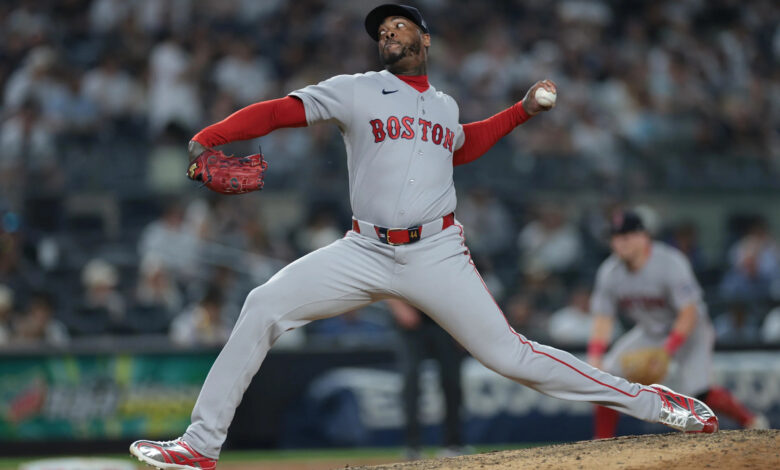
We’ll start with the biggest name: Aroldis Chapman. Boston is 41-48, but in the terrible American League, they’re just four games back in the Wild Card. It feels like a good season for Boston to sell, but we’ll see. Chapman, in any case, has still got it; he was the best reliever in baseball last season, and this year he’s pitched to a 2.36 ERA/2.44 FIP and is still striking out nearly 12 batters per nine innings. He doesn’t throw quite as hard as he used to, but even at age 38, he’s still averaging 97.5 mph on his fastball.
The hangups with Chapman: first, there’s the fact that he’s not exactly an easy guy to root for, given his history of domestic violence issues. Second, the money isn’t small. Chapman has a $13 million salary in 2026, and while Milwaukee could probably handle the prorated amount, he’s also got a conditional option for 2027 that reportedly vests if he surpasses 40 innings — which he will do if he is healthy enough to get traded before the deadline.
I’d like to also address two more top-line closers from teams in this category: San Diego’s Mason Miller and Toronto’s Louis Varland. Both teams have been disappointing this year, but both closers have been absolutely lights out. Here’s the issue, though: if San Diego trades Miller, they’ll want to recoup something close to the value they gave up for him last season — which was a top-five overall prospect. Miller still has three years of control, so his value is enormous, but I don’t think the Brewers would trade Jesús Made for him, especially given that they’ve got a good closer. Varland is under control for even longer — he’s not a free agent until 2031 — and the Blue Jays, even if they decide to sell this year, will expect to compete next year, and they’ll want him then. I don’t think either Miller or Varland gets traded.
San Diego and Toronto both have other players who could be available, though. A player who will certainly be moved if San Diego is out of it is lefty Adrián Morejón. By his standards, his 3.52 ERA this season (119 ERA+) isn’t very good. But the underlying numbers are strong: he’s got a 2.47 FIP and a 4.91 K:BB ratio. He’s also coming off a two-year run of being a solid reliever for a good team with postseason experience. The fact that he’s left-handed also would make him a desirable target for the Brewers, whose top two relievers are both right-handed. Morejón is still only 27, but he’s been in the big leagues since he was 19, so he becomes a free agent after the season, which should make him relatively attainable. From a financial perspective and fit perspective, Morejón would be one of the targets that would make the most sense for Milwaukee, but every team wants another good lefty reliever.
Another Padre, Wandy Peralta, has a lot of experience and a 3.05 ERA over the past seven years. He’s always managed to outperform his FIP, which for his long career is a whole 1.35 runs higher than his ERA, but it’s still somewhat concerning, and Peralta’s strikeout numbers have gone from “not very good” (career 7.3 per nine) to “alarming” (5.8 per nine this year). I’d stay away.
The Toronto reliever who makes sense in a vacuum is Tyler Rogers, who has been awesome this season and has put together an underrated career. But money is a problem here: Rogers signed a three-year, $37 million contract before the season that includes a vesting option for a fourth year at an additional $11 million. If that option vests, Rogers will be 38 in the last year of the contract, and this is the kind of big money deal that the Brewers have taken pains to avoid. Maybe a wealthy team will get desperate, but I’d expect Rogers to stay with Toronto as well.
A lesser but still prime target from Boston is Garrett Whitlock. Whitlock, who is 30, was excellent in 2025 and has been basically just as good in 2026, with a 2.40 ERA, 2.75 FIP, 10.2 K/9, and just 1.8 BB/9 in 30 innings pitched. He doesn’t throw all that hard, but he’s got a ton of extension — a trait the Brewers like. Whitlock is under control for two more seasons, but he’s not all that cheap; his options are for $8.25 million in 2027 and $10.5 million in 2028.
Baltimore’s Yennier Cano is another big target. He’s got two more years of control after this season, and aside from a blip in 2025, he’s been quite good for four years running. Cano doesn’t throw as hard as some of these other guys, and his strikeout numbers aren’t great for a reliever, but he’s an extreme groundball pitcher (99th percentile) who keeps walks down and, this year at least, isn’t allowing home runs.
There are two players on the Diamondbacks who I’d be interested in as well: Jonathan Loáisiga and Juan Morillo. Loáisiga is another groundball guy, one who throws harder than Cano and is a free agent after the season, so if Arizona decides to sell, he’d be an obvious one to go. Morillo is much less likely to get traded; he’s by no means a proven quantity, as he just debuted last season, but he has five more years of control and is one of the hardest throwers in the league. Both pitchers have performed well this season.
A few names to keep an eye on who are not as proven as those above but could still conceivably help:
- I’m skeptical, but Arizona’s Taylor Clarke (a former minor leaguer in Milwaukee’s system) has put up pretty good numbers for two years in a row, and he’s a free agent after the season.
- Sticking with the Diamondbacks, 26-year-old Brandyn Garcia is another hard-throwing groundball pitcher who has been good in a small sample. He’s also got a lot of control, like his teammate Morillo.
- Another San Diego pitcher with a solid ERA but who I’d stay away from: Yuki Matsui. Too many walks.
- One more intriguing Boston pitcher: Tyron Guerrero is 35 and has almost no MLB track record — before this season, he hadn’t pitched in the big leagues since 2019 — but he’s having a good season and throws as hard as almost anyone in the league. He’s also a big extension guy and a groundball machine, traits that the Brewers tend to value. The samples are tiny, though, and there’s not a lot in his history that makes you trust him.
- A former almost-Brewer, Grant Wolfram, has a 4.15 ERA for Baltimore this season. That’s bad, but his FIP in 26 innings is just 1.81, and he’s got 29 strikeouts to only four walks. He’s not really a leverage arm, but he could help bolster things if Milwaukee wanted to go that way.
- In a near-opposite case, Kyle Finnegan has just a 2.18 ERA for the Tigers this season, but he’s got just 6.8 K/9 compared to 5.4 BB/9 in 39 games and has a 4.69 FIP. Stay away!
- One Tiger that intrigues me but also has red flags: Will Vest. He’s hurt at the moment with what has been described as a “non-ligament-related” elbow injury, so it’s a question whether he’ll even be healthy enough to pitch (and given what happened with Shelby Miller last year, the Brewers might be wary of pitchers with health questions). Vest also has a 6.08 ERA this year… but his FIP is just 3.42, and he’d been quite good every year from 2023-25, which is a long run for a reliever in today’s game.
Conclusions
We’ll have to wait and see on the Padres, Blue Jays, Red Sox, Diamondbacks, and Orioles — a couple of good weeks, and any of them could be right there in the Wild Card hunt. But of all the options that seem like they could be realistically available, here’s how I’d rank them:
- Aroldis Chapman, Red Sox
- Adrián Morejón, Padres
- Luke Weaver, Mets
- Yennier Cano, Orioles
- Jonathan Loáisiga, Diamondbacks
- Garrett Whitlock, Red Sox
- Jimmy Herget, Rockies
- Antonio Senzatela, Rockies
I think it’s at least reasonable that the guys I’ve listed above will be traded, and while a few (Chapman, Weaver, Whitlock) would require some real financial support from the ownership level, I don’t think any of them are unrealistic from a cost perspective.
Anyone else I’ve mentioned in this article falls into one of three categories:
- I don’t think they’d be a meaningful upgrade (Strahm, Raley, Peralta, etc.)
- They make too much money (Williams, Rogers)
- I don’t think they’ll be traded (Miller, Varland, Morillo, etc.)
What do you think? Anyone I’ve missed?