When college athletes suffer fatalities due to activities conducted during practice—and often pre-existing conditions—coaches are almost never criminally charged. But thanks to a new lawsuit brought by Pennsylvania’s attorney general, that could change.
On Monday, Pennsylvania AG Dave Sunday charged former Bucknell football strength and conditioning coach Mark Kulbis following the death of Bucknell football player CJ Dickey Jr. in 2024 following a summer workout where he collapsed. Kulbis, who maintains his innocence, faces felony aggravated hazing, as well as misdemeanor counts of involuntary manslaughter, reckless endangerment, and hazing.
The fact that the charges are criminal makes the case rare, multiple industry experts and attorneys tell Front Office Sports. Regardless of its outcome, the case could have wide-ranging effects on the college coaching landscape, forcing more scrutiny of practice activities and coaching conduct.
“We’re seeing the tide shift in terms of general public awareness about hazing,” Elizabeth Allan, principal of StopHazing and director of the Hazing Prevention Research Lab at the University of Maine, told FOS. “I feel this is potentially an indication of some larger shifts in the culture.”
A Fatal Workout
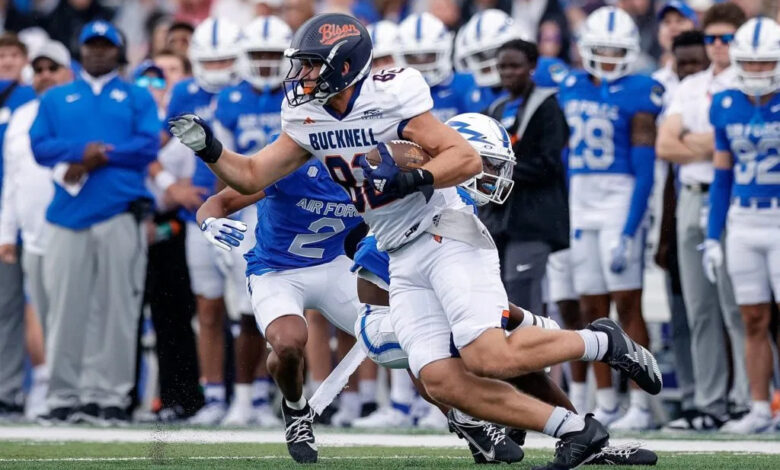
On July 10, 2024, Dickey, along with other Bucknell freshmen football players, suited up for their first practice led by Kublis, who had previously spent time on the coaching staffs at Dartmouth, Ohio State, and Austin Peay.
Players were required to conduct “extensive calisthenics” including more than 100 up-downs, the AG’s office said, activities that were “done in spite of training and direction from other coaches that such exercises were not appropriate or safe for use as part of training.” Dickey was required to do so even though Bucknell was aware he had sickle-cell trait, a condition that makes extreme exercise more dangerous and for which the NCAA requires testing. Dickey was visibly struggling with the exercises, and was rushed to the hospital after he collapsed, according to the AG’s statement. He died two days later.
Dickey’s parents brought a civil action against Bucknell in 2025, alleging negligence and wrongful death (the case is still ongoing).
In the complaint, they said the coaches should not have allowed him to engage in these activities given his condition, and that the school did not have proper protections in place including having a trainer present at practice (an NCAA requirement) and emergency action plans (EAPs).
The complaint said Kulbis—who left Bucknell in January 2025, according to his LinkedIn page—was known to conduct “annual hazing of freshman football players by causing, coercing, or forcing them to endure brutality of a physical nature in the form of an unreasonable and excessive number of intense and rigorous calisthenic exercises, including up-downs, as punishment and for the purpose of being initiated into or to remain with the team.”
These details, along with an investigation conducted by the Union County District Attorney’s office, led to Kulbis being charged in the separate criminal case. Kulbis was arraigned Monday morning in a Pennsylvania court, with bail set at $10,000, according to the AG’s office.
“While the death of Calvin Dickey is tragic, Mark Kulbis did not contribute to it and is not responsible for it,” Kulbis’s attorney Barbara Zemlock said in a statement to FOS. “The strength and conditioning program that was implemented was appropriate and in accordance with the training that Mr. Kulbis received, and within applicable standards. There are facts and other circumstances surrounding this matter that, once presented at the appropriate time, will demonstrate that Mr. Kulbis did not commit the crimes charged.”
A Bucknell spokesperson said the school was “aware” of the criminal charges and has “cooperated” with the investigation. “We continue to remember Calvin “CJ” Dickey, Jr. and extend our deepest sympathies to his family and friends.” The spokesperson added they wouldn’t comment further due to ongoing litigation.
Long-Term Implications
Attorneys FOS spoke with agreed they had never seen a hazing law applied to this particular situation, where a player died as a result of complications from team practice activities.
The charges are based on a 2017 Pennsylvania hazing statute established in the wake of the fraternity hazing death of Penn State student Tim Piazza. Though the statute suggests excessive physical activity can be considered hazing, it includes an exception for team practices, saying that reasonable training activities wouldn’t be considered hazing.
David Bianchi, a trial attorney and founding partner of Stewart Tilghman Fox Bianchi & Cain. P.A., told FOS the prosecution will “have a tough time” proving Kulbis’s guilt, because the case doesn’t have the typical hallmarks of a hazing case, which includes illegal activity, and because of the statute’s athletics carveout.
“So the question then becomes: Is telling the athletes…that they had to go through a particular exercise program—is that reasonable and customary athletic training?” said Bianchi, who handles anti-hazing cases. “And if it was, then by statutory definition it is not hazing.”
But prominent anti-hazing attorney and founder of the Fierberg National Law Group, Doug Fierberg, has a different view. “It seems that information must have come from athletes that were part of those workouts that would suggest that what was being required—particularly given the vulnerabilities of this young man—were far beyond the normal standards of what athletic training should be on the first day of students trying to make the team,” he told FOS.
But both lawyers agreed the case could be unnerving for college coaches.
The charges themselves could serve as a warning to coaches over potential liability for player health and safety. Fierberg said that the case, regardless of its outcome, will have an impact. “It suggests that your behavior can’t be without boundaries,” he said, adding that the law “won’t tolerate reckless behavior that can rise to the level of killing someone.”
If Kulbis is ultimately convicted and serves jail time, the case would likely lead to other prosecutors following suit with criminal charges. Bianchi said coaches may even reconsider their career path. “Every time you’re looking at a student-athlete you have to wonder whether or not he has some sort of a condition, diagnosed or not diagnosed, that could lead to his death on the practice field—and are they going to try to make the same claims against me?” Bianchi said.
The post Criminal Case Against Former Bucknell Coach Could Set Precedent appeared first on Front Office Sports.