

Intro
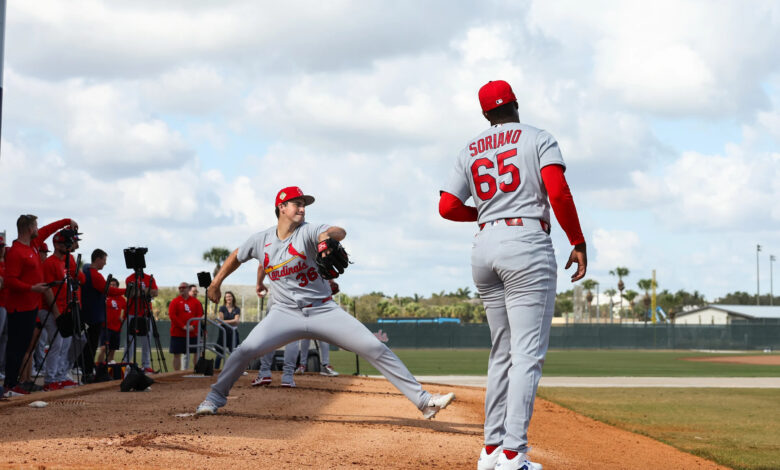
Today’s article will do a bit of a deep dive on George Soriano. This guy has seemingly come from nowhere to become a stalwart in the Cardinal bullpen. Not dissimilar to Ryan Fernandez in 2024 or Matt Svanson in 2025, a guy who could reasonably be considered unheralded, but still becomes a key member of the cadre.
Authors Note: I’m travelling over the 4th, so I had to do this article a fair bit in advance. The stats I cite are going to be over a week old by the time you read this. I’m not sure if the VEB hex applies when I write the article or when I publish, but George could crater in between and foul up the data. Such is life.
How unheralded? He came into 2026 with a career fWAR of -1.0, backed by career ERA and FIP figures exceeding 5.00. Across 3 years with Miami, he progressed from bad to worse, ending last year with an 8.35 ERA. He found himself on the Nationals roster and ultimately dealt to St. Louis for Andre Granillo. What did the Cardinals see that prompted them to swap out a low-grade prospect for him?
Here in St. Louis, he has filled a variety of roles all the way from chase reliever to high leverage. It hasn’t been perfect, but he is outperforming his career norms by a fair bit. Interestingly, he is not far off his Zips projection, which projected a 4.19 FIP with a 21.3% K rate and a 9.5% BB rate. So, I’m curious. What gives?
We’ll start with back of the baseball card stuff. George is carrying a 3.16 ERA with a relatively pedestrian 20.8% K rate. His 8.5% walk rate is a marked improvement from his career 10% rate. He has accumulated .1 fWAR. Further down, he has qualified for 11 shutdown (SD) appearances, which is 70th percentile among relievers with 30 or more IP (George has 30.1 IP). He has 4 meltdown (MD) appearances which is tied with a bunch of guys right at average for the league. For comparison, Justin Bruihl and JoJo Romero pace the league with 10 and 9 MD appearances. Thus, why he is rising up the trust scale.
Sidebar: Riley O’Brien is second overall in baseball with 20 SD appearances, behind only Cade Smith of Cleveland.
What is underneath this improved performance?
If we wander on over to Statcast/Baseball Savant, some interesting details emerge. Morsels to chew on, as it were.
Pitch Mix

Note his pitch mix vs. left and right-handed batters. This will come up later. In general, he is more FF and CH heavy against LH hitters and more SL and SI heavy against RH hitters.
Since joining StL, they’ve had him de-emphasize his SI and ST (sweeper). He has cut the sweeper use from 16% to 10%, and sinker use from almost 20 to 12%. The SL usage has increase from 16% to nearly 25% and he has upped his four-seamer (FF) usage from 18% to more than 25%. Subtle changes, but they appear to have had some success. Pitch mix is one of the places the Cardinals tinkered, but not the only.
Pitch effectiveness

To the left you see the current run values for his entire pitch mix. Looking at the blue, you can see why the Cardinals wanted to de-emphasize the Sinker (SI) and Sweeper (ST).
Mechanics

One of the things I found striking was now much the Cardinals influenced his arm angle. That 34 degree angle is new this year, up from 29 degrees in 2025. That is pitching lab stuff. In ways, given how late in the off-season they acquired him, I am surprised they were able to implement what is a fairly radical change, and be successful doing it.
It’s not clear how the arm angle has affected his pitch metrics, which have not really changed a lot even though the arm angle did.
Pitch Movement
That mechanical changes have produced a pitch movement profile that leaves me scratching my head a bit.

His 4-Seam Fastball (FF) is pretty average in terms of movement, although it does have 87th percentile velo, averaging 96.7 mph. The four-seam grades at 87 Stuff+, but the Sinker grades out at a nice 108+.
That ChangeUp? It has somewhat below average arm-side run, but well above average drop. That pitch could almost be called devastating. That Whiff% has climbed for 19.6% in 2025 to 41.8% this season. That change is particularly effective against LH hitters, allowing him to navigate the left-right lanes. It grades out as a 116 on Stuff+. Impressive.
The Slider (SL) is an odd one. Used mostly against RH hitters, it produces a near 40% whiff rate, but that is in line with career norms. The arm angle change seems to have produced less arm-side run and a bit more drop. It grades out as a 96 by Stuff+.
I can’t figure his Sweeper. It doesn’t sweep, but still gets a 40%+ whiff rate. How? No Stuff+ grade. I think because the sample size is too small.
His very average Sinker (SI) gets clobbered at an xwOBA of .622. Seems contradictory to a Stuff+ of 108.
Spin

George seems to tunnel his pitches well, which can improve the effectiveness of the mix. The fastballs and the change come out of a pitcher’s hand looking the same from a spin standpoint but act quite a bit differently as they approach the hitter.
Oddly, his sinker comes out with all different spins, almost all around the watch face. I don’t know if he is still tinkering with it or what, but that is a lot of inconsistency and probably helps explain why it is a mostly straight pitch, yet oddly effective.
Overall

Putting it all together, we can look at his overall performance against the rest of the league.
His fastballs (4-seam, sinker) perform at an average rate in terms of run value. Neither good nor bad, as do the breaking pitches. The Offspeed pitches (Sweeper, Change) provide most of his positive value, ranking in the 85th percentile. I’d opine here is where pitch mix is key … an average fastball combined with near-elite offspeed can make an effective pitcher if deployed properly.
Note the 81st percentile FB velocity, but also note that much of his very poor 8th percentile exit velo comes … off his fastballs.
He gets excellent chase and whiff, as noted above. Oddly, for all the excellent whiff numbers his K% rate is pretty pedestrian a 20.8%, probably not enough for a leverage reliever.
Concerns
Beyond the hard hit data just above, a few other concerns pop out in his profile.
His 2026 BABIP is running an extremely low .241. Now, in 3 of his 4 seasons, he has run really low BABIPs, so that may be normal for him, but the number itself suggests some luck is smiling on him in 2026 and regression could bite him, particularly since he doesn’t strike a lot of guys out.
On that vein, his 21% strike out rate and 9% walk rate result in a ~12% K-BB%, which really isn’t good enough for a leverage reliever. 15% is the number I use as a floor for a pitcher expected to pitch well reliably.
Summary
We like to say relievers are volatile. Well, every player is volatile to an extent, relievers just seem to be moreso. George may be the archetype of one form of reliever volatility.
A pitcher equipped with largely average stuff, with some above average offerings and some below. Nets to a Stuff+ of 101. Some years, such a pitcher will have good luck in sequencing or random and others years it will horrid luck. 2025 appears to have been his horrid year and 2026 appears to be the year the GOB are smiling upon him.